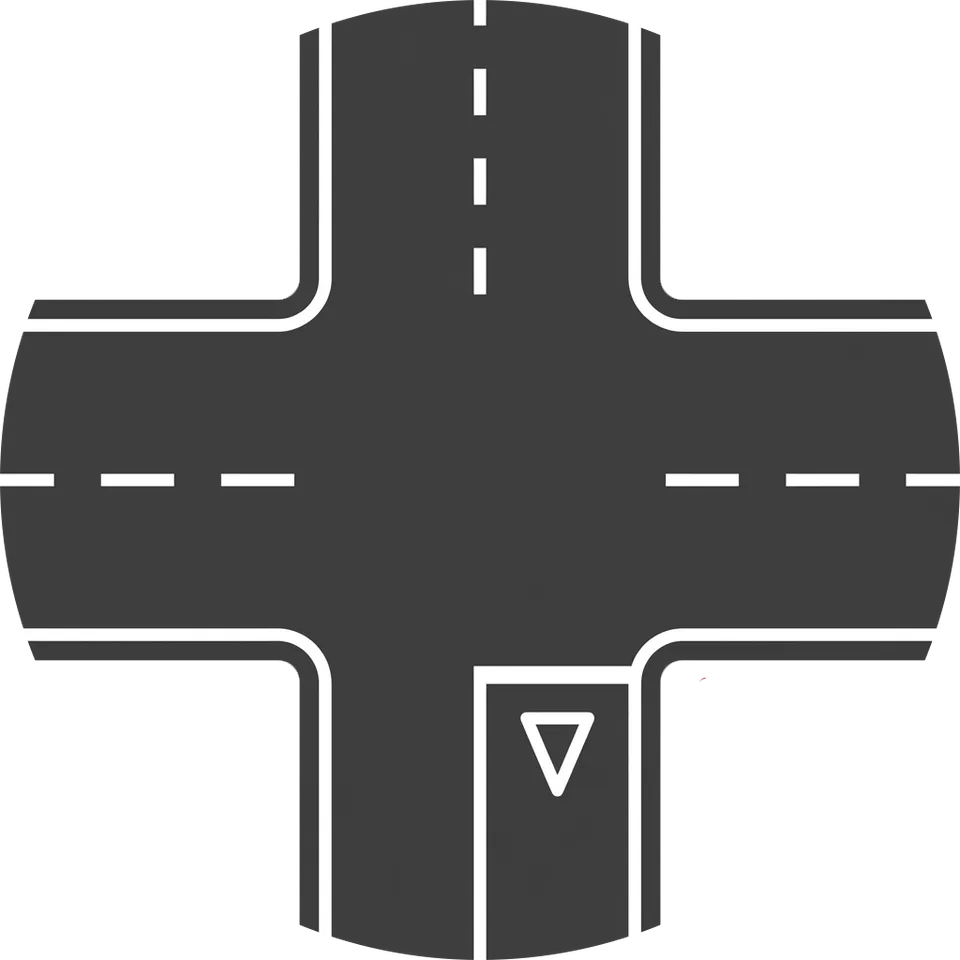
Top view of an intersection with white road markings and yield lines / shark's teeth

Priority rules & Junctions

35 Questions
Hard
0 Parts

Who goes first? The CBR priority rules at equal and priority junctions, at shark teeth, driveway exits and unpaved roads, and for pedestrians.

Practise car theory

Free mock exam · no account needed

Study material

What will you learn?

Priority in traffic follows a fixed order: first the instructions of traffic controllers, then traffic lights, then traffic signs and shark's teeth, and only after that the general rule that drivers from the right go first.

Explore per subject

Priority rules & Junctions at a glance

Here you learn who goes first at every type of junction, at a driveway exit and with pedestrians. Each part has its own page.

  • Priority rules: without a controller, working lights, priority signs or shark's teeth: drivers from the right go first, straight on along the same road goes before turning, and the short turn first.
  • Equal junction: here no signs, shark's teeth, lights or traffic controller regulate priority. You give way to drivers from the right, and a tram always goes first.
  • Priority junction: at sign B3, B4 or B5 you get priority. At shark's teeth, sign B6 or stop sign B7 you give way.
  • Driveway exits: when you leave a driveway exit (uitrit), you let all traffic go first, pedestrians too. You can often recognise an exit by a pavement that continues across it.
  • Priority from an unpaved road: coming from a sand track, you give way to all drivers on the paved road, from the left and from the right.
  • Shark's teeth (haaientanden): white triangles pointing towards you. You give way to all drivers on the crossing road and only stop when that is necessary.
  • Priority at a T-junction: without shark's teeth, priority signs or traffic lights, traffic from the right goes first, even if you are on the through road.
  • Priority rules for pedestrians: coming from the right gives them no priority. But you let them go first at a zebra crossing, when you turn and they walk straight on, or leaving a driveway.

Priority on a roundabout is covered under roundabouts. Sirens and flashing lights are covered under priority vehicles, and the gestures under traffic controller signals.

FAQ

Frequently asked questions

Short answers to common questions about Priority rules & Junctions.

How far is a railway beacon with three stripes from the level crossing?

Each diagonal stripe on a railway beacon represents 80 metres distance. Three stripes mean the crossing is 240 metres away.

What is the hierarchy between traffic controllers, traffic lights and road signs?

Follow applicable instructions from an authorised traffic controller. Without such instructions, operating lights at that traffic arrangement take precedence over signs and markings regulating priority there, such as B6 and give-way markings. Other signs, such as mandatory directions or speed limits, remain valid. Where there are no applicable priority signs or lights, ordinary traffic rules apply.

How do you recognize an exit construction on the exam?

Assess the whole layout: a continuous pavement or cycle path with recognisable entrance kerbs may form a driveway construction. A clearly apparent limited destination, such as access to a property or car park, may also matter. A lowered kerb or hump alone does not prove a driveway. When entering or leaving one, let all other traffic go first, including pedestrians.

When does traffic from the right not have priority at an equal intersection?

The right-hand rule concerns drivers approaching an equal junction. Someone leaving a driveway or making a special manoeuvre must let other traffic go first; that is a different situation. The tram exception may also decide who goes first. Where priority signs or paved/unpaved approaches differ, do not treat the junction as simply equal.

When does traffic from the right not have priority?

The right-hand rule does not apply automatically. A driver from the right may need to wait when leaving a driveway, making a special manoeuvre or entering a paved road from an unpaved one. Signs, markings, lights or an authorised controller may set another arrangement. Check whom the signal applies to: a sign or light somewhere at the junction does not automatically give you priority.

What is an equal intersection (gelijkwaardig kruispunt)?

An equal junction has no priority arrangement through signs, give-way markings, operating lights or a controller, and its approaches are not unequal because of a driveway or an unpaved road meeting a paved road. Give way to drivers from the right. A tram has special priority over other drivers at such a junction even from the left, while remaining subject to applicable signals and instructions.

Who has priority on a roundabout?

Roundabout sign D1 sets the direction of travel, not priority. Give-way markings or B6 at an entry require entering drivers to give way to drivers on the crossing road. Without such a priority arrangement, ordinary rules apply, including priority to drivers from the right at an equal junction. Check cycle paths and pedestrians separately, especially when leaving.

Does the short bend have priority over the long bend?

Yes, for two ordinary oncoming drivers on the same road turning into the same side road: the left-turning driver lets the right-turning driver go first. If both have give-way markings for the crossing road, each must first meet that obligation. The special turning rules for trams are an exception.

Keep practicing with up-to-date material

With this explanation you understand the basics of priority, traffic lights and junctions. In traffic there are many exceptions, such as arrow lights and instructions from traffic controllers; therefore practise in our app with the most up-to-date CBR information.

Ready to practise?

Test your knowledge of Priority rules & Junctions with 35 practice questions in the app.

Practise car theory

Free mock exam · no account needed

Your first quiz is free, no account needed. After that from €34.99 for 90 days of access.