Part 7 of 9 in Priority rules & Junctions
T-junction: who has priority?
T-junction: without signs or give-way markings, traffic from the right goes first, even if you are on the through road. How priority works there.


Written by Chris Prosman Reviewed by Dirk van Zuijlen
Updated Reviewed on 5 min read
Free mock exam · no account needed
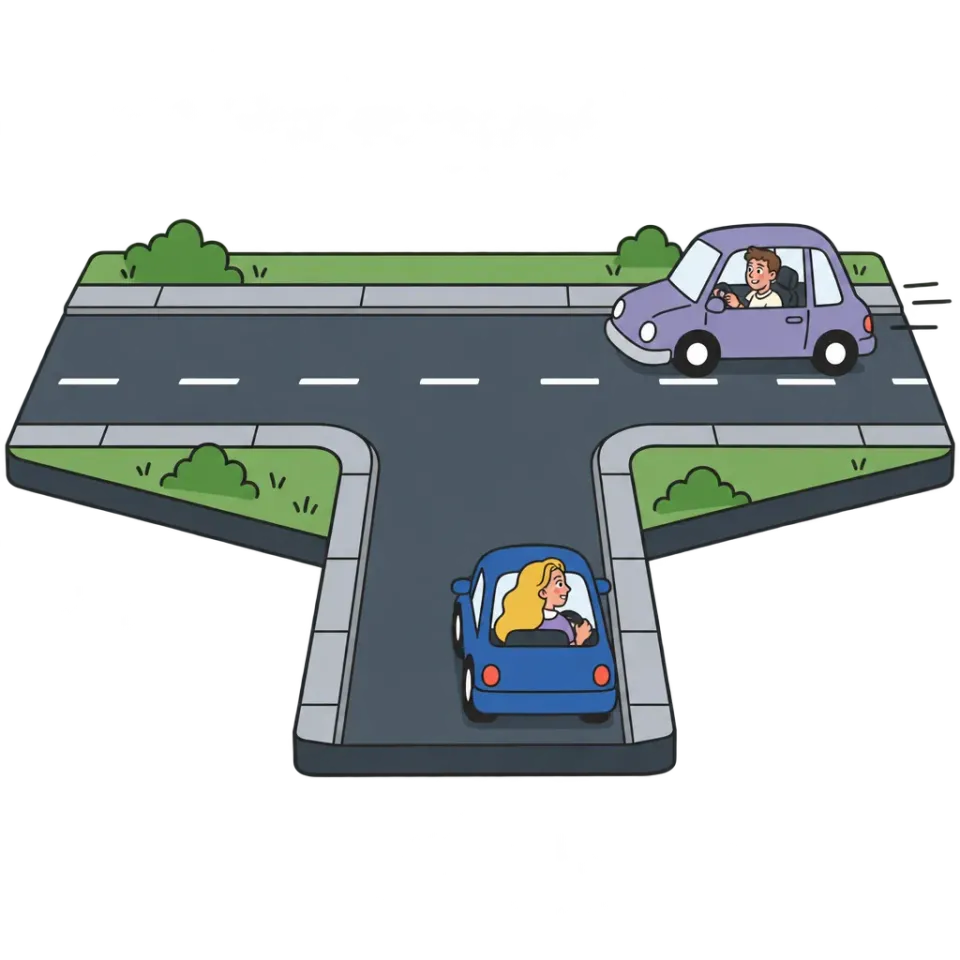
A T-junction (T-splitsing) is a junction shaped like a T: a side road joins a through road. Are there no shark’s teeth, priority signs or traffic lights? Then traffic from the right goes first. Even if you are on the through road.
What is a T-junction?
At a T-junction (T-splitsing or T-kruising) a side road joins a road that continues to the left and right. From above you see the letter T. From the side road you can only turn left or right. On the through road you go straight on or turn into the side road.
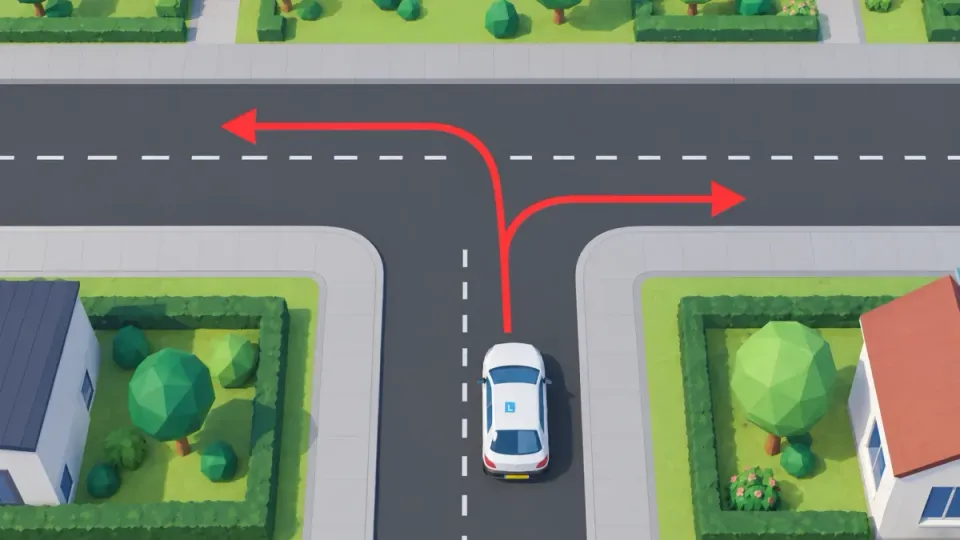
Is a T-junction a junction? Yes. By law a junction is any “crossing or fork of roads” (article 1 RVV). So all priority rules for junctions apply here too.
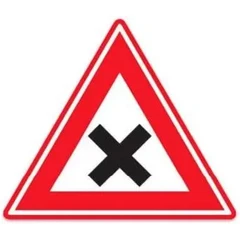 There is no separate warning sign for a T-junction. You sometimes see sign J8 (dangerous junction), but it does not regulate priority. More under equal junction.
Who has priority at a T-junction?
At a T-junction without shark’s teeth, priority signs or traffic lights, traffic from the right goes first. It is then an equal junction: a junction without shark’s teeth and without stop signs or other priority signs. Only then does the right go first. The fact that the through road goes straight on does not give you priority.
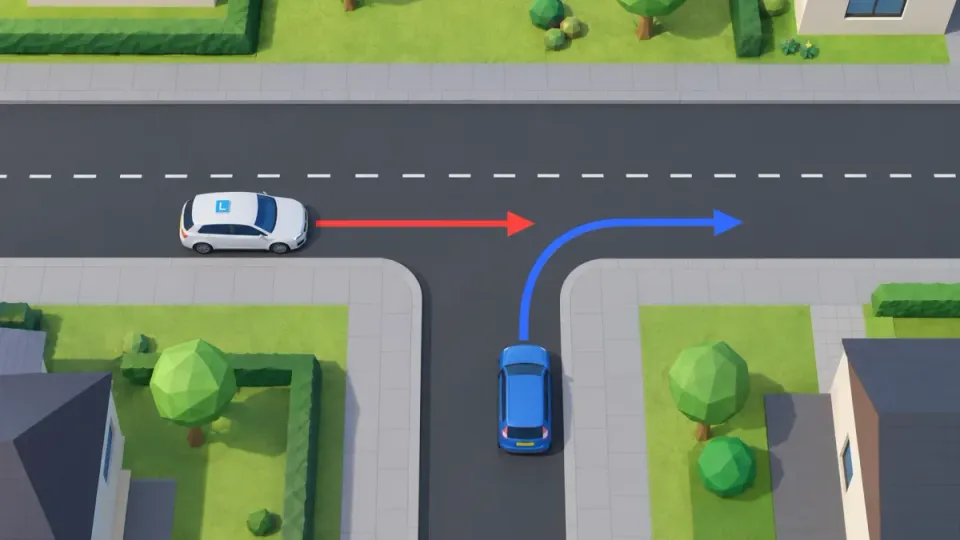
- Are you on the through road and does someone come out of the side road from the right? Then they go first, even if you go straight on and they turn.
- Is the side road on your left? Then you have priority over traffic from the side road.
- Are you coming out of the side road? Then you let traffic from the right go first. Turning left? Also look carefully to the left: you first cross that half of the road.
The rule “straight on goes before turning” only applies on the same road (article 18 RVV). The car in the side road is on another road. If it comes from the right, it goes first.
Two cars on the through road
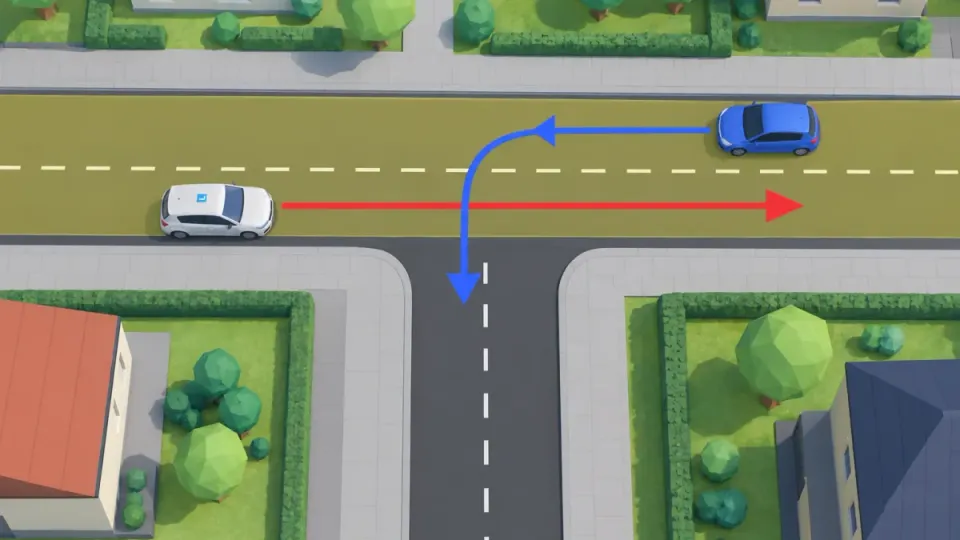
Are two drivers both on the through road? Then they are on the same road. Whoever turns into the side road lets traffic going straight on go first. Also think of cyclists next to you or just behind you. If two oncoming drivers both turn into the side road, the short turn (right) goes before the long turn (left). How to position yourself is explained under getting in lane.
Trams at a T-junction
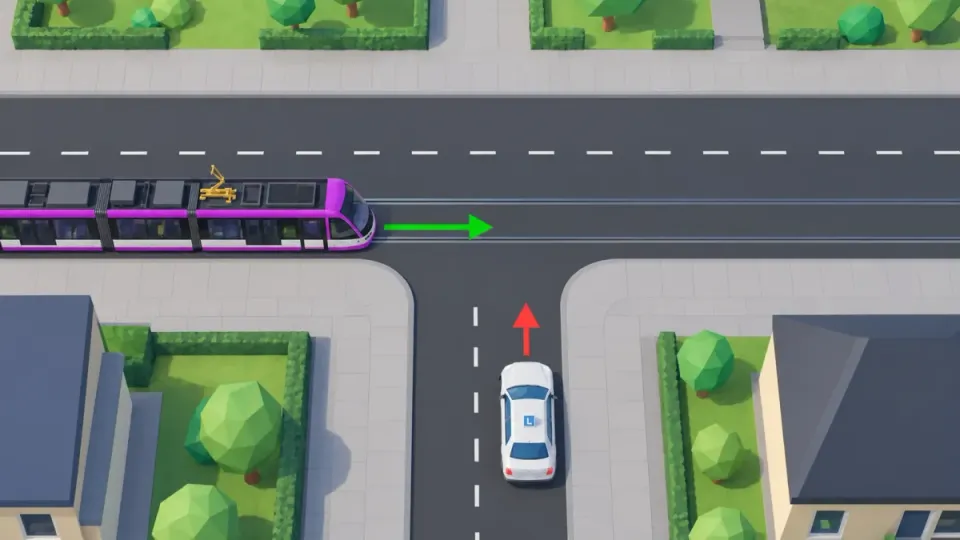
At an equal T-junction a tram always goes first, even from the left (article 15 RVV). More under the tram.
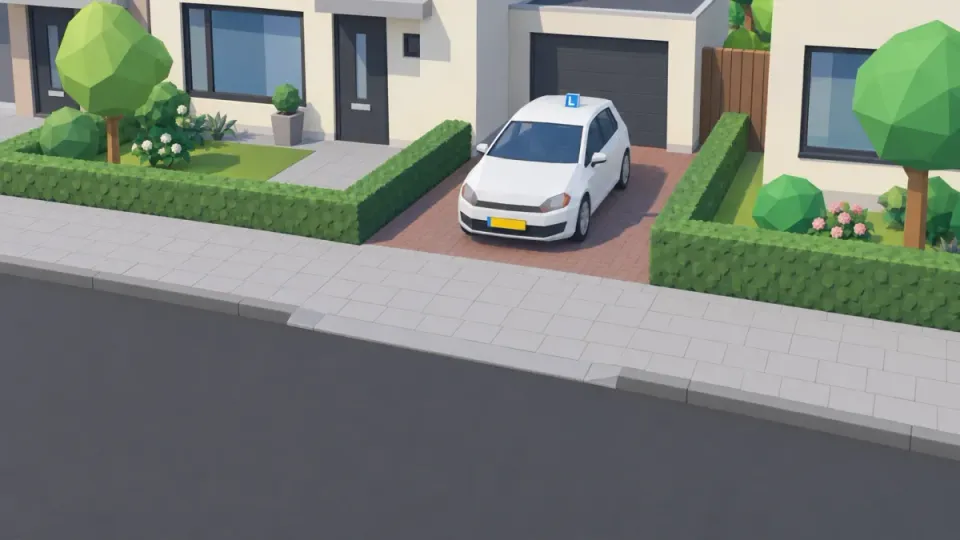
Looks like a T-junction, but is it a driveway exit?
Do you drive onto the road across a continuous pavement or cycle path? Then it is a driveway exit and you let all traffic go first, pedestrians too. Is the side road made of sand or gravel? Then you let all drivers on the paved road go first. More under driveway exits and unpaved roads.
Priority at a T-junction with 3 cars
Do three cars arrive at the same time? Then first find the car that has nobody on its right. That car goes first. An example at an equal T-junction:
- Car A (the learner car) is on the through road and goes straight on. The side road is on its right.
- Car B (the blue car) comes out of the side road and wants to turn left.
- Car C (the red car) comes towards A on the through road and also goes straight on.
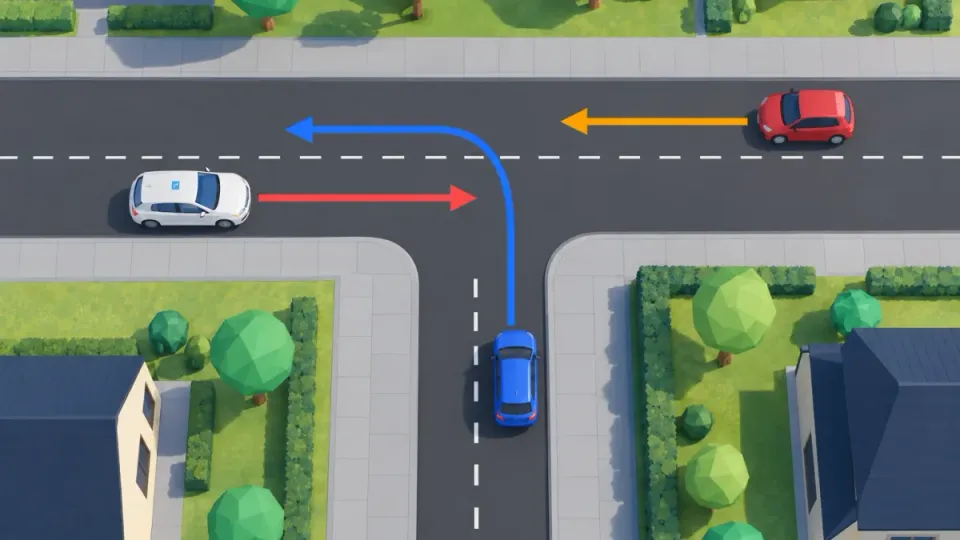
The order is C, B, A:
- C has nobody on its right. C goes first.
- B lets C go first, because C comes from B’s right. Then B goes.
- A waits for B, because B comes from A’s right. A goes last.
More examples with three or more road users are under the priority rules.
Unequal T-junction: shark’s teeth and priority signs
Often priority at a T-junction is regulated. Then it is an unequal junction. The signs and shark’s teeth then come before the rule that traffic from the right goes first (article 63 RVV).
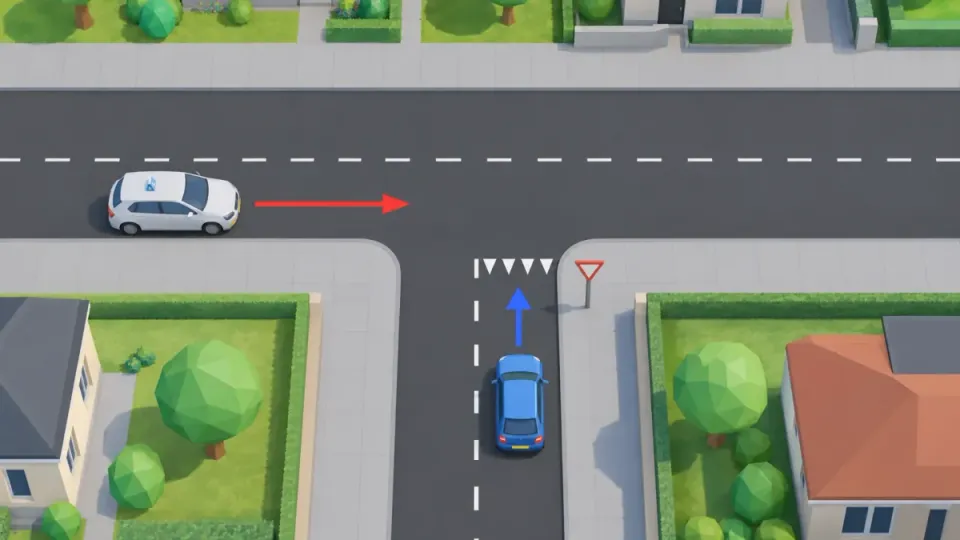
- Shark’s teeth, sign B6 or stop sign B7 in the side road: you let all drivers on the through road go first, from the left and from the right. Cyclists on the cycle path along that road too. At B7 you always stop completely. More under shark’s teeth (haaientanden).
- Sign B4 or B5 on the through road: you have priority over traffic from the side road. B4 shows a side road on the left, B5 a side road on the right. More under priority junction.
- Working traffic lights come before signs and shark’s teeth. See traffic lights.
Can you park near a T-junction?
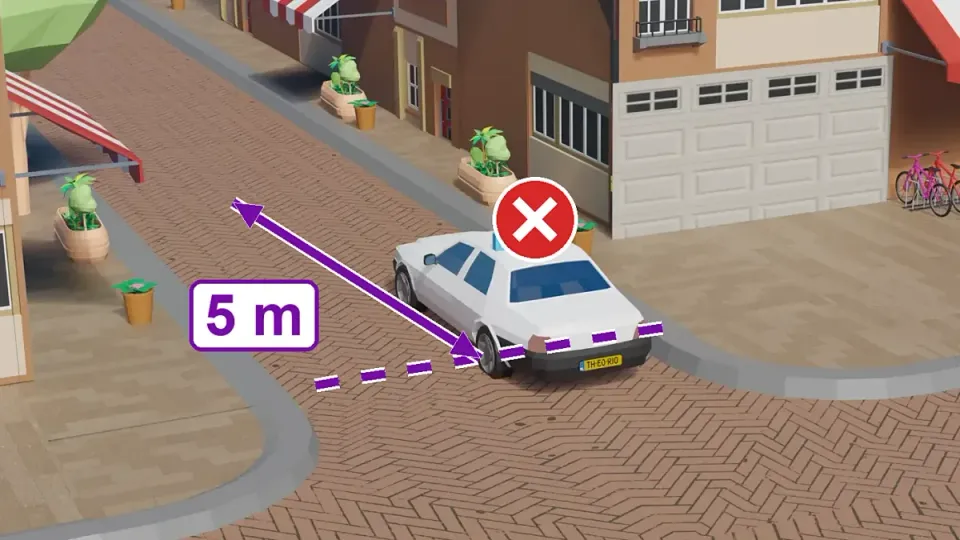
Not within 5 metres of the junction. You may not park within five metres of a junction (article 24 RVV), and a T-junction is a junction. You may not stop on the junction itself either. More under stopping and parking near a junction.
Sources: RVV 1990, art. 1 (junction), 15, 18, 24, 54, 63, 64 and annex 1 (signs B4–B7, J8), wetten.overheid.nl.
Practise like the exam
Example questions like in the CBR exam
Real questions from the Theorio app. You can expect similar questions in your CBR exam.
Question 1 of 5
You come out of the side road and want to turn left. There are no signs or shark's teeth. Who goes first?
Tap the answer you think is right.
You go straight on along the through road. There are no signs or shark's teeth. Who goes first?
Tap the answer you think is right.
The side road has shark's teeth and sign B6. You want to turn left. Who goes first?
Tap the answer you think is right.
You are on a priority road (sign B1). A blue car comes out of the side road on your right. Who goes first?
Tap the answer you think is right.
You come out of a sand road and want to join the paved road. Who goes first?
Tap the answer you think is right.
Answers and explanations for the example questions
Question 1: You come out of the side road and want to turn left. There are no signs or shark's teeth. Who goes first?
Correct answer: The blue car
This is an equal T-junction, so traffic from the right goes first. The blue car comes from your right. You let it go first.
Question 2: You go straight on along the through road. There are no signs or shark's teeth. Who goes first?
Correct answer: The blue car
The through road does not give you priority. The blue car comes out of the side road from your right and goes first, even though it is turning. Straight on only goes first on the same road.
Question 3: The side road has shark's teeth and sign B6. You want to turn left. Who goes first?
Correct answer: The red car
Shark's teeth and sign B6 mean: give way. You let all drivers on the through road go first, from the left and from the right.
Question 4: You are on a priority road (sign B1). A blue car comes out of the side road on your right. Who goes first?
Correct answer: The learner car
Sign B1 means you are on a priority road. You then have priority over traffic from the side road, even when it comes from the right. The blue car waits.
Question 5: You come out of a sand road and want to join the paved road. Who goes first?
Correct answer: The blue car
Coming from an unpaved road, you let all drivers on the paved road go first. Even when they come from the left, like the blue car.
FAQ
Frequently asked questions
Short answers to questions that often come up on this subject.
Who has priority at a T-junction?
The shape does not determine priority. At a genuinely equal T-junction, give way to drivers from the right, including those from the side road. With give-way markings, B6 or B7 on the side road, its drivers give way to drivers on the crossing road; an applicable B7 also requires stopping. Also check driveways, unpaved versus paved approaches, trams and any signals or instructions.
Does the through road have priority at a T-junction?
Not automatically. Signs and give-way markings may regulate priority, but a driveway or unpaved side road meeting a paved road can also matter. When approaches are genuinely equal and no other arrangement applies, drivers from the right go first. Width or the apparent continuation of a road does not itself give priority.
Does straight on go before turning at a T-junction?
The rule concerns traffic on the same road, including a pedestrian continuing straight while you turn. For example, a left-turning motorist on the through road lets an oncoming driver continuing straight go first. For someone coming from a different road, assess the applicable junction rules. Turning trams have an exception.
Is there a road sign for a T-junction?
There is no separate official warning sign exclusively for a T-junction. J8 warns of a dangerous junction without setting priority. B4 and B5 show a side road on the left or right and give drivers priority over drivers from that side road; they are priority signs, not a general rule based on the T shape.
Does a tram have priority at a T-junction?
A tram has special priority over other drivers at an equal T-junction even from the left. A turning tram also has an exception to ordinary turning rules. It must still obey applicable give-way markings, B6/B7, traffic lights and authorised controllers’ instructions. “Trams always go first” is therefore not a rule for every situation.
Ready to practise?
Test your knowledge of Priority rules & Junctions with 35 practice questions in the app.
Free mock exam · no account needed
Your first quiz is free, no account needed. After that from €34.99 for 90 days of access.