Learn to be environmentally aware and drive economically: save fuel and act safely when you have a breakdown on the road. Practice this CBR exam topic for free with real theory questions.
Drive economically by looking ahead and choosing suitable gears. Also learn how to warn safely, call for help and assist casualties after breakdowns or accidents.
Here you learn how to drive economically and what to do after a breakdown or an accident. Each part has its own explanation page.
Engine speed and changing gear: change up at about 2,000 to 2,500 rpm, or earlier if the engine keeps running smoothly. Choose the highest gear in which the engine runs smoothly.
Switching off the engine: standing still for more than 1 minute, for example at an open bridge or the ferry? Switch off the engine. Start-stop does this by itself during short stops.
Reducing fuel consumption: look far ahead, roll to a stop in good time and keep an even speed. Take off a roof box or bike carrier when you no longer need it.
Breaking down: switch on your hazard lights, get out on the right and wait with everyone behind the crash barrier. Place a warning triangle about 30 metres behind your car.
Helping a casualty: first make sure you are safe yourself and call 112. Do CPR with rounds of 30 chest compressions and 2 rescue breaths, and give no food or drink.
Driver assistance supports you, but you remain responsible. Recognise risks from road design, vulnerable road users and poor visibility.
Driver assistance can help, but you remain responsible. Recognise risks from road design, visibility and other road users.
Driver assistance supports the driver
Cruise control, ABS, ESP and an emergency braking system help, but they do not remove the limits of grip or your own responsibility. Keep your attention on the traffic and take action yourself where needed. How each system works and where its limits are is explained under driver assistance systems.
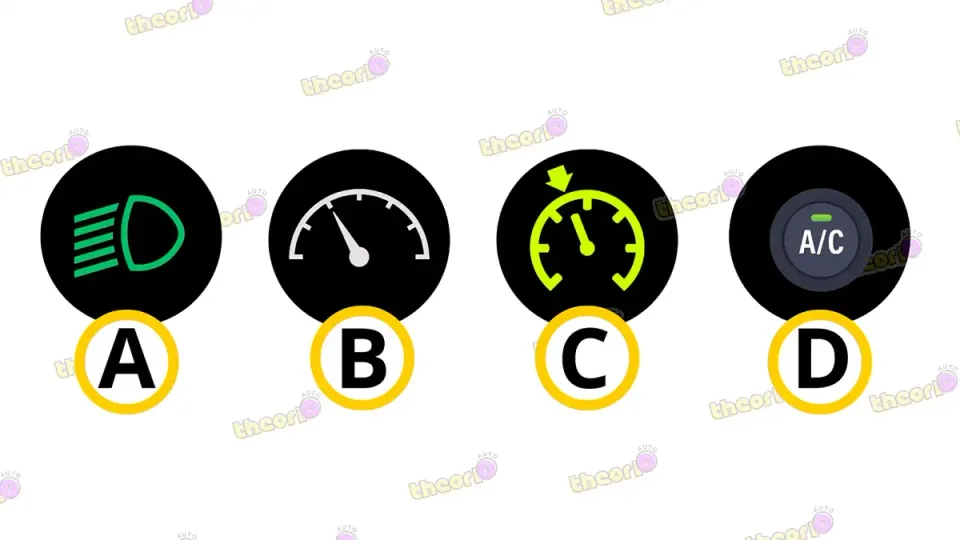
C is cruise control. Assistance with speed does not mean you can stop watching the road.
Road design and collision risk
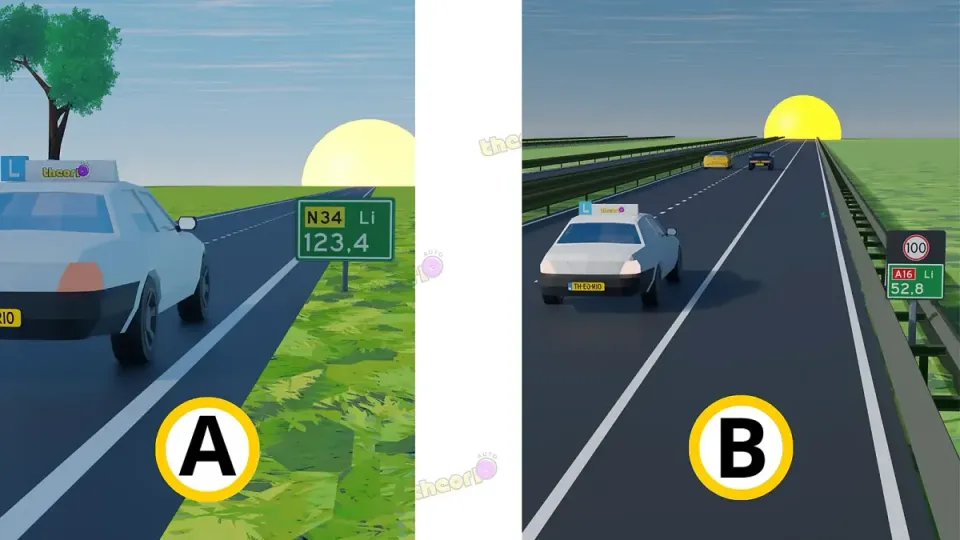
A motorway separates directions and has no at-grade junctions. An ordinary road offers more potential conflicts.
Motorways separate opposing directions and lack at-grade junctions. This reduces certain conflicts with oncoming and crossing traffic. Many 50, 60 and 80 km/h roads instead combine access points, different road users and opposing traffic. Reduce speed and increase space when such risks arise.
Do not confuse accident totals with risk per kilometre travelled. Without a date, definition and source, “most accidents happen here” is not a reliable universal claim. Even a comparatively safe motorway layout can have serious crashes involving queues, lane changes or high speed.
Motorcyclists and poor visibility
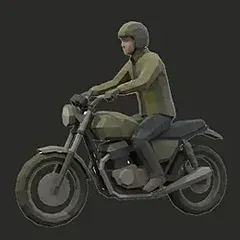
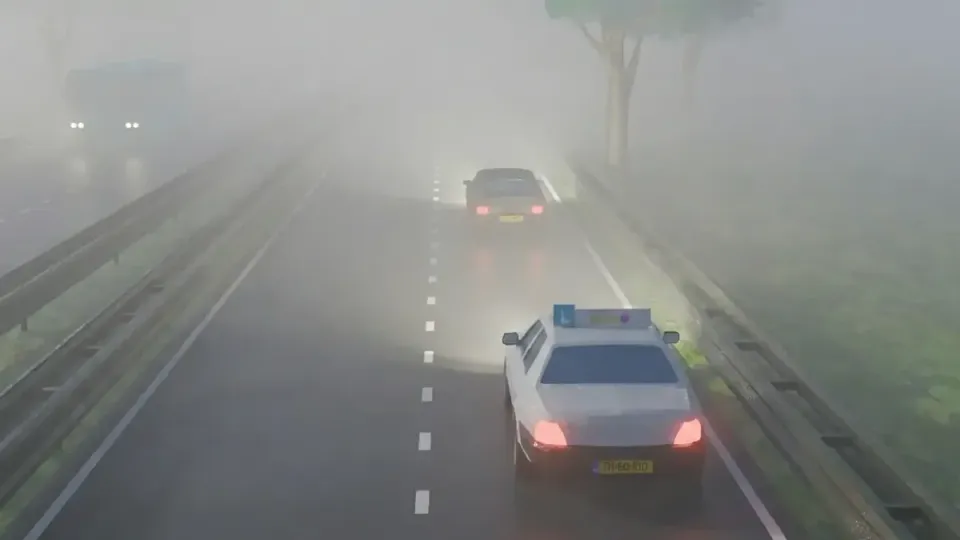
A motorcycle is narrow and can disappear behind a pillar, mirror or other vehicle: look for it deliberately when turning and changing lanes, and give it room. In fog, rain or snow you see danger later; choose a speed at which you can stop within the distance you can see to be clear. More about driving in bad weather is explained under weather conditions.
A motorcycle is narrower and gives its rider less protection than a car. Deliberately look for motorcycles.
Warn only to avert danger
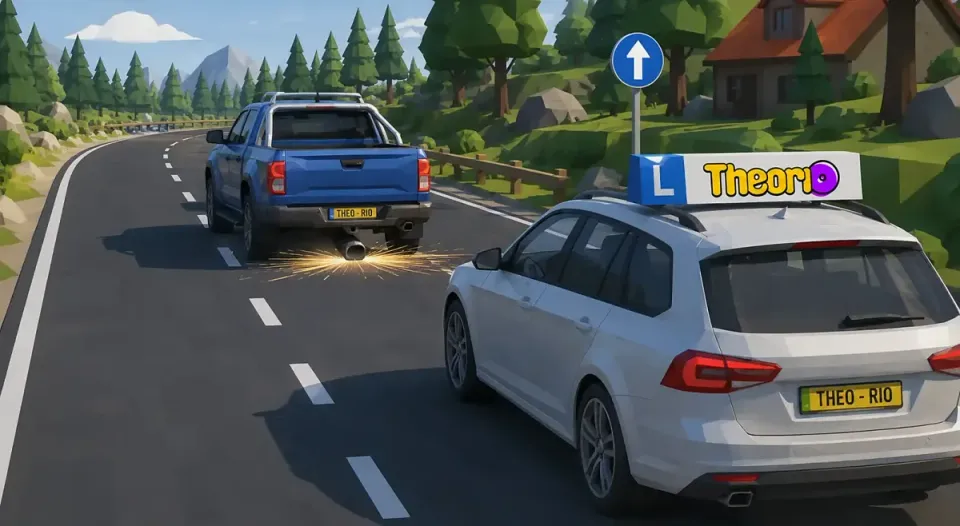
You use the horn or a light signal only to avert imminent danger, for example a dragging exhaust. Not to hurry someone or to vent your irritation, and it does not replace braking. More examples are explained under high beam and light signals.
A dragging exhaust may detach and cause danger: a warning may be necessary here.
Remain fit and sober
Alcohol, drugs, some medicines and tiredness reduce your driving ability, and no driver assistance system makes up for that. Do not drive if you cannot observe, operate or react safely. The alcohol limits and measures such as a driving ban or disqualification are explained under alcohol, blood alcohol and medicines.
Example situations like those in the exam
Situation 1
C identifies cruise control.
Who remains responsible with cruise control active?
The manufacturer takes over everything.
You keep observing and intervening.
Nobody needs to keep a gap anymore.
Correct answer: B. You.
Explanation: A system assists within its limitations; it does not replace the driver.
Situation 2
An exhaust is dragging on the carriageway.
May you warn to prevent this imminent danger?
Yes, an appropriate horn signal may help.
No, it is never permitted outside built-up areas.
Only to show anger.
Correct answer: A. Yes, for imminent danger.
Explanation: The purpose is preventing an accident, not expressing irritation.
Situation 3
Fog limits the view of the road.
What is a safe choice?
Drive faster to keep rear lights visible.
Rely only on a driver-assistance system.
Reduce speed and choose sufficient space.
Correct answer: C. Adapt speed and distance.
Explanation: You must be able to stop within the clear distance you can see.
Short answers to common questions about Eco-friendly Driving & Breakdowns.
Do driver aids such as ABS and ESP take over responsibility?
No. Driver aids such as ABS, ESP and emergency braking systems inform, warn or intervene, but they never take over the driver’s responsibility.
What should you do if you break down in a tunnel?
With an ordinary breakdown, leave the tunnel safely if possible. Otherwise: hazards on, stop safely by the wall, switch off and leave the key. Exit carefully, do not cross the road, and have passengers wait along the wall about 50 metres beyond the car in the direction of travel. Contact traffic control through the help point. With smoke or fire, evacuate away from danger through an emergency exit.
How far behind the car do you place the warning triangle?
About 30 metres from the vehicle, clearly visible towards approaching traffic for which it presents danger. Flashing hazards remove the triangle requirement under Article 58; using both is permitted. Without those lights, a triangle may be required for an obstacle that cannot be seen in time. Place it only without endangering yourself.
What should you do if you break down on the motorway?
Keep control and reach a safe refuge if possible. Otherwise stop with hazards on as far from traffic as possible. Exit safely and move all occupants behind the barrier or well into a safe verge. Call 112 on a traffic lane, open rush-hour lane or in other immediate danger, including when you cannot exit safely. Call breakdown assistance from a safe place.
How do you drive as economically as possible?
Plan your trip, leave space and drive as steadily as possible. Shift to a suitable higher gear in good time, without making the engine vibrate or labour at excessively low RPM. Release the accelerator early where safe. Correct tyre pressure and less unnecessary weight and air resistance also help.
Keep practicing with up-to-date material
This lesson gives you the basics for economical, environmentally aware driving and for acting safely in case of a breakdown. There are more exceptions involving tunnels, hard shoulders, emergency services and vehicle checks; learn in our app with up-to-date CBR information how to respond economically and safely.
Ready to practise?
Test your knowledge of Eco-friendly Driving & Breakdowns with 60 practice questions in the app.