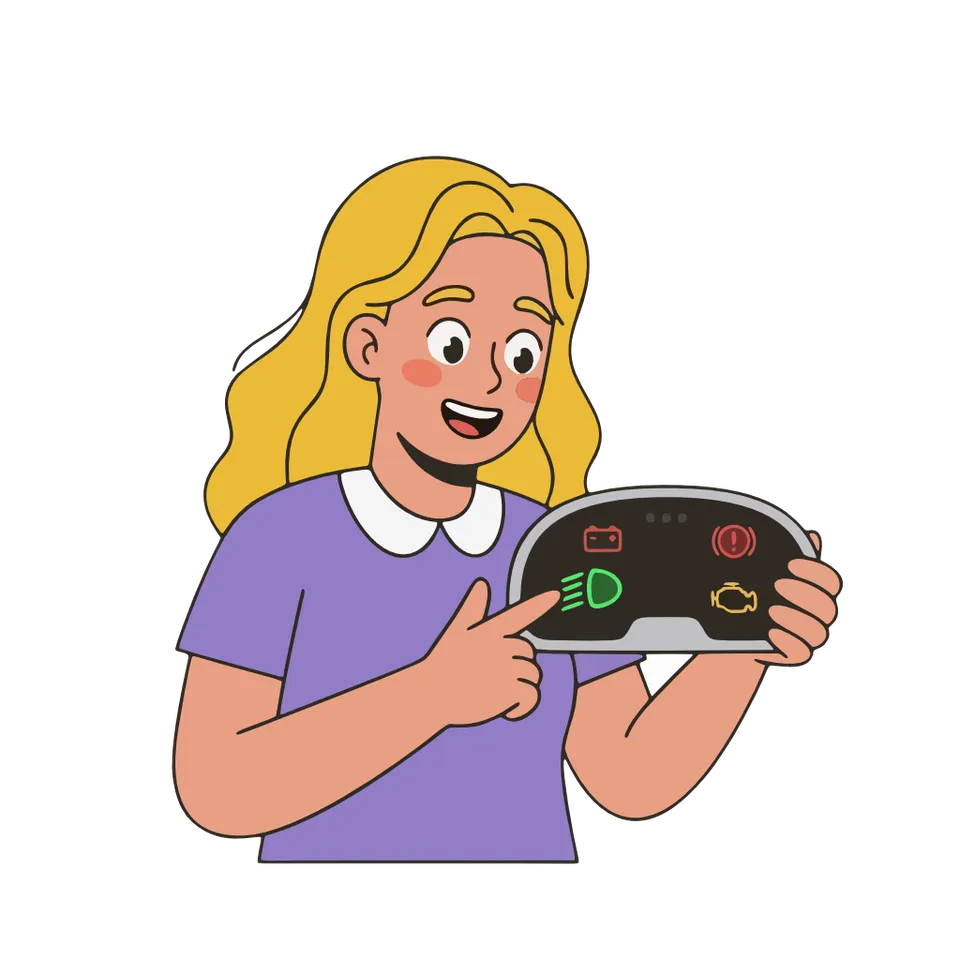
Illustration of a learner holding a dashboard with illuminated warning lights

Car lighting & Dashboard

55 Questions
Easy
0 Parts

Learn how car lighting works and what dashboard lights mean for safe driving and communication. Practice this CBR theory topic for free with exam questions.

Practise car theory

Free mock exam · no account needed

Study material

What will you learn?

Choose lights for visibility, weather and traffic. Identify dashboard messages by symbol and colour and know when to stop safely.

Car lighting & Dashboard at a glance

Here you learn which lights to use when and what the warning lights on your dashboard mean. Each part has its own explanation page.

  • Full beam: the blue light with straight lines. You may only use full beam in the dark and when you dazzle nobody, not even a cyclist or pedestrian.
  • Fog lights: front fog lights are allowed when fog, snow or rain seriously reduces visibility. The rear fog light only in fog or snow with less than 50 metres of visibility.
  • Dipped beams, side lights and DRL: dipped beams are always allowed and required at night, in poor visibility and in a tunnel. Side lights are for standing still, DRL for daytime in good visibility.
  • Dashboard warning lights: with a red light you stop as soon as it is safe; have an orange light checked soon. Is the orange engine light flashing? Then you stop anyway.

Is the orange light for tyre pressure or the ABS light on? Read what to do there. If you have to stop, see breaking down.

FAQ

Frequently asked questions

Short answers to common questions about Car lighting & Dashboard.

When do you use dipped, main and fog lights?

Use dipped headlights in darkness and seriously impaired visibility. Full beam is permitted in darkness inside and outside built-up areas when not meeting another road user or closely following a vehicle. Front fog lights are allowed in seriously impaired visibility from fog, snow or rain. Rear fog lights require fog or snow with visibility below 50 metres, never rain.

What do the colours of the warning lights in your car mean?

Colour is an initial clue; symbol and message determine the action. Red oil-pressure, temperature or brake warnings need immediate safe action. For red oil pressure, stop safely and switch off the engine. Have amber faults assessed promptly. A red parking-brake/belt indication or normally flashing indicator differs from engine failure. Follow the manual.

Keep practicing with up-to-date material

You now have the basics of car lighting, dashboard lights and giving signs and signals. The exact rules often depend on visibility, weather, time of day and danger; practice in our app with the most up-to-date CBR information so you know which light or signal applies when.

Ready to practise?

Test your knowledge of Car lighting & Dashboard with 55 practice questions in the app.

Practise car theory

Free mock exam · no account needed

Your first quiz is free, no account needed. After that from €34.99 for 90 days of access.