Part 1 of 5 in Eco-friendly Driving & Breakdowns
Engine speed and changing gear
Learn exam-focused how to drive more economically with low revs and by shifting up in time, so you use less fuel.


Written by Chris Prosman Reviewed by Dirk van Zuijlen
Updated Reviewed on 4 min read
Free mock exam · no account needed
Change up to a higher gear in good time. Low revs save fuel. For the CBR exam you learn: change up at about 2,000 to 2,500 rpm. That is a guideline, not a law.
When should you change gear in a car?
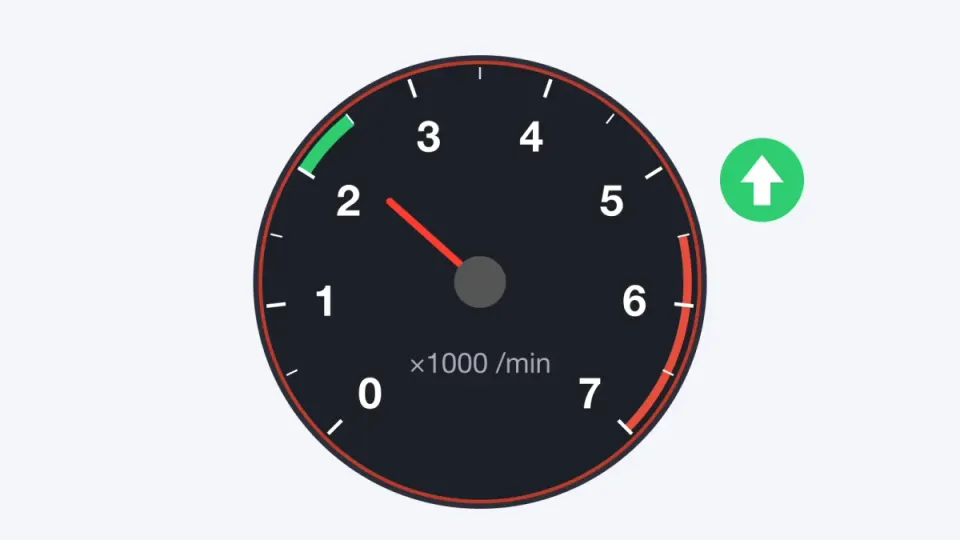
Change up to a higher gear at about 2,000 to 2,500 rpm. That is the answer in the CBR exam. Changing up earlier, for example at 1,800 rpm, is also fine and also saves fuel. As long as the engine keeps running smoothly.
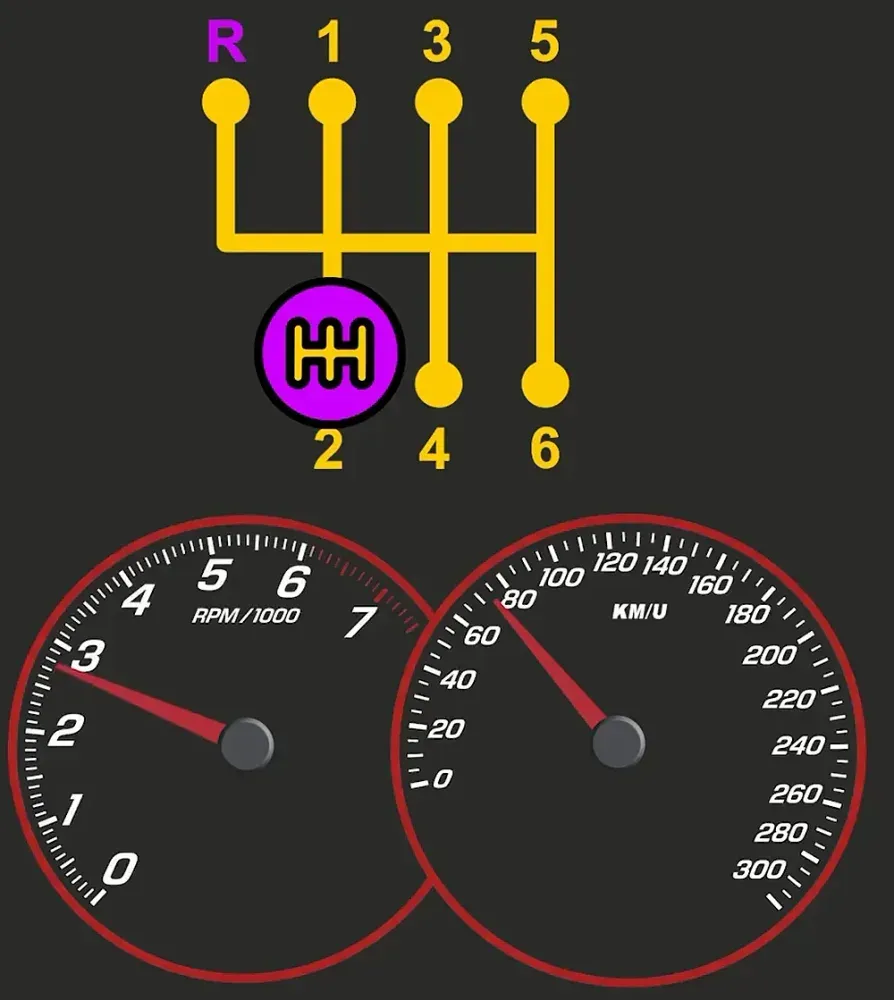
Do not wait until the engine revs high. High revs use more fuel and give more CO₂ emissions. Does the engine start to shake, or does it lack power, for example on a hill? Then change down instead.
What does the rev counter show?
The rev counter shows how fast the engine turns, in revolutions per minute (rpm). A 2 on the dial means 2,000 rpm. That is not the same as your speed. In a low gear the engine can rev a lot while you drive slowly. Think of cycling in a light gear: you pedal fast, but you move slowly.
Which gear at which speed?
There is no fixed table that is right for every car. The rule is: choose the highest gear in which the engine still runs smoothly. Driving 80 km/h in a car with five gears? Then that is usually fifth gear. That is also the answer in the exam.
This table is a rough guide for a car with five gears. Every car is different, so also look at your rev counter.
| Speed | Gear |
|---|---|
| Pulling away | 1st |
| About 10 to 30 km/h | 2nd |
| About 30 to 40 km/h | 3rd |
| About 40 to 60 km/h, such as 50 km/h in a built-up area | 4th (sometimes already 5th) |
| About 60 km/h and faster, such as 80 km/h outside built-up areas | 5th (or 6th if your car has one) |
Does your car have a gear shift indicator on the dashboard? It shows when it is better to change up or down. An automatic chooses its own gear.
When to change gear with 5 or 6 gears?
It works the same with 5 and with 6 gears: change up at about 2,000 to 2,500 rpm. With a sixth gear you drive at high speed with even lower revs. Only use it if the engine still runs smoothly.
High or low gear: which uses less fuel?
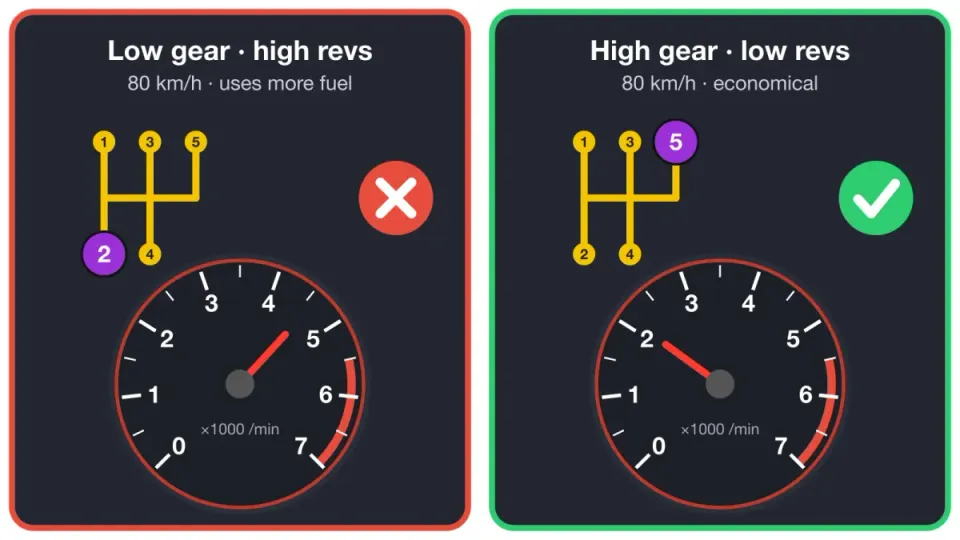
Low revs, high gear: that is what you want. A high gear uses less fuel. At the same speed the engine turns more slowly. Fewer revs mean less fuel and fewer emissions. So change up early and do not keep driving in a low gear.
A simple rule to remember
Low revs = high gear = economical. Not sure in the exam? The economical answer is almost always: change up earlier.
When should you change down?
You change down when the engine does not have enough power. For example when it starts to shake, on a hill, or when you want to speed up again. First slow down to the speed you want. Then choose the gear that fits that speed.
Red light or queue ahead: roll in gear
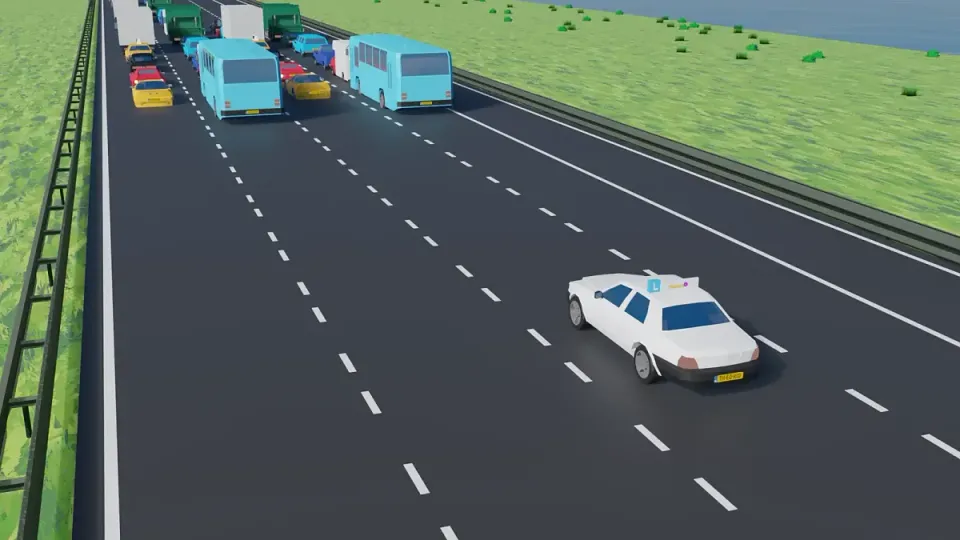
Do you see a red light or a queue far ahead? Take your foot off the accelerator in good time. Let the car roll in the gear you are in, even if that is fifth. Do not press the clutch and do not coast in neutral. Many modern engines cut the fuel supply then, as long as the revs are high enough. Do brake when you need to, to stop safely.
Driving economically with an automatic
An automatic chooses its own gear. You help by pressing the accelerator gently, looking far ahead and releasing the accelerator in good time. An electric car usually has no gears to choose. More tips are under reducing fuel consumption.
RPM and changing gear · Switching the engine off · Reducing fuel consumption · Breakdowns · First aid at an accident
Practise like the exam
Example questions like in the CBR exam
Real questions from the Theorio app. You can expect similar questions in your CBR exam.
Question 1 of 6
When is the best time to shift?
Tap the answer you think is right.
You are driving at 80 km/h. Are you going to drive in 4th or 5th gear?
Tap the answer you think is right.
In situation A, you drive at low RPM, in situation B at high RPM. The RPM indicates how many times the engine rotates per minute: the higher the RPM, the harder the engine has to work.
In which situation is the fuel consumption higher?
Tap the answer you think is right.
The revolutions show how often the engine rotates per minute. In a low gear, the engine makes many revolutions, in a higher gear, it makes fewer. Therefore, shifting up in time leads to a lower engine speed and more economical driving. You can compare this to cycling: if you pedal hard in a low gear, you make many pedal revolutions (revolutions) but move slowly. If you shift to a higher gear, you pedal more calmly with fewer revolutions (revolutions) while you ride faster and more efficiently. Remember: drive at low revolutions by shifting to a higher gear in time.
How can you reduce the number of revolutions?
Tap the answer you think is right.
How can you reduce fuel consumption?
Tap the answer you think is right.
You approach a traffic light in 5th gear and you need to stop. What do you do?
Tap the answer you think is right.
Answers and explanations for the example questions
Question 1: When is the best time to shift?
Correct answer: Situation A
Situation A indicates 2,000 RPM and Situation B 3,000 RPM. For an environmentally conscious driving style, you shift with a gasoline engine between 2,000 and 2,500 RPM. Therefore, Situation A is the right moment. 📈
Question 2: You are driving at 80 km/h. Are you going to drive in 4th or 5th gear?
Correct answer: 5th gear
According to The New Driving, you shift up early, usually between 2,000 and 2,500 RPM. At 80 km/h, the car drives in 5th gear more smoothly and economically than in 4th. This is better for the environment and your wallet. 🍃
Question 3: In which situation is the fuel consumption higher?
Correct answer: Situation B
In situation B, you are at high RPM, which puts more strain on the engine, rotates more, and consumes more fuel. 🔥 Avoid unnecessary high RPM.
Question 4: How can you reduce the number of revolutions?
Correct answer: By shifting to a higher gear
By shifting to a higher gear in time, the engine runs at fewer revolutions and you consume less fuel. ⚙️ Low revolutions through a high gear.
Question 5: How can you reduce fuel consumption?
Correct answer: By shifting to a higher gear
By shifting to a higher gear at the right moment, you lower the RPM and save fuel. 💡 Low RPMs through a high gear.
Question 6: You approach a traffic light in 5th gear and you need to stop. What do you do?
Correct answer: Release the gas and roll out in 5th gear
Release the gas in time and let the car roll out in gear. This interrupts the fuel supply (you are driving 'for free'). Only when the engine speed becomes too low idle, do you press the clutch or downshift. This is the most energy-efficient way. 🚦
FAQ
Frequently asked questions
Short answers to questions that often come up on this subject.
At how many RPM do you shift up?
2,000–2,500 RPM is a common economical-upshifting guideline, not a compulsory minimum. Earlier shifting may be suitable if the engine remains smooth. Follow the shift indicator and handbook, considering load, gradient and required pulling power. Do not make the engine labour in too high a gear.
Which gear do you use at 80 km/h?
Choose a suitable high gear in which the engine runs smoothly and has enough pulling power. In many cars that may be fifth, but no gear is fixed for every car at 80 km/h. Follow the shift indicator and handbook; a load or gradient may require a lower gear.
Ready to practise?
Test your knowledge of Eco-friendly Driving & Breakdowns with 60 practice questions in the app.
Free mock exam · no account needed
Your first quiz is free, no account needed. After that from €34.99 for 90 days of access.