Part 1 of 8 in Traffic Signs, Signals & Directions
Mandatory signs
Mandatory signs are round and blue: you must do what they show. Mandatory direction, diagonal arrows, the end of an obligation and the exam traps.


Written by Chris Prosman Reviewed by Dirk van Zuijlen
Updated Reviewed on 5 min read
Every CBR sign · start for free
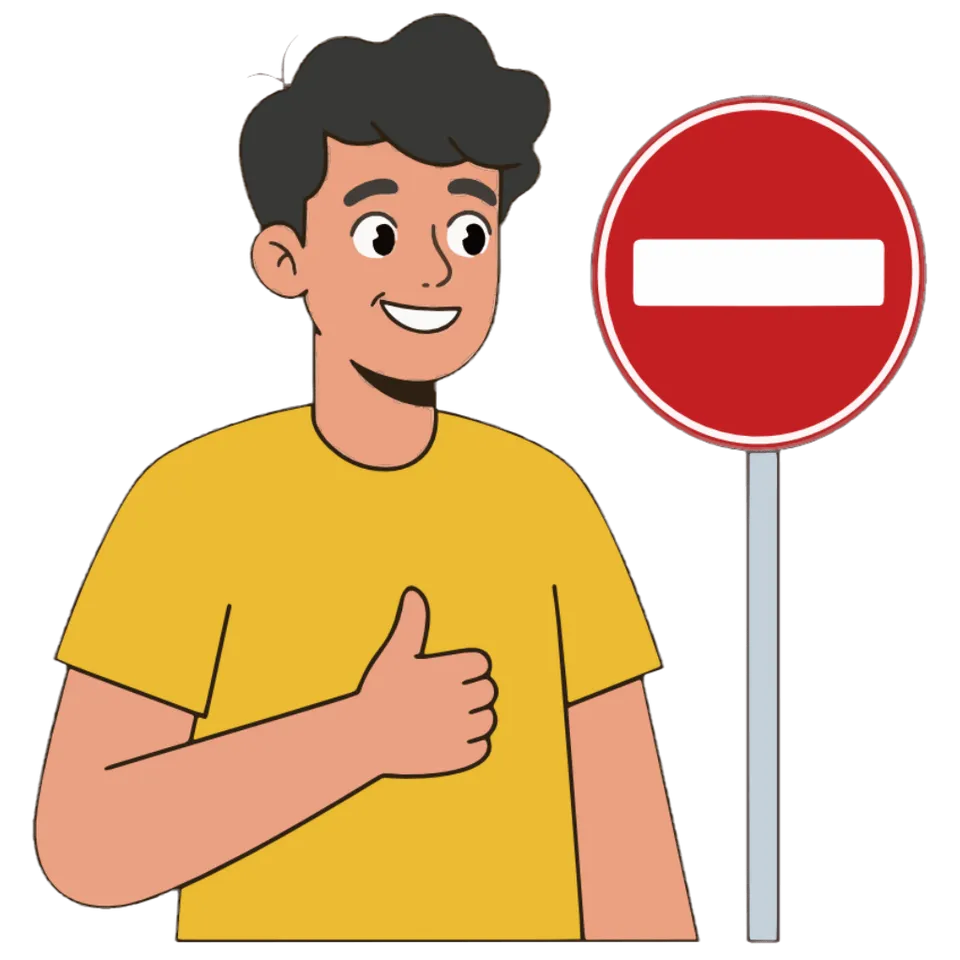
A mandatory sign is a round blue sign with a white symbol: it tells you what you must do. Think of a mandatory direction, the roundabout sign or a mandatory cycle path. Where the obligation ends, you see the same sign with a red diagonal line through it. From there the normal traffic rules apply again.
What is a mandatory sign?
A mandatory sign is a round blue sign with a white symbol. It tells you what you must do: follow a direction or use a path. This is how you recognise a mandatory sign:
- Shape: always round.
- Colour: blue with a white symbol.
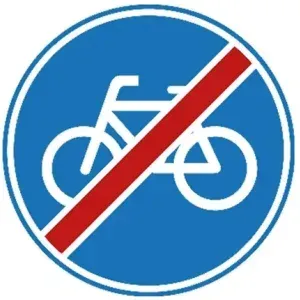
- End: for the path signs you see the same sign with a red diagonal line, such as
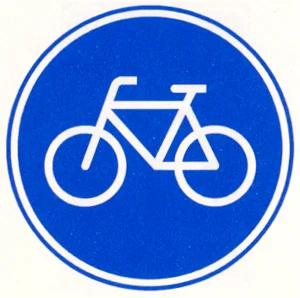 G11 and
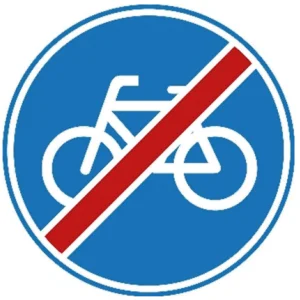 G12. The arrow signs D1 to D7, such as
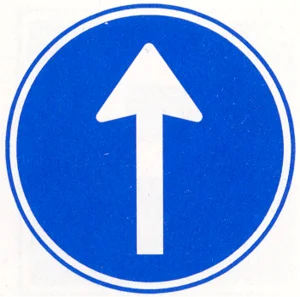 D4, only apply where they stand and have no end sign.
The difference with a prohibition sign in one sentence: a blue mandatory sign says what you must do, a round sign with a red border says what you may not do. The red signs are on the page about prohibition signs.
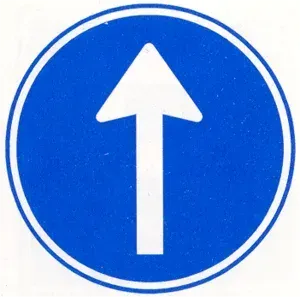
Round blue sign with arrows: mandatory direction sign
A round blue sign with a white arrow is a mandatory direction sign. You must follow the direction of the arrow. Going another way is not allowed.
- Sign D4: follow the direction on the sign, here straight on.
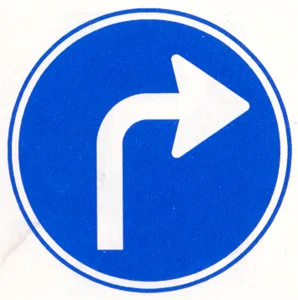 Sign D5: the same rule, but to the right.
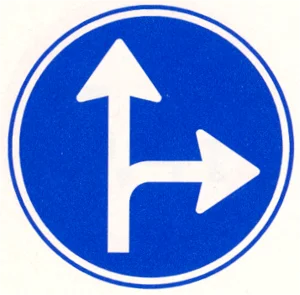 Sign D6: choose one of the directions on the sign, here straight on or right.
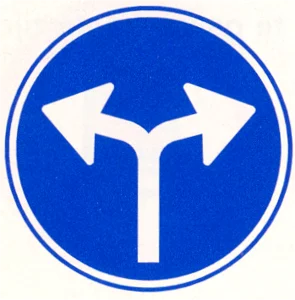 Sign D7: left or right. Straight on is not allowed.
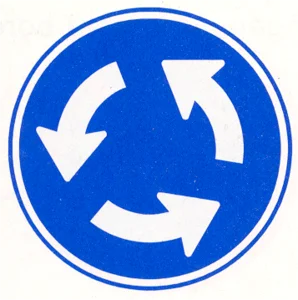 Sign D1: roundabout. You drive around the centre island in the direction of the arrows.
What does a blue sign with a white arrow mean? That depends on the shape. Round: a mandatory direction. Square: a one-way street. With a mandatory direction you can still meet oncoming traffic. The difference is explained on the page about the one-way street sign.
Memory aid: a round sign looks like the letter O. Traffic can come from the Other direction.
Do you have to indicate at a mandatory direction sign?
Yes. If you turn left or right, you use your indicator. Even when the sign sends you that way. Other road users need to see what you are doing. This is in article 55 of the RVV 1990.
Making a U-turn is not allowed at a mandatory direction sign. You would not be following the arrow.
Arrows pointing to the bottom right or bottom left
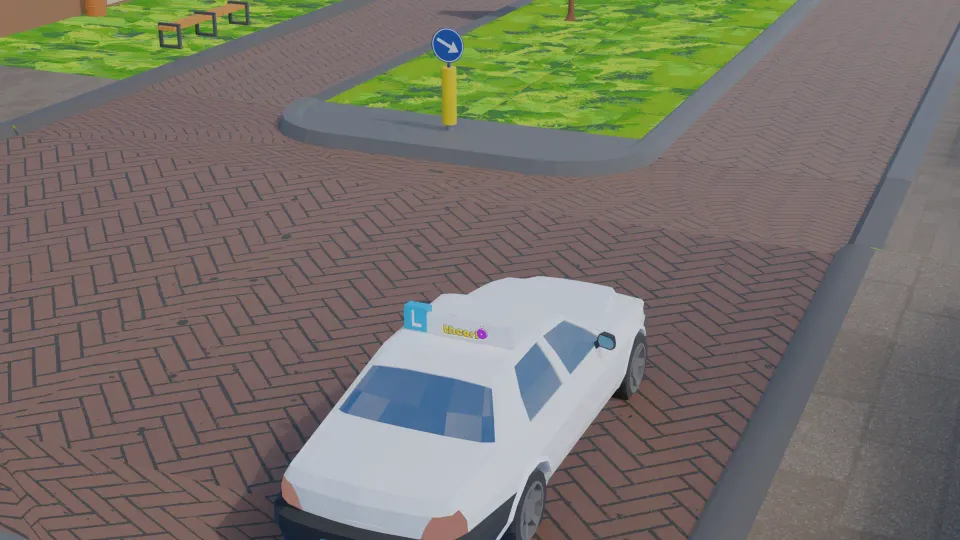
A round blue sign with an arrow pointing diagonally downwards is sign D2. It does not tell you which way to go, but on which side you must pass the sign. You see it for example on a traffic island or a central reservation.
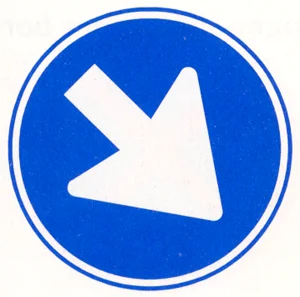 Arrow to the bottom right: you pass the sign on the right. On a road with traffic in both directions, this keeps you to the right of the middle strip.
- Arrow to the bottom left: the same sign mirrored. You pass the sign on the left.
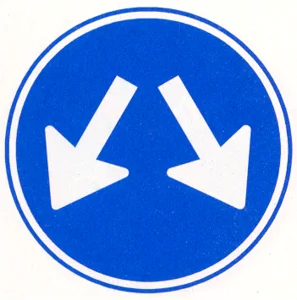 Two arrows, to the bottom left and the bottom right: sign D3. You may pass the sign on either side.
End of an obligation
You recognise the end of an obligation by the same round blue sign with a red diagonal line. From that sign you no longer have to follow the obligation. The normal rules apply again.
- Sign G12, end of mandatory cycle path: cyclists no longer have to use this path. They ride on the carriageway again, or on a cycle path if there is one.
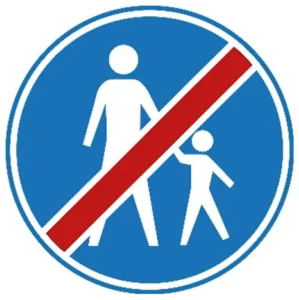 Sign G8, end of footpath: from here the path is no longer for pedestrians only.
So a red line through a blue sign means end, not forbidden. Black lines through a white sign are the end of a prohibition. You find those on the page about prohibition signs.
Mandatory sign, prohibition sign or information sign?
For pedestrians there are signs of all three kinds. The shape and colour tell you straight away what such a sign asks of you.
| Mandatory sign | Prohibition sign | Information sign |
|---|---|---|
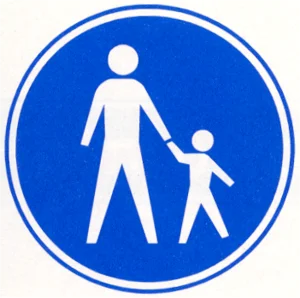 | 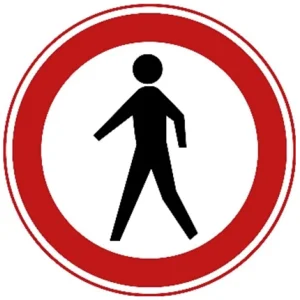 | 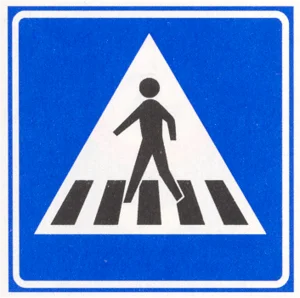 |
| G7, footpath: round and blue. Pedestrians must use this path. | C16, closed to pedestrians: round with a red border. Pedestrians may not go here. | L2, pedestrian crossing: square and blue. The sign announces a zebra crossing; you let people who cross there go first. |
Common mandatory signs in the CBR exam
These are the mandatory signs you meet most: turn right only, and the signs that say who must use a path.
- Sign D5 (turn right only): you must turn right here. Going straight on or turning left is not allowed. If the arrow points left, you must turn left. You still signal your turn.
- Sign G11 (mandatory cycle path): cyclists must use this path. You do not drive on it with a car.
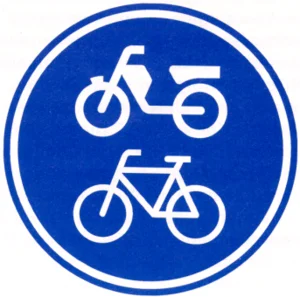 Sign G12a (cycle/moped path): cyclists and moped riders must use this path.
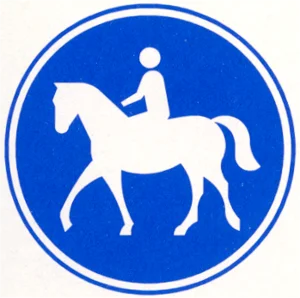 Sign G9 (bridle path): for horse riders only; riders must use this path.
Mandatory or optional cycle path?
| Sign | What do you do? |
|---|---|
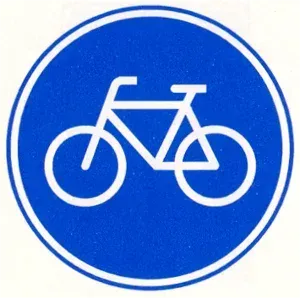 | G11 is round: cyclists and, in principle, light-moped riders use this mandatory cycle path. Local exceptions for light mopeds may be signposted. |
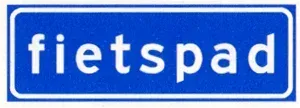 | G13 is rectangular and says fietspad: cyclists may use the path but are not required to. A light moped with a combustion engine may use it only with its engine switched off. |
The red diagonal stripe in G12 ends the mandatory cycle path. It does not prohibit entry.
CBR traps with mandatory signs
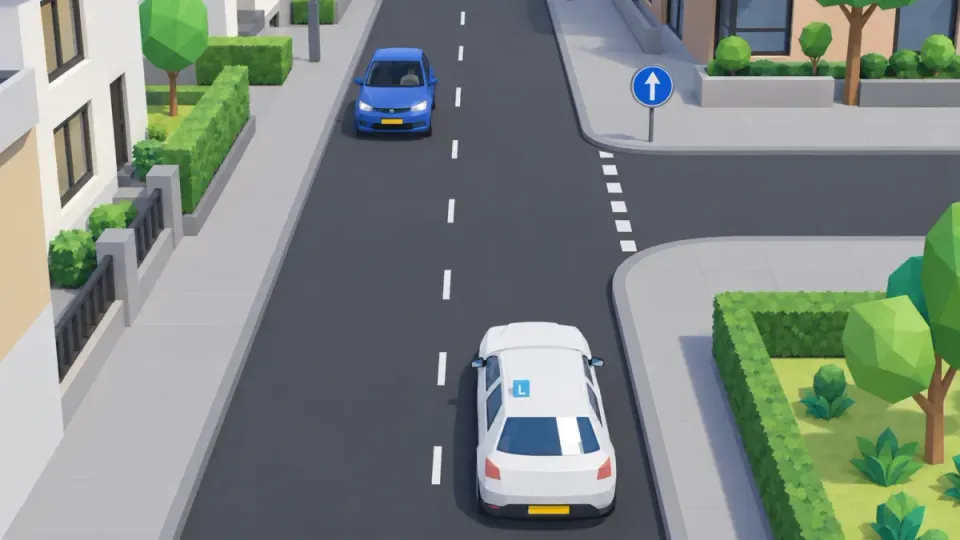
❌ Wrong: reading a round blue sign with an arrow as "one-way street, so no oncoming traffic". ✅ Right: round blue is a mandatory direction. Oncoming traffic is possible. A one-way street has a square blue sign.
❌ Wrong: seeing a blue sign with a red diagonal line as a prohibition. ✅ Right: that line means end of the obligation. Nothing is forbidden.
❌ Wrong: turning that way at a diagonal arrow to the bottom right. ✅ Right: sign D2 only tells you on which side to pass the sign.
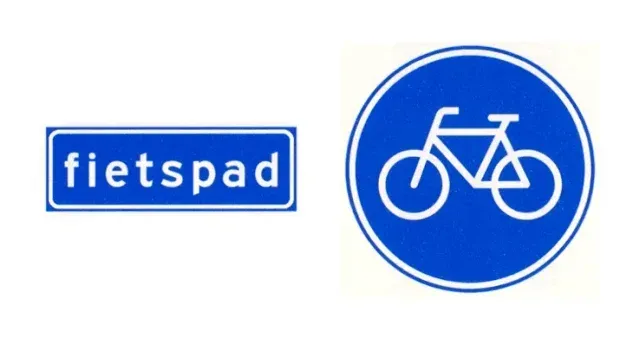
❌ Wrong: reading the rectangular sign with the word "fietspad" (G13) as an obligation. ✅ Right: that is an optional cycle path. Only the round blue sign G11 makes the cycle path compulsory.
Practise like the exam
Example questions like in the CBR exam
Real questions from the Theorio app. You can expect similar questions in your CBR exam.
Question 1 of 6
At a mandatory driving direction you follow the arrow. You can expect oncoming traffic here.
Are you allowed to go left here?
Tap the answer you think is right.
Can you expect oncoming traffic here?
Tap the answer you think is right.
At which sign are you allowed to go straight?
Tap the answer you think is right.
Is it allowed to cycle here?
Tap the answer you think is right.
At which sign may you turn left?
Tap the answer you think is right.
Which sign can you expect traffic from the left?
Tap the answer you think is right.
Answers and explanations for the example questions
Question 1: Are you allowed to go left here?
Correct answer: No
This sign indicates a mandatory direction to the right. You are not allowed to go left. 🚫
Question 2: Can you expect oncoming traffic here?
Correct answer: Yes
Even with mandatory driving direction to the right, there can be oncoming traffic. Be prepared for traffic from unexpected directions. ⚠️
Question 3: At which sign are you allowed to go straight?
Correct answer: None of the above
Sign A means prohibited to enter this road from both sides. Sign B indicates a mandatory driving direction to the right. This means you must turn right here.
Question 4: Is it allowed to cycle here?
Correct answer: No
This is a equestrian path, a road that is exclusively intended for riders (people on horseback). It is not allowed to cycle or use other vehicles here.
Question 5: At which sign may you turn left?
Correct answer: Sign B
Sign A is a one-way street to the right. Sign B is a mandatory direction, but traffic from all directions is possible. So you may turn left at Sign B. 🔀
Question 6: Which sign can you expect traffic from the left?
Correct answer: Sign B
Sign A is a one-way street to the left (traffic from right to left), Sign B is a mandatory direction where traffic can come from all directions. At Sign B you can expect traffic from the left. ➡️
FAQ
Frequently asked questions
Short answers to questions that often come up on this subject.
Does a blue sign with a diagonal arrow mean you must turn that way?
No. A diagonal arrow to the bottom right means you keep to the right of the middle strip. If there are two diagonal arrows (sign D3), you may pass the sign on either side.
What is the difference between a mandatory sign and a prohibition sign?
Round blue mandatory signs with a white symbol require an action, such as following a direction or using a particular path. A prohibition sign states what is not allowed and often has a red border. Read the whole symbol: a blue sign is not automatically mandatory, and a red slash can also mark the end of a compulsory path.
What does a round blue sign with a red line through it mean?
It depends on the whole sign. G12 shows the white compulsory-cycle-path symbol crossed by a red slash: that obligation ends. E1 is a blue circular sign with a red border and one red slash and means no parking. E2 has a red cross and prohibits voluntary stopping. A red slash on blue therefore does not automatically mean an obligation has ended.
Ready to practise?
Test your knowledge of Traffic Signs, Signals & Directions with 90 practice questions in the app.
Every CBR sign · start for free
Your first quiz is free, no account needed. After that from €34.99 for 90 days of access.