Part 8 of 8 in Traffic Signs, Signals & Directions
Level crossing
Level crossing: protected or unprotected, what flashing red lights and signs J10 to J13 mean, and what to do if you are stuck between the barriers.


Written by Chris Prosman Reviewed by Dirk van Zuijlen
Updated Reviewed on 7 min read
Every CBR sign · start for free
A level crossing (spoorwegovergang or overweg in Dutch) is one of the most dangerous places in traffic. According to ProRail, more than forty accidents happen at level crossings every year, and a third of them are fatal. That is why there are many rules and recognition points. The two most important: at flashing red lights you stop, and you only drive onto the track if you can get off it in one go.
Types of level crossings
There are two types: protected level crossings, where lights warn automatically when a train is coming, and unprotected level crossings, where you only see a St Andrew’s cross. A protected crossing usually has barriers too, but there is also an in-between form with lights only.
| Type | What do you see? | What do you do? |
|---|---|---|
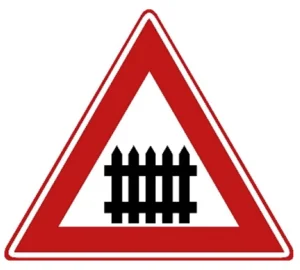 Protected, with barriers | Flashing red lights, a bell and half barriers that close after the flashing starts. | Stop as soon as the lights start flashing, even if the barriers are still open. |
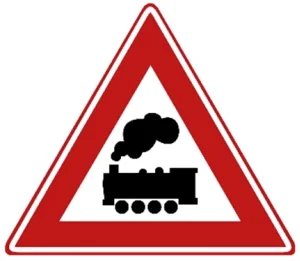 Protected, without barriers | Flashing red lights, but no barriers. This in-between form is rare. | Stop at flashing red. There is no barrier to hold you back, so you have to brake yourself. |
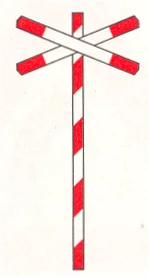 Unprotected | Only a St Andrew’s cross (J12 or J13). No lights and no barriers. | Look and listen yourself. If a train is coming, you stop. |
ProRail is working to close or adapt unprotected public level crossings. So you will see them less and less, but they can still come up in the exam.
The rules at a level crossing
A few fixed rules from the RVV 1990 apply at a level crossing. They come down to one thing: the train always goes first.
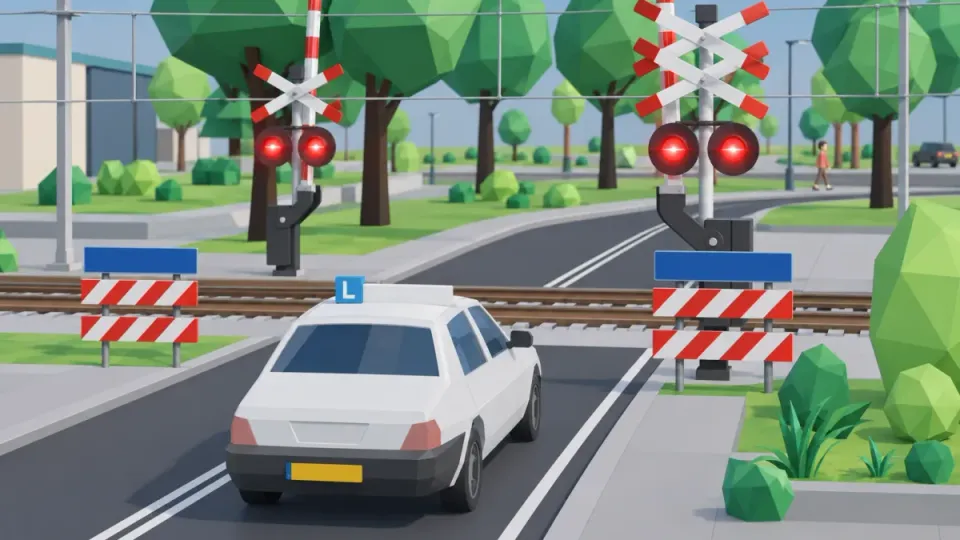
- Flashing red means stop. Flashing red crossing lights mean stop (Article 71 RVV). Wait before the stop line or the crossing.
- Wait until everything is open. A barrier starting to rise is not permission to proceed. Wait for the red light to go out and the crossing to open fully.
- Only drive on if you can get off. You may only drive onto a level crossing if you can carry straight on and clear the crossing completely (Article 15a RVV). Ensure there is room beyond the tracks for your whole car or combination. Do not enter if a queue would leave you standing on the tracks.
- The train goes first. You always let a train go first, also at a crossing without lights or barriers (Article 15a(2)).
- Never stop on the track. You may not let your car stand still on a level crossing, not even briefly (Article 23 RVV).
- Not around the barriers. Never drive around closed barriers and do not zigzag between them.
- White flashing light. The RVV also has a white flashing light for level crossing lights. It means: no train is approaching.
Good advice: always look yourself
This is not an official rule, but it is sensible. Look left and right, even when the lights are off. After one train, another can approach on a different track.
Fines at a level crossing
- Not stopping at flashing red: €320 (offence code R 608).
- Driving onto a level crossing when you cannot carry straight on: €320 (R 340 a).
- Stopping on a level crossing: €130 (R 396 j).
Amounts for a car, excluding €9 administration costs (Wahv rates, valid from 1 September 2026).
How to recognise a level crossing
A level crossing announces itself in steps: first a warning sign, then distance markers, and at the track itself a St Andrew’s cross, often with lights and barriers.
The signs: count the crosses
| Sign | Name | Meaning | What do you do? |
|---|---|---|---|
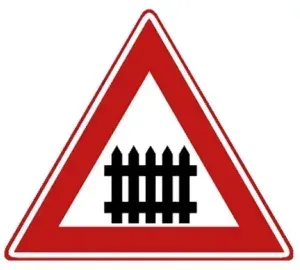 | J10: crossing with barriers | You approach a crossing with barriers. | Slow down and expect the protection to activate. |
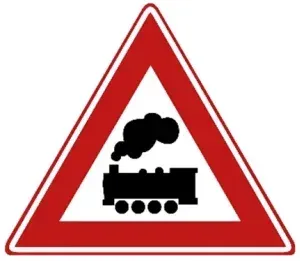 | J11: crossing without barriers | There are no closing barriers. | Look and listen yourself; flashing red still means stop. |
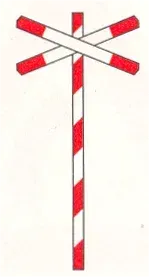 | J12: single St Andrew’s cross | There is one track. | The cross stands at the track; keep checking signals and trains. |
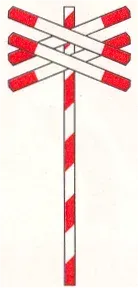 | J13: double St Andrew’s cross | There are two or more tracks. | After one train, another may approach from the opposite direction. |
J10 and J11 stand before the crossing and warn that it is coming. The St Andrew’s cross stands at the track itself: in the law, a level crossing is the place where a J12 or J13 stands. More per sign: J10, J11, J12, J13.
Lights, bell and barriers
A protected level crossing always starts with flashing red lamps. At a crossing with barriers the bell also rings, and then the barriers come down. So stop at the first flash. Do not wait until you see the barriers lowering.
Distance markers: 240, 160 or 80 metres
| Marker | Stripes | Distance to the track |
|---|---|---|
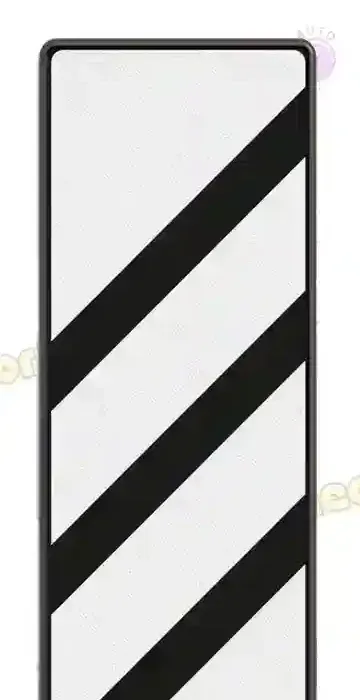 | Three stripes | about 240 metres |
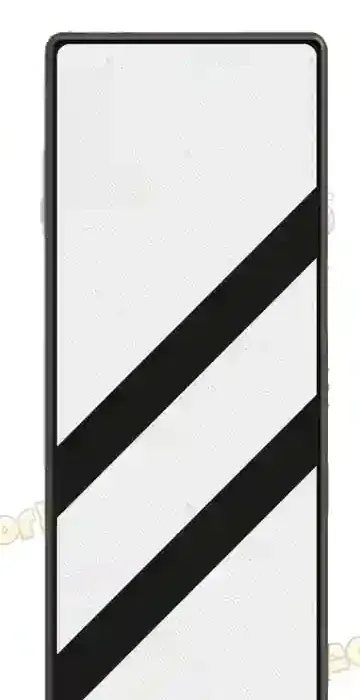 | Two stripes | about 160 metres |
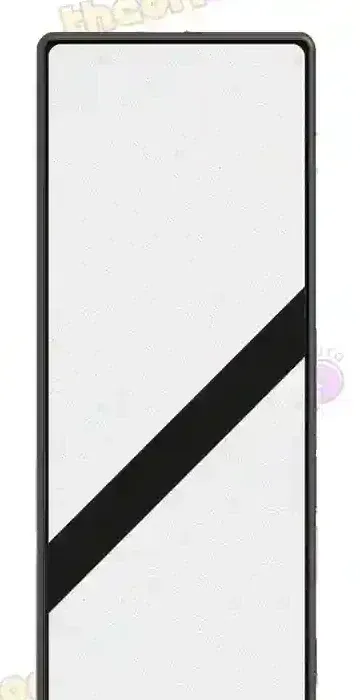 | One stripe | about 80 metres |
Each diagonal stripe stands for about 80 metres: number of stripes × 80 metres. You first see three, then two and finally one. Use the distance to reduce speed and look ahead in time. The stripes slope down towards the road, showing which side of the marker the road is on.
Tram signal or crossing light?
| Tram signal: not for you | Crossing light: for you |
|---|---|
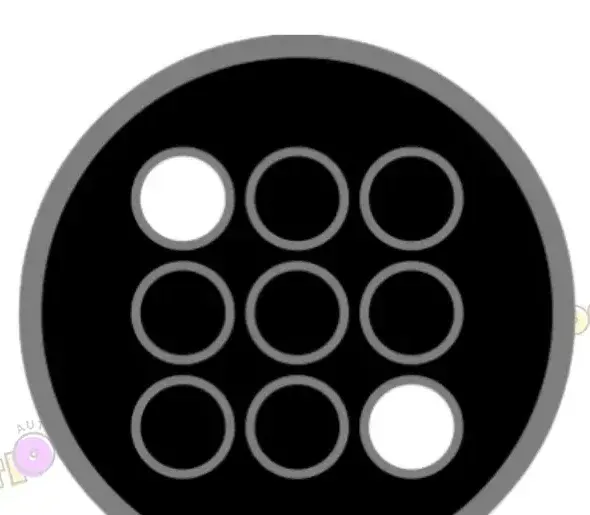 | |
| White dots or bars: this signal is for the tram and the bus. | Two red flashing lights: stop. This signal is for road traffic. |
A signal with white points or bars is for public transport. Two flashing red lamps at a tram track tell you to stop. Do not confuse a single yellow warning lamp with red either: yellow calls for care, red means stop. Read more under traffic lights.
Step-by-step plan at a level crossing
This is how you approach a level crossing, step by step:
- Warning sign. A red triangle with a gate (J10) means a level crossing with barriers. A red triangle with a train (J11) means a level crossing without barriers. Ease off and look far ahead.
- Distance markers. You see posts with three, two and one diagonal stripe. That is about 240, 160 and 80 metres to the track.
-
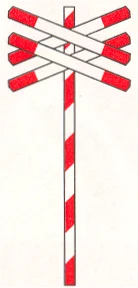 St Andrew’s cross. At the track itself there is a white cross with red edges. One cross (J12) means one track. A double cross (J13) means two or more tracks.
- Red lights or a bell? Stop before the stop line, even if the barriers are still up. Wait until the lights are off.
- No lights? Look and listen both ways. If there is a J13, check every track.
- Room beyond the track? Only drive onto the track if there is room for your whole car beyond it. Then cross in one go.
What to do if you are stuck on a level crossing
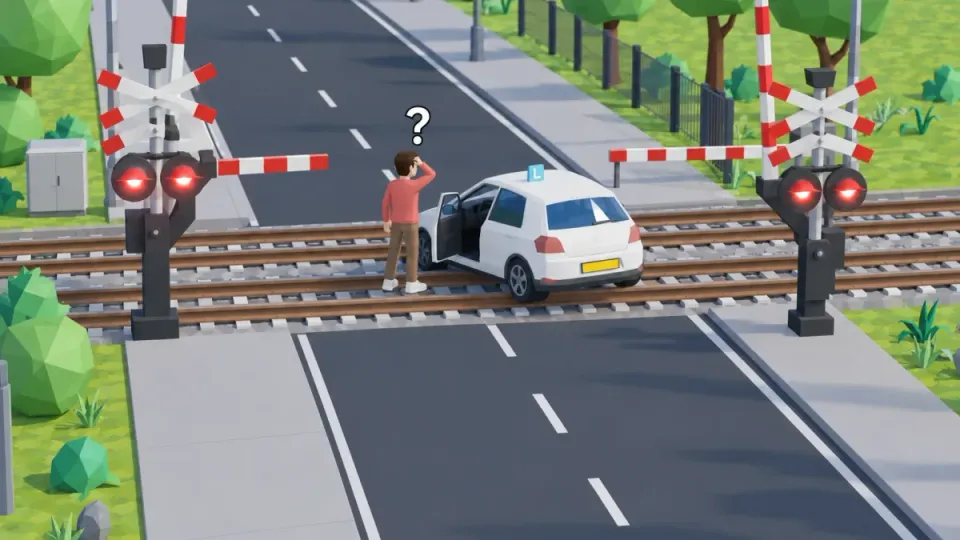
It can still happen: the barriers close while you are still on the track, or your car stalls. This is what ProRail advises:
- Stuck between the barriers? Drive on. Simply drive through the barrier. The barriers are made to break off and will not hold your car back.
- Better a broken barrier. ProRail would rather have damage to a barrier than someone injured or worse.
- Has your car stalled on the track? Get out in time, bring yourself and your passengers to safety, away from the track, and call 112.
Sources: ProRail and TLN and ProRail, Wacht voor rood. Even better is not getting stuck: only drive on if you can get off again.
CBR pitfalls at level crossings
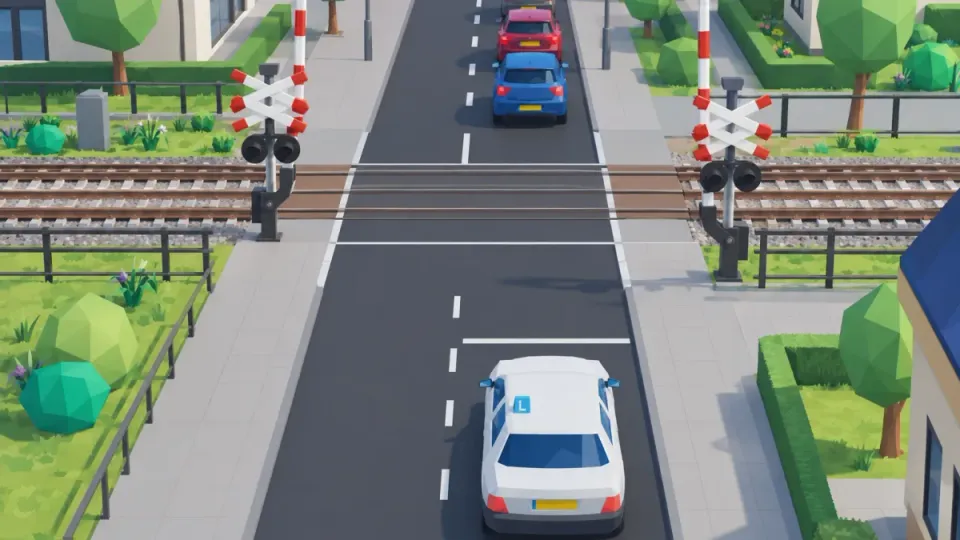
❌ Wrong: following a queue onto the tracks. ✅ Right: if there is no room beyond the tracks, you wait before the crossing.
❌ Wrong: driving on at flashing red because there are no barriers. ✅ Right: flashing red means stop, with or without barriers.
❌ Wrong: driving off as soon as the first train has passed. ✅ Right: wait until the lights are off. Another train may come.
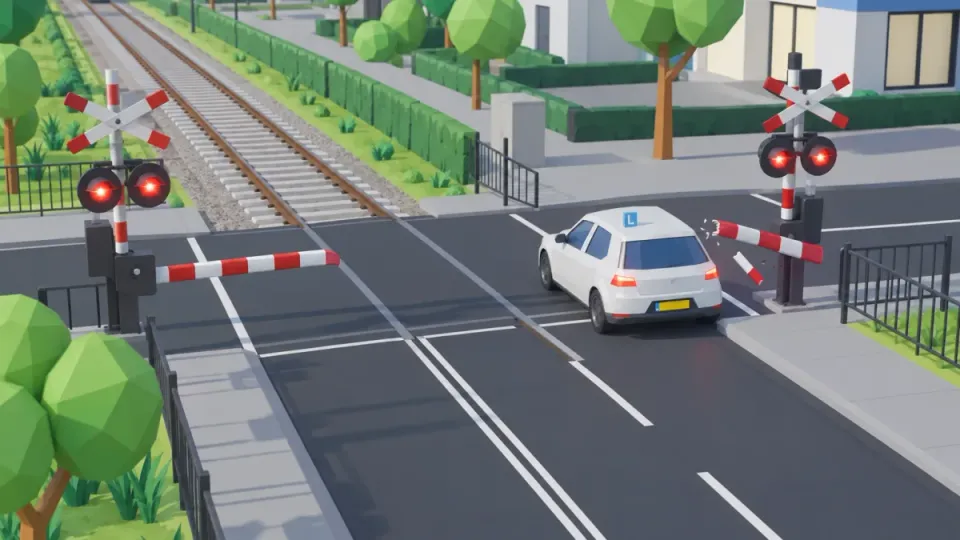
❌ Wrong: staying put between the closed barriers. ✅ Right: drive on: the barrier breaks off.
Practise like the exam
Example questions like in the CBR exam
Real questions from the Theorio app. You can expect similar questions in your CBR exam.
Question 1 of 4
Which sign indicates that there is a level crossing 80 meters ahead?
Tap the answer you think is right.
How many railways can you expect here?
What does this sign tell you?
Tap the answer you think is right.
The red lights are flashing, but the barriers are still up. May you still quickly cross?
Tap the answer you think is right.
Answers and explanations for the example questions
Question 1: Which sign indicates that there is a level crossing 80 meters ahead?
Correct answer: Sign A
One stripe means you are 80 meters approaching the level crossing. Two stripes mean 160 meters distance. Three stripes mean 240 meters distance.
Question 2: How many railways can you expect here?
Correct answer: Correct value: 2 pieces
Count the number of crosses; you see two. So you can expect two tracks where a train can pass. Be extra alert here! 🚂
Question 3: What does this sign tell you?
Correct answer: There are two or more tracks
This is sign J13, a double St Andrew’s cross. It stands at a level crossing with more than one track, so after one train another may come.
Question 4: The red lights are flashing, but the barriers are still up. May you still quickly cross?
Correct answer: No, you stop and wait until the lights are off
Flashing red lights at a level crossing mean: stop. The barriers are about to come down and the train can arrive quickly.
FAQ
Frequently asked questions
Short answers to questions that often come up on this subject.
What does a double St Andrew's cross at a level crossing mean?
A double St Andrew’s cross (J13) warns of two or more tracks. Another train may follow the first. At a protected crossing, wait until red lights are off and any barriers are fully open. Also check that you can completely clear the crossing before entering.
What should you do if the barriers close while you are still on the level crossing?
Keep driving, even if that means going straight through a barrier. ProRail says the barriers are meant to break off. A broken barrier is far less serious than a collision with a train.
How high is the fine for driving through flashing red lights at a level crossing?
In a car €320 (offence code R 608), plus €9 administration costs. Driving onto a level crossing when you cannot get off it straight away costs the same (R 340 a).
Ready to practise?
Test your knowledge of Traffic Signs, Signals & Directions with 90 practice questions in the app.
Every CBR sign · start for free
Your first quiz is free, no account needed. After that from €34.99 for 90 days of access.