Priority in traffic is based on a fixed order of rank. In the CBR exam you must apply the rules between drivers, pedestrians and special vehicles flawlessly.
Priority & Special Road Users at a glance
CBR Order of Priority of Traffic Rules
At an intersection, there is always a strict hierarchy. You follow the rules in this fixed order, from highest to lowest.
1. Instructions from authorized persons: Traffic controllers and the police come above all signs and rules.
2. Traffic lights: Light signals take priority over traffic signs and road markings.
3. Traffic signs and symbols: Priority signs and haaientanden take priority over general rules.
4. General traffic rules: On equivalent intersections, traffic from the right has priority.
In priority questions on the CBR exam, do not guess; check in a fixed order: first traffic lights, then priority signs and markings, and only then the standard rules.
If there is no regulation, the usual rule is: drivers from the right have priority. On the same road: straight on goes before turning traffic, and the short turn goes before the long turn.
Basic Priority Rules & Equivalent Intersections
What is an equivalent intersection?
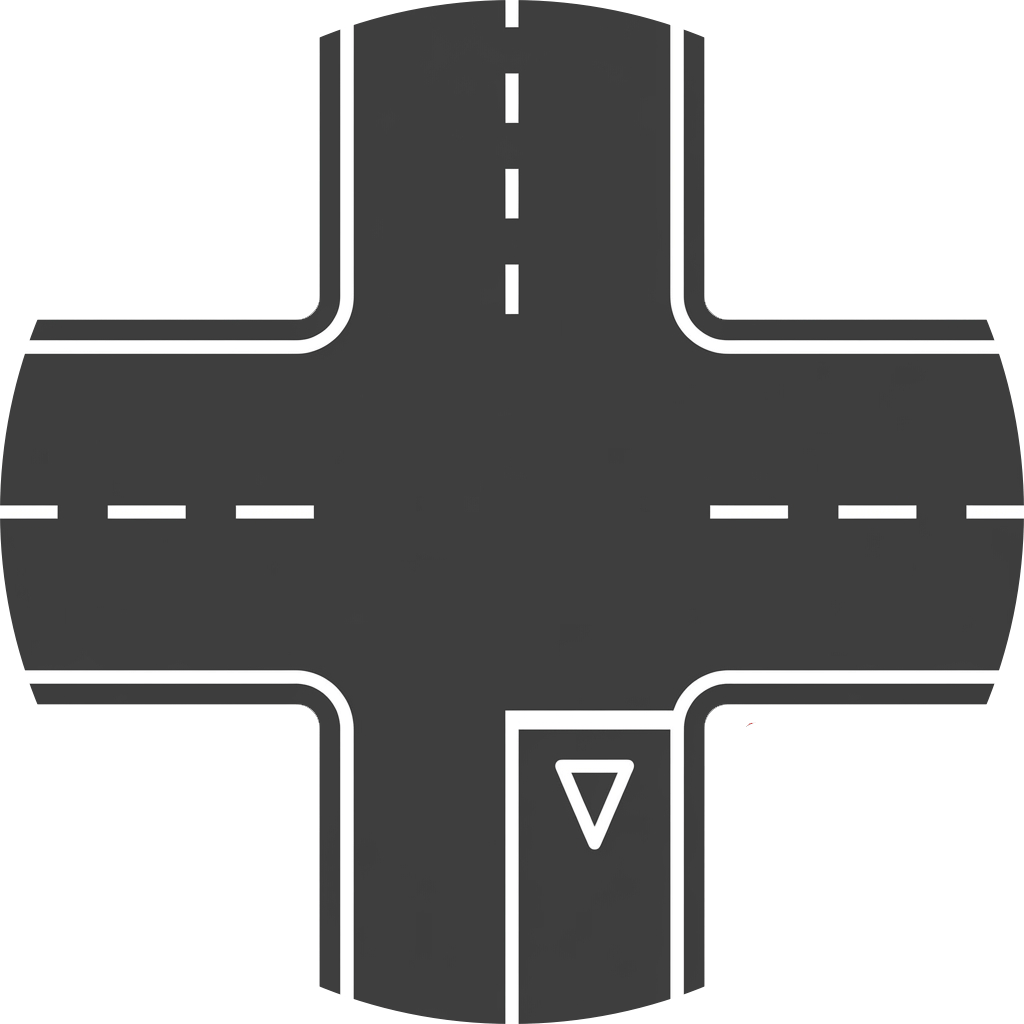
An equivalent intersection has no priority signs, haaientanden or traffic lights. At this intersection, the main rule always applies: traffic from the right has priority.
The 3 CBR main priority rules
At an equivalent intersection, you apply three fixed rules in a strict order.
1. Drivers from the right: Give priority to all drivers approaching from the right.
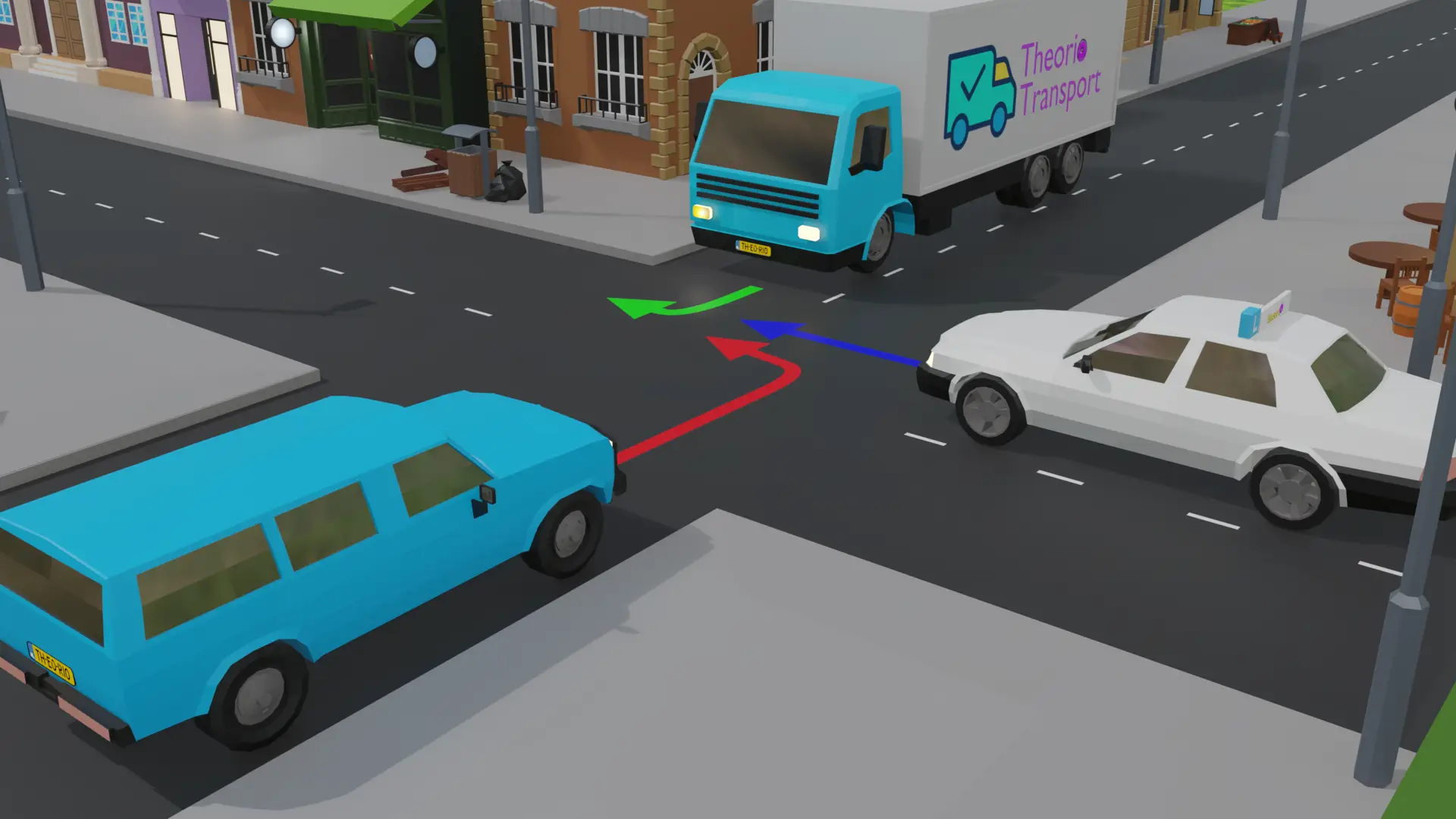
2. Straight ahead on the same road: Traffic going straight on the same road has priority over turning traffic.
3. A short turn goes before a long turn: Drivers turning right have priority over drivers turning left.
The step-by-step plan: from sign to rule
Those three main rules only apply if the signs and symbols say nothing. That’s why, in the exam, you solve every priority question using the same step-by-step plan — and always in this order.
Step 1 — Follow the signs and symbols. First check who has a priority sign, a stop sign or haaientanden. If everything is clear from that, you’re done.
Step 2 — Drivers from the right go first. If the signs don’t regulate it, then look at who is coming from the right. If nobody is coming from the right, you’re all driving on the same road — go to step 3.
Step 3 — Going straight goes before turning; a short turn goes before a long turn. If someone goes straight on the same road, they may go first. If you both want to turn, then the short turn (right turn) goes before the long turn (left turn).
Never jump from step 1 to step 3. Drivers from the right always come before drivers on the same road. If you skip step 2, the order will almost always come out wrong.
And remember: priority must be given to you, not taken. Even when it’s your turn, keep checking whether the other person actually gives you that priority.
A warning sign is not a priority sign
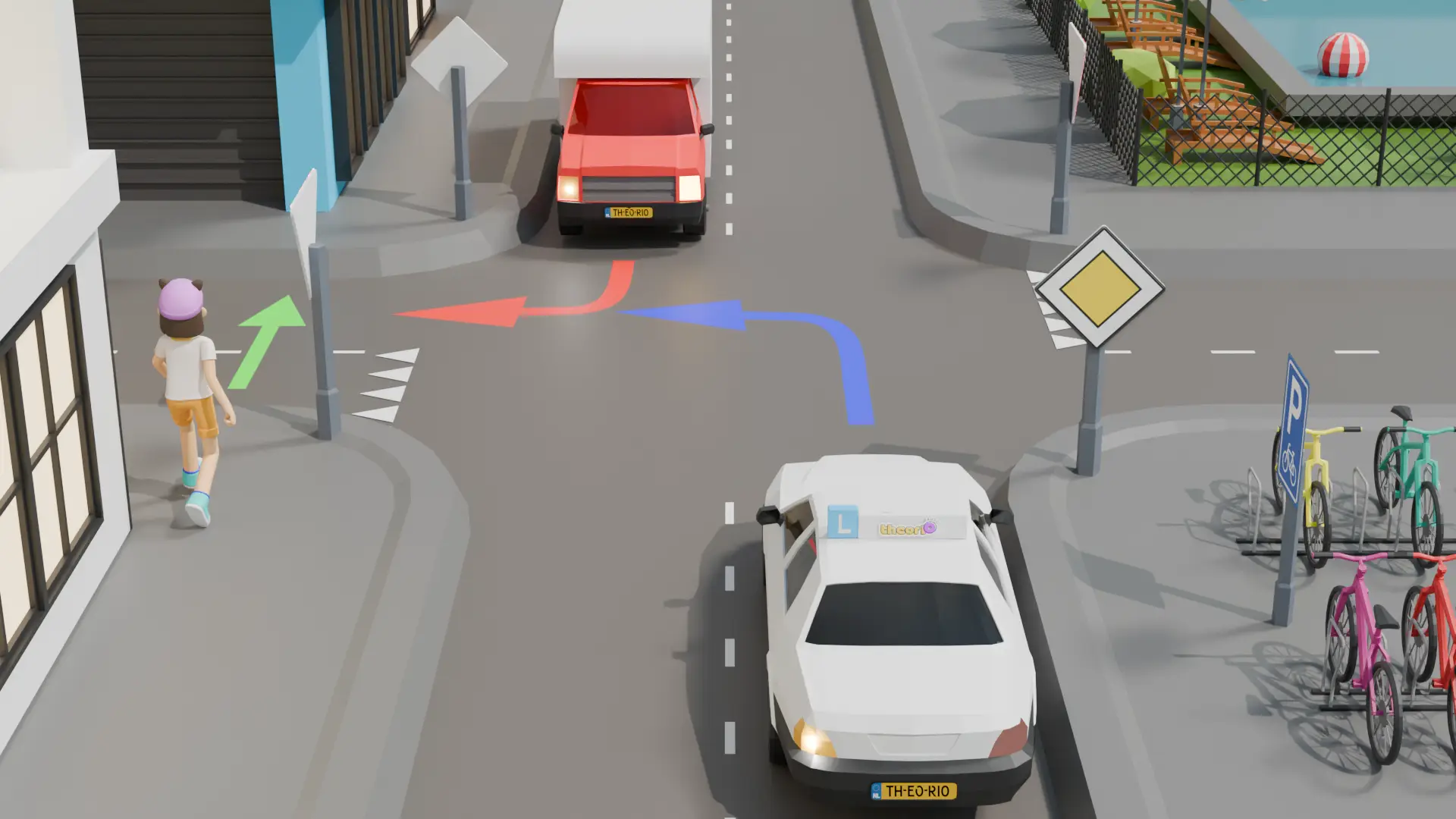
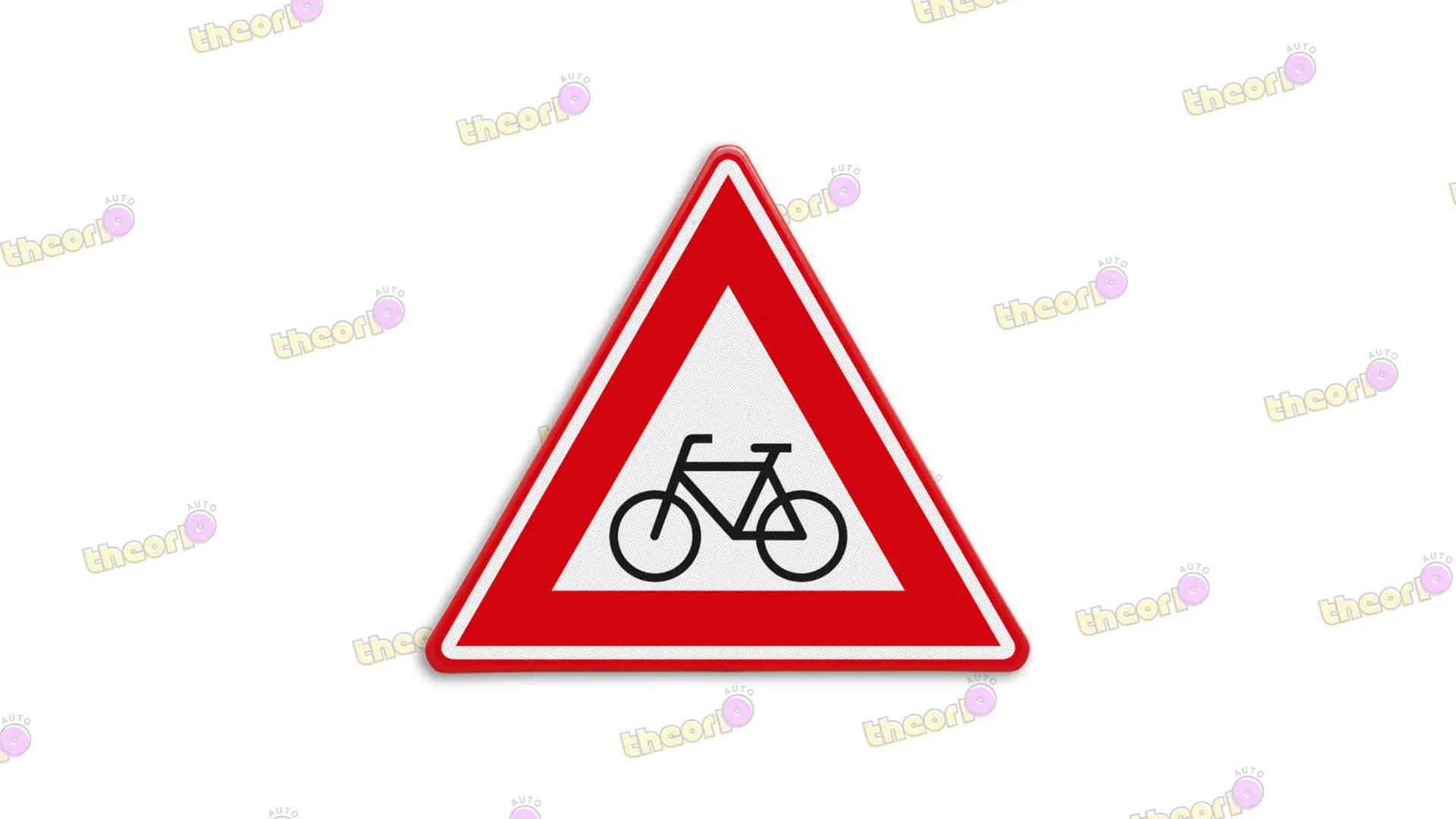
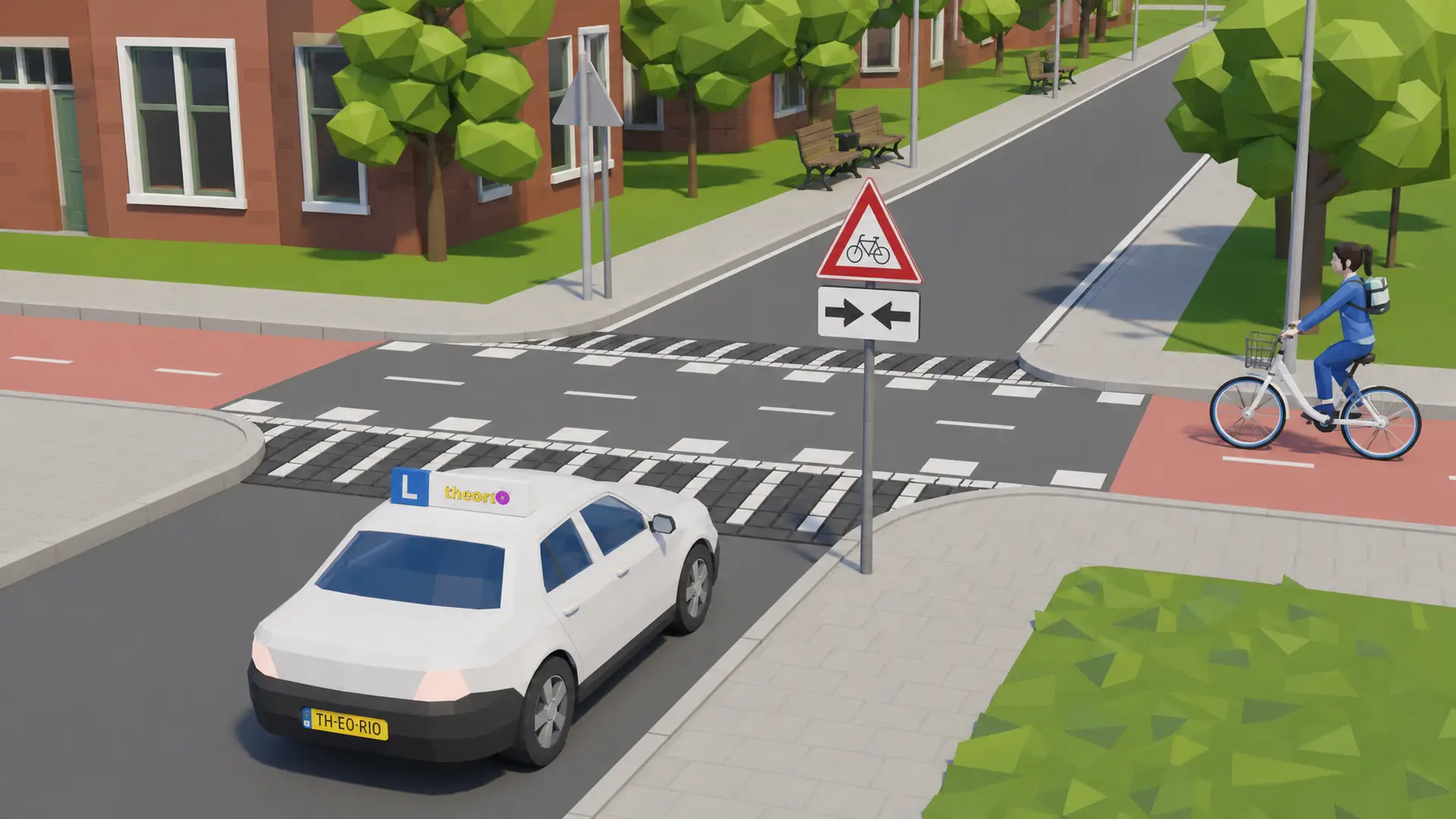
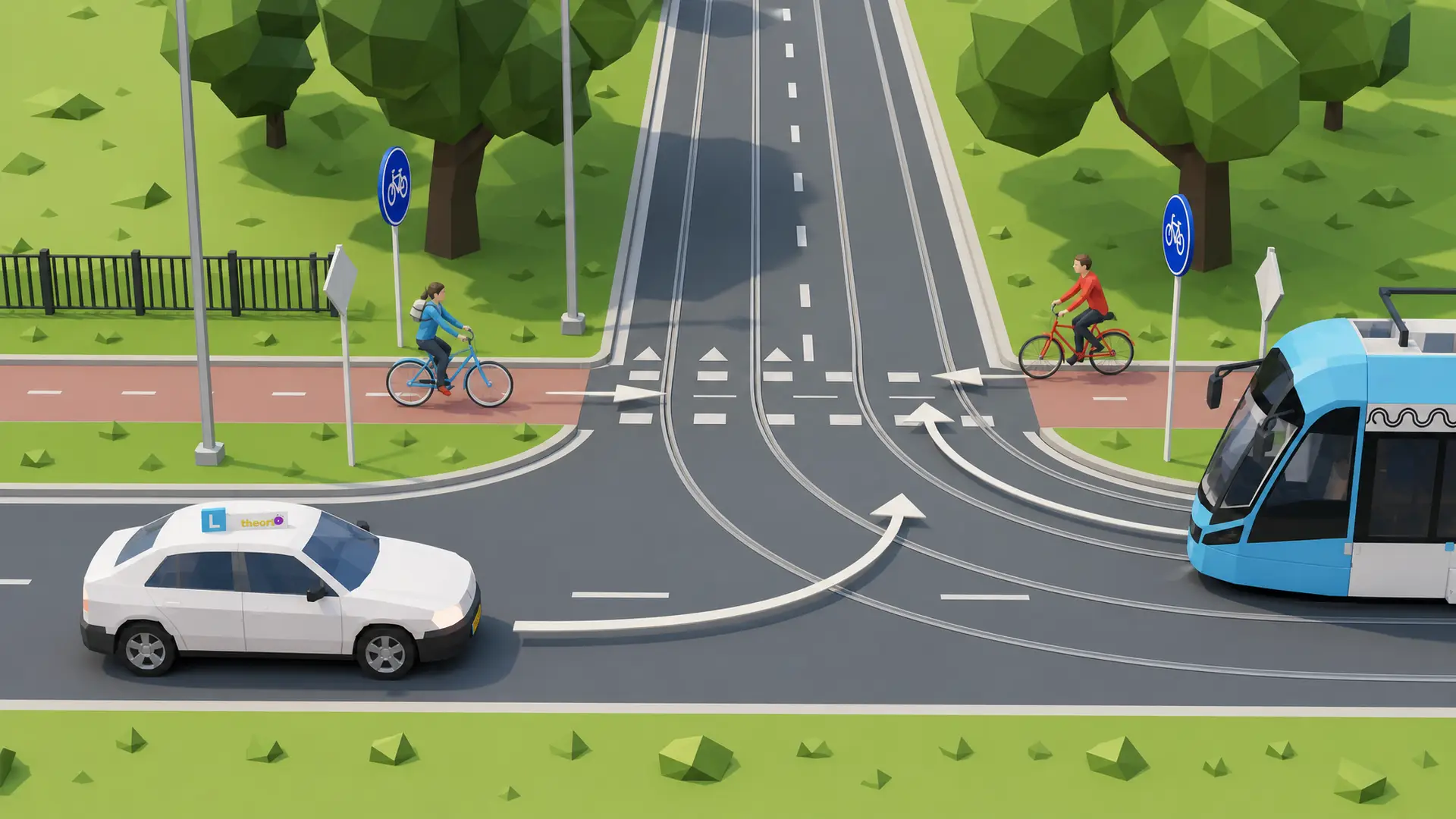
In step 1, you look at signs that regulate priority. A triangular warning sign does not do that. A sign warning you about an intersection with a cycle path only means: watch out, cycle traffic from the left and right. It says nothing about who is allowed to go first.
The same applies to lines on the road surface that look like piano keys: they warn you about a speed bump, not about priority.
So if there is only such a warning sign, you simply continue to step 2. If the cyclist comes from the right, then you give priority.
No priority sign in sight: the warning sign and the speed bump markings regulate nothing. Go to step 2.
The difference between drivers and pedestrians
Legally, pedestrians are not drivers. At an equivalent intersection, pedestrians from the right have no priority.
Cyclists, snorfiets riders and riders are drivers. At an equivalent intersection, they do get priority from the right.
Pedestrians do have priority when they are walking straight ahead on the same road as a turning car.
The cycle path next to the road counts as the same road
In step 3, everything depends on the question of what “the same road” is. A cycle path that runs next to the carriageway is part of it — even if there is a verge in between.
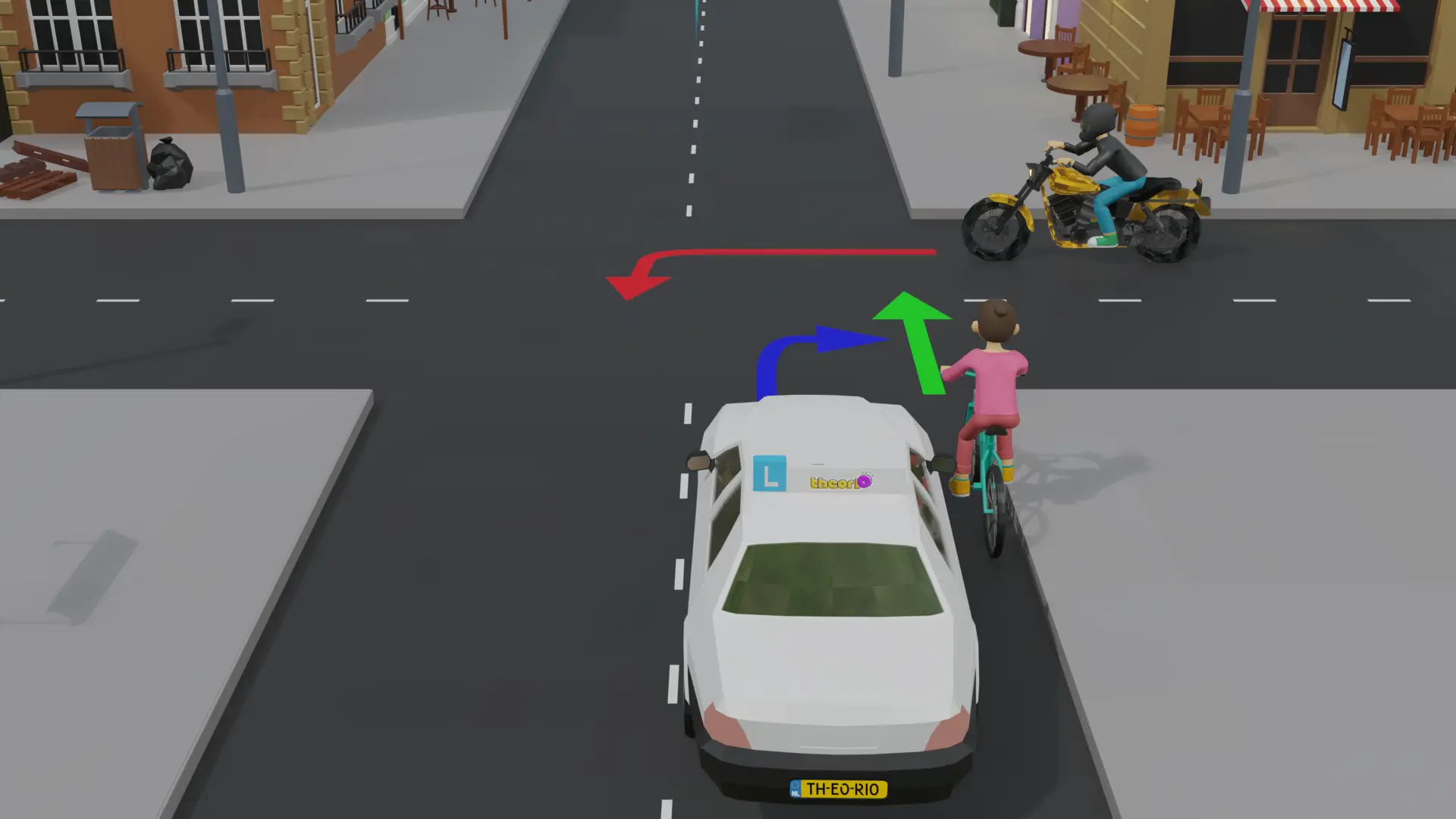
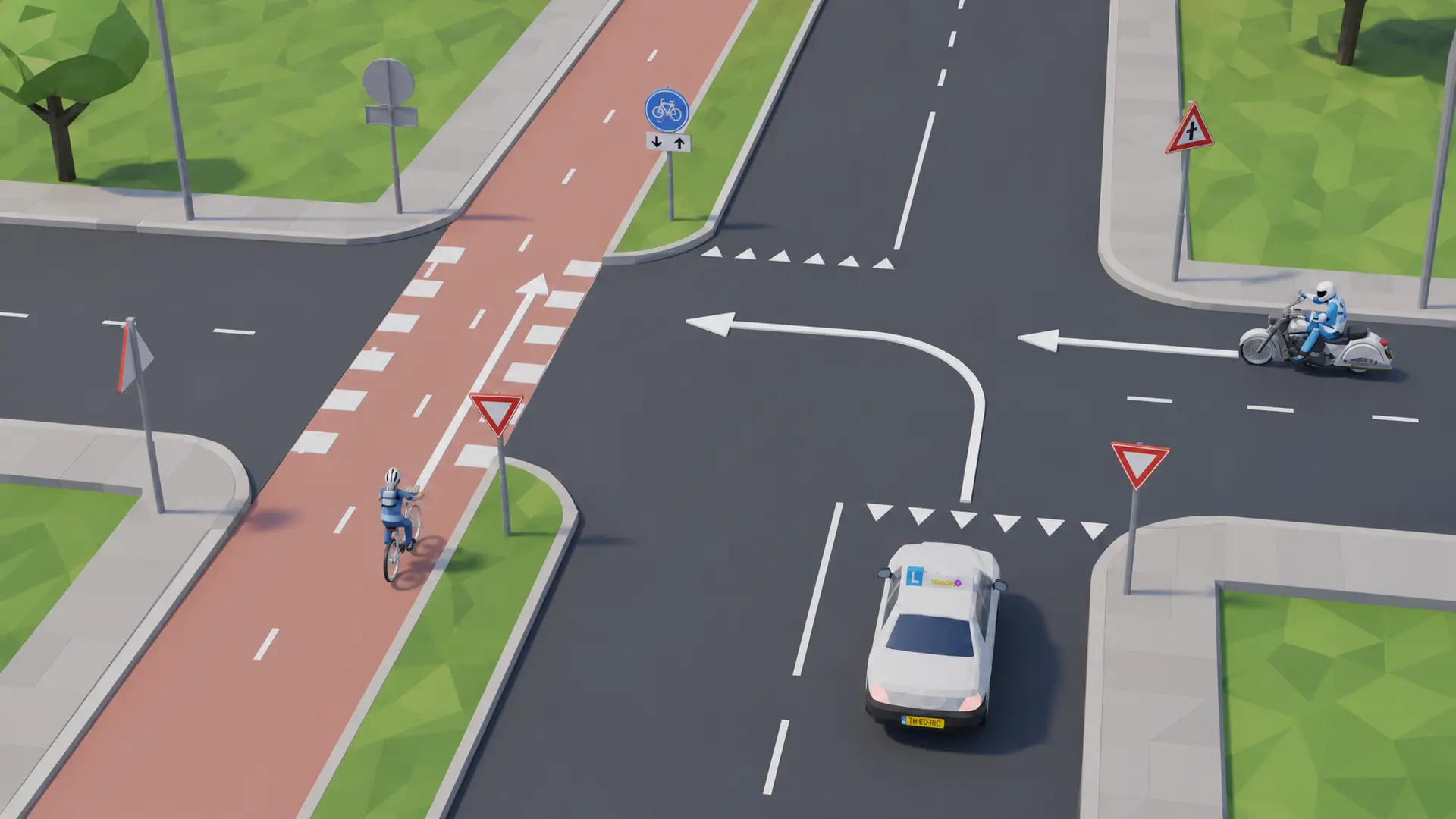
So if you turn, you must check whether there is a cyclist going straight ahead next to you. They are going straight ahead on the same road and therefore have priority over you.
A verge in between changes nothing: the cycle path is part of the same road, so going straight goes before turning.
Comparison table: Priority rules
Road user from the right
Is it a driver?
Priority at an equivalent intersection?
Cyclists and e-bikes
Yes
Yes, give priority
Snorfiets riders and moped riders
Yes
Yes, give priority
Riders and handlers of livestock
Yes
Yes, give priority
Pedestrians and pedestrians with a dog
No
No, no priority from the right
People on a riding track or inline skates
No (pedestrian)
No, no priority from the right
Driver of a brommobiel
Yes (counts as a motor vehicle)
Yes, give priority
Tram
Yes
Always priority, also from the left
When you may ignore the signs
Don’t just look at the sign you have; also think about which sign the other person has. You can often figure that out directly.
If you have a stop sign, then the oncoming traffic on the same road has it too. In that case, your signs are the same and cancel each other out: you can ignore them and the standard priority rules apply again. The one going straight ahead on the same road may go first.
The general rule: if two drivers are on the same road, they usually have the same signs and symbols — and then those signs do not count against each other.
There is one situation where it’s different: at a turning priority road. Then it can happen that you and your oncoming traffic have different symbols, while the driver from the right has exactly the same haaientanden as you. On the sub-sign you can see with a thick line which road is the priority road; the thin dashes are the roads with haaientanden. If nobody is driving on the priority road and you and the other person both have haaientanden, then the standard rules apply — and the driver from the right goes first.
If the traffic lights don’t work
Traffic lights take priority over signs and symbols on the road. But that only applies as long as they are working.
Are the lights off, flashing yellow/orange or defective? Then they don’t apply, and you fall back on the signs and symbols on the road. If there aren’t any either, then it’s still an equivalent intersection and traffic from the right goes first.
Example situation: The Triangle of the Right
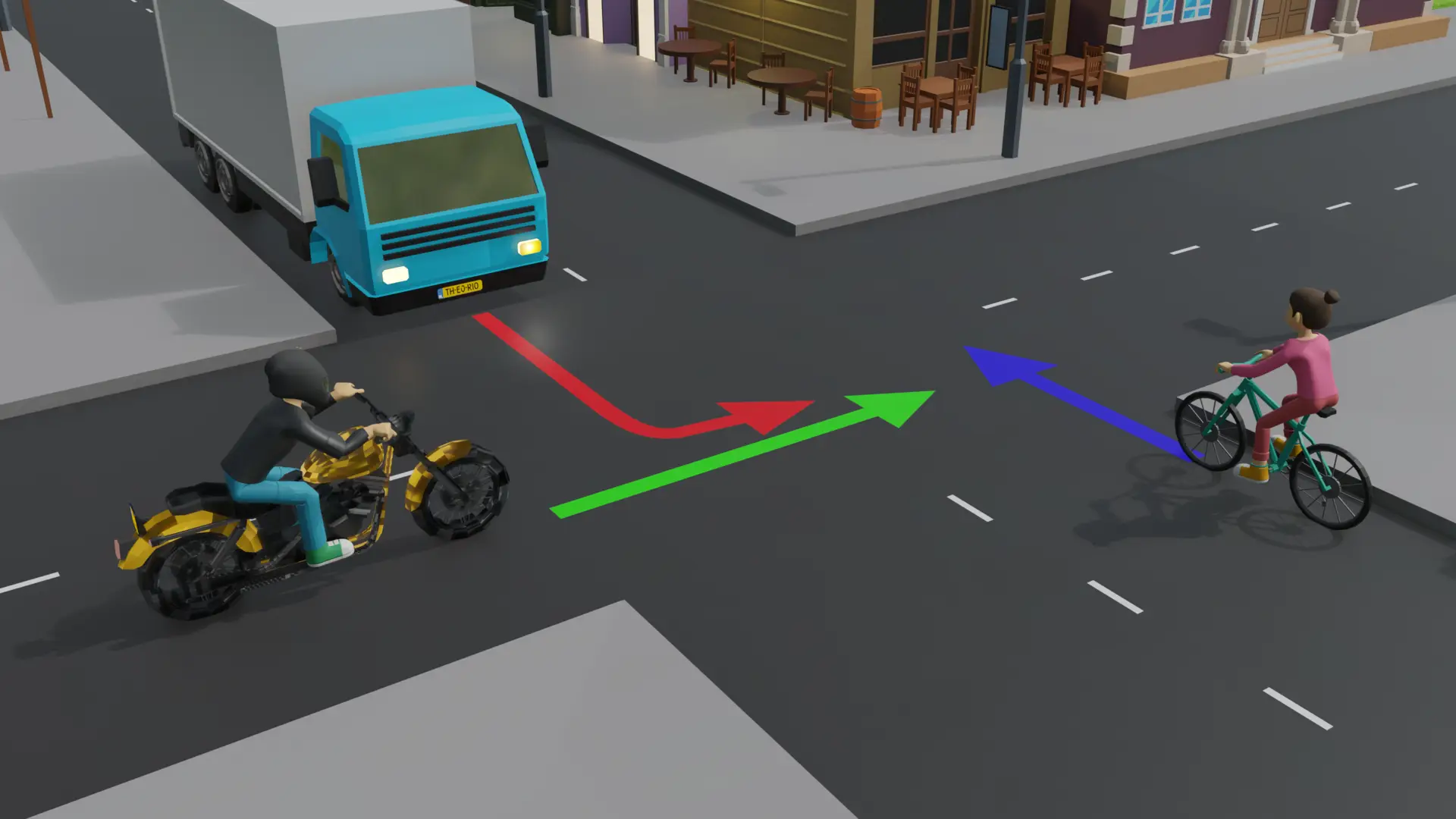
If three drivers approach each other from the right, a blockage forms. The driver who does not have obstructed traffic from the right may drive first.
Find the one who comes the most from the right
A variation that often comes up in the exam: the driver from the right also has someone on their right side.
Suppose: a motorcycle comes from the right relative to a lorry, and a cyclist comes from the right relative to that motorcycle. Nobody comes from the right of the cyclist anymore. Then the cyclist may go first, then the motorcycle, and the lorry last.
So the trick is: find the driver who no longer has anyone coming from the right. That one starts, and from there you work back.
Order: first the cyclist (nobody from the right), then the motorcycle, then the lorry.
Frequently asked questions (FAQ)
Does a cyclist from the right have priority?
Yes, a cyclist is a driver. At an equivalent intersection, you give priority to a cyclist from the right.
Does a pedestrian from the right have priority?
No, a pedestrian is not a driver. At an equivalent intersection, a pedestrian from the right does not get priority.
What does going straight ahead on the same road go before mean?
Traffic that continues straight ahead on the same road has priority over turning traffic. This also applies to pedestrians.
Do traffic signs still count if the traffic lights are off?
Yes. Switched-off, flashing yellow or defective traffic lights do not apply. Then you follow the signs and symbols on the road; if there aren’t any, then it’s an equivalent intersection.
You've covered Basic Priority Rules & Equivalent Intersections. Does it stick?
For priority questions in the CBR exam, use a fixed order: first traffic lights, then priority signs and road markings, and only then the standard rules.
If there is no regulation, at an equal junction the rule is: traffic from the right goes first, straight ahead on the same road goes before turning traffic, and the short turn goes before the long turn.
What are priority signs and symbols?
Priority signs and road markings indicate who has priority at an intersection. They override the standard rule traffic from the right has priority.
The most important priority signs in the exam
In the CBR exam you must recognize the meaning of each priority sign immediately.
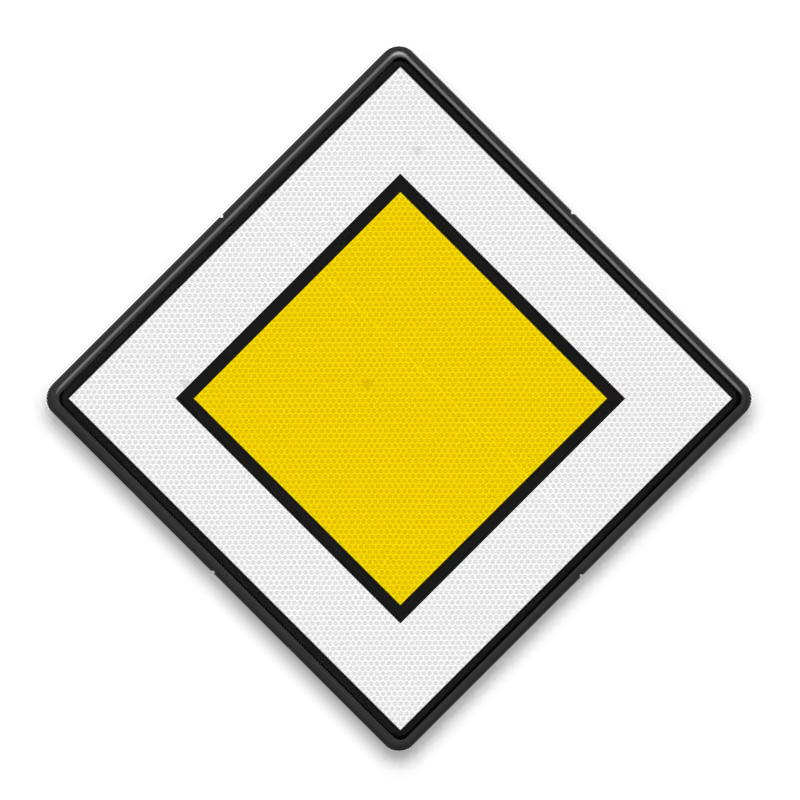
Sign B1 (Priority road): You are driving on a priority road. You have priority over drivers from side roads.
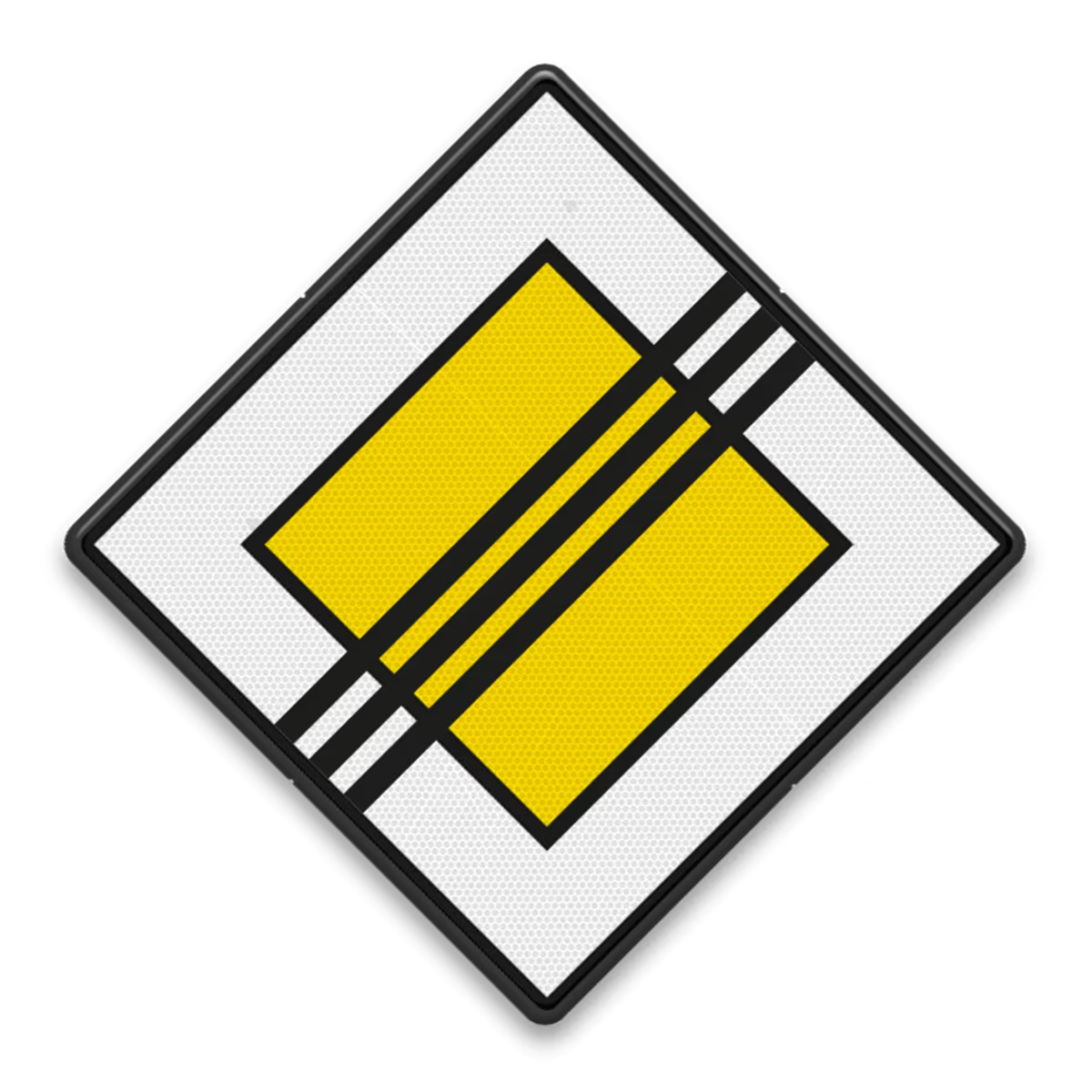
Bord B2 (End of priority road): The priority road ends. You must again take traffic from the right into account.
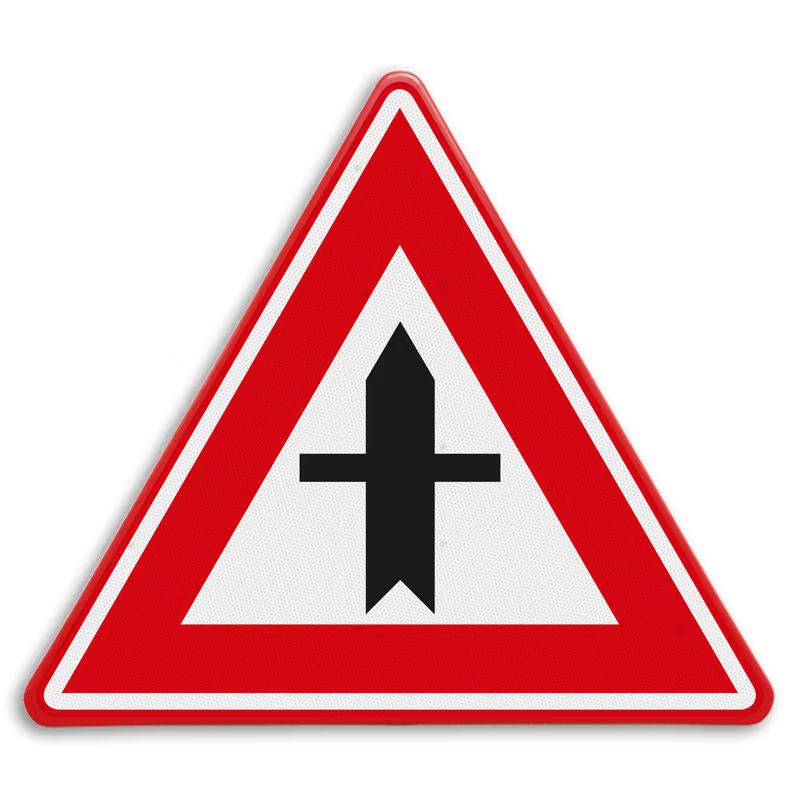
Bord B3 (Priority intersection): You are approaching an intersection where you have priority over drivers from side roads.
Bord B6 (Give priority): Inverted triangle. You must give priority to drivers on the intersecting road.
Bord B7 (Stop sign): You must stop for the stop line. Give priority to drivers on the intersecting road.
Memory aids for the four priority signs
At a priority intersection you come across four priority signs: with two of them you must give priority, and with two of them you get priority.
Give — B6: the inverted triangle has exactly the shape of a haaientand, just like the symbols on the road surface. Sign and haaientanden mean the same thing: give priority to drivers from the left and right on the intersecting road.
Give — B7: the stop sign speaks for itself. The only difference from haaientanden is that here you must always stop physically, even if you think nobody is coming. Such a sign is usually there because the intersection is not easy to see.
Get — B1: the cheerful yellow sign looks a bit like an egg — you can eeeeiably drive on nicely. Other drivers give you priority at every intersection, until the priority road ends.
Get — B3: the thick arrow is the main road, the thin dashes are the side roads that connect to it. The thick line goes above the thin one: you have priority over traffic coming from the side roads.
Pay attention to the stop line itself: it only indicates where you must stop, and means nothing else. You can also see it under traffic lights, where you simply drive on when it’s green. Only the stop sign means stop.
Haaientanden on the road
Haaientanden are white triangles on the road surface. They require you to give priority to drivers on the intersecting road.
Haaientanden only apply to drivers. Pedestrians on the intersecting road do not get priority from haaientanden.
Haaientanden or piano keys?
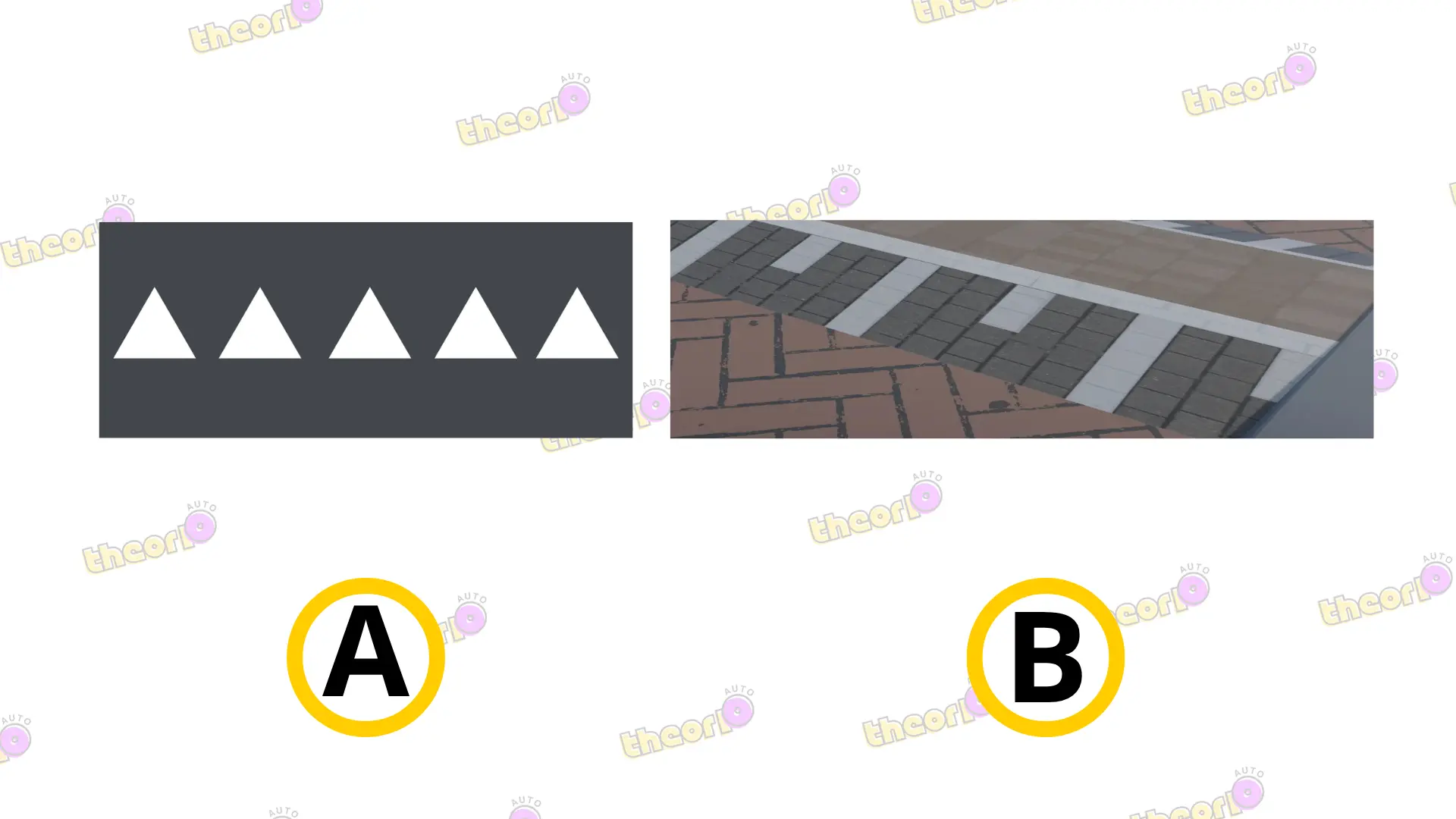
There is one type of line on the road surface that is often confused with haaientanden: wide white blocks that, with a bit of imagination, look like piano keys. They have nothing to do with priority — they only warn you about a speed bump.
Sign J38 (Traffic speed bump): belongs to the piano keys on the road surface. A speed bump, not a priority sign.
The difference: haaientanden are triangles with the point facing you, across your lane. Piano keys are rectangular blocks and are usually placed in the length direction of the speed bump.
Haaientanden on the left (give priority), piano keys of a speed bump on the right (no priority sign).
The difference between an exit and an intersection
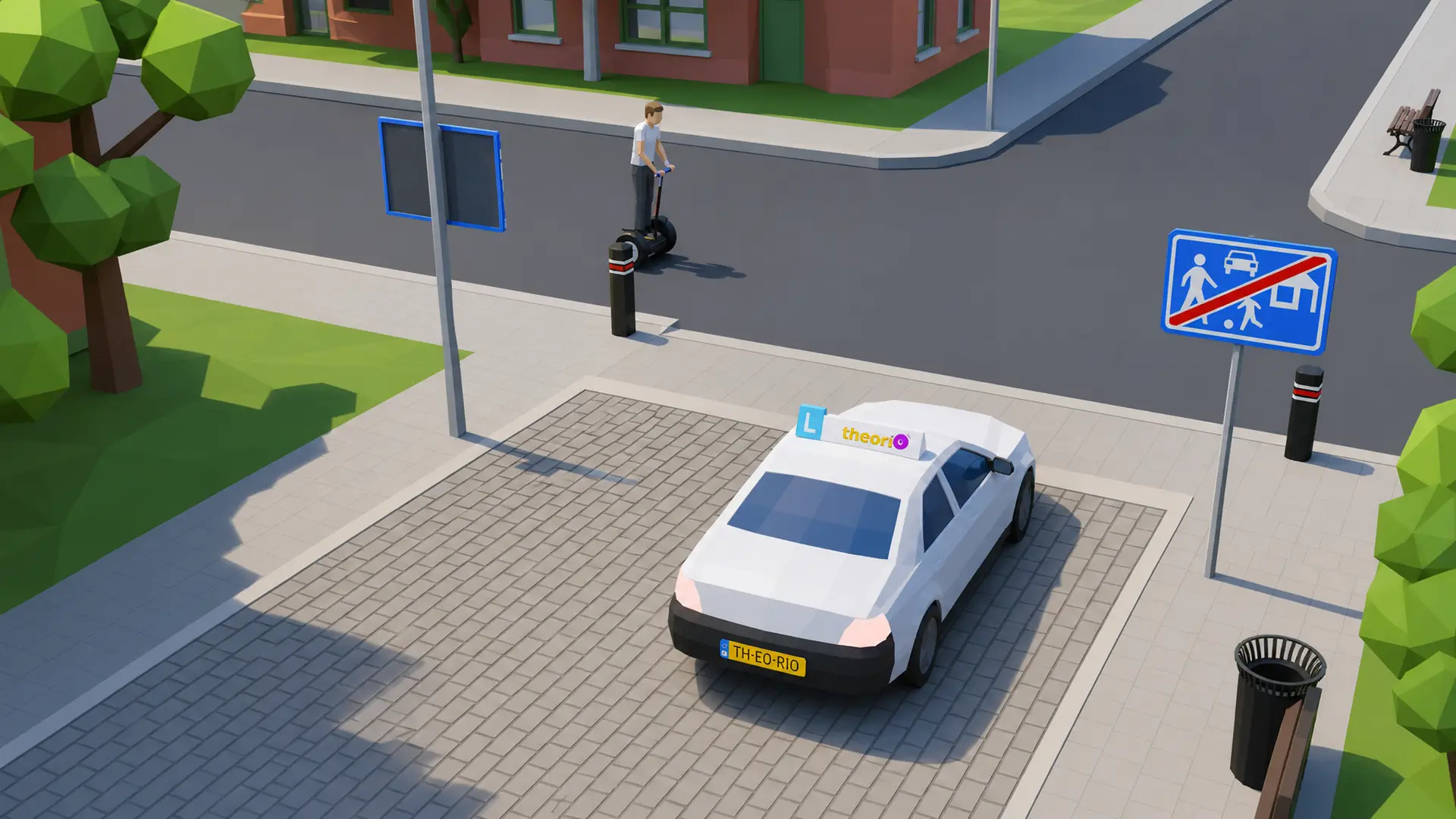
Exiting an exit area is a special manoeuvre. You must let all traffic go first, including pedestrians.
You recognize an exit by a continuous pavement or an entrance strip. An equivalent intersection has no continuous structure.
Not every exit has a lowered kerb edge
The lowered kerb edge is the clearest feature, but it is not mandatory. If that structure is missing, it is not an exit and the normal priority rules apply. So always look at the road surface itself and not only at the small sign at the gate.
First out, then in
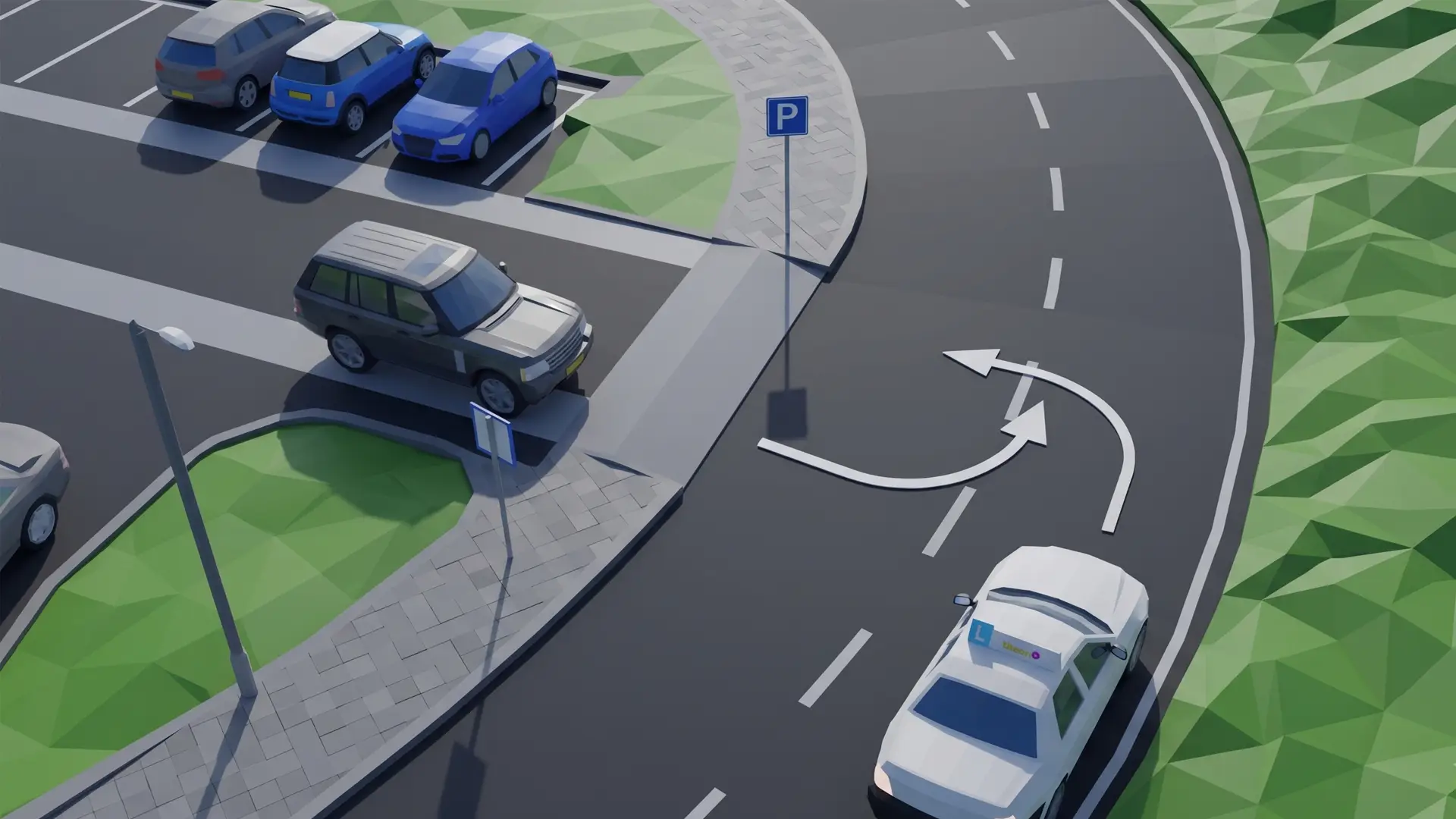
Is an exit narrow and a car is coming out while you want to drive in? Then let that car go first. This gives it space to leave the exit area, and then you have space to drive in yourself. The principle is simple: first out, then in.
First out, then in: going in and out at the same time doesn’t work.
From an unpaved road to a paved road
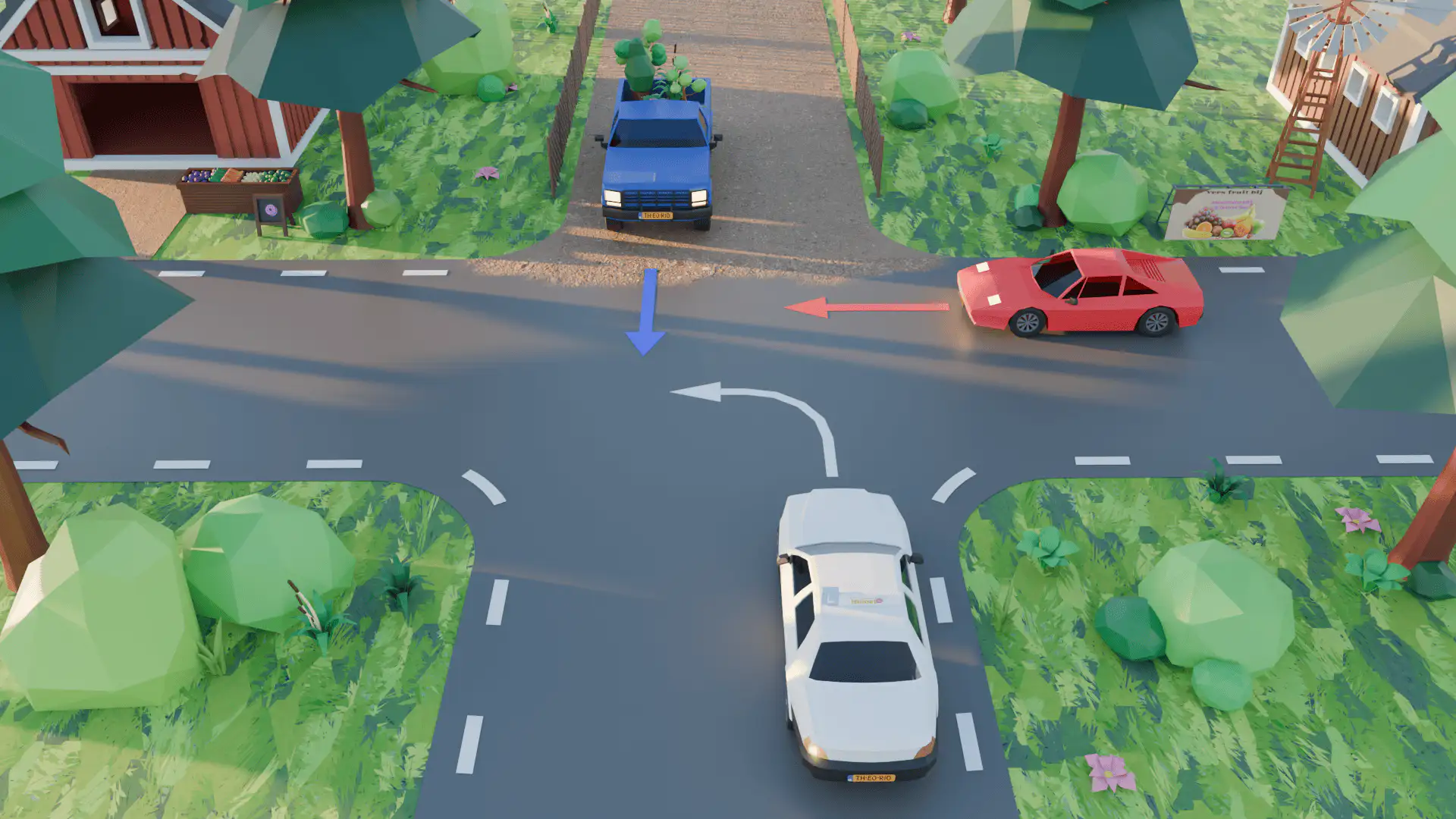
A driver on an unpaved road must give priority to all drivers on the paved road.
This rule only applies to drivers. Pedestrians on the paved road do not get priority from the unpaved road.
Imagine invisible haaientanden
We speak of an unpaved road when there is no hard layer: no asphalt, tiles or concrete, but sand or gravel. You usually recognize it immediately by its brown, sandy colour.
The most useful memory aid: imagine that when leaving an unpaved road there are always haaientanden. Then all the rules automatically match — left or right doesn’t matter, you give priority to all drivers on the paved road.
And because those haaientanden are imagined, they apply just as little to pedestrians as real haaientanden. Against a pedestrian you simply apply the standard rule: if you see their belly or back, ease off; if you see them from the side, accelerate.
If you and another driver are both coming from an unpaved road and nobody is driving on the paved road, then you have the same (imagined) sign and the standard priority rules apply again between you.
Road narrowing and priority
With a road narrowing, traffic signs or arrow markings determine who may drive first.
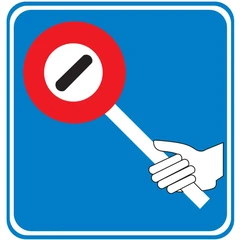
Sign F5 (Round red border with red and black arrow): You must let oncoming traffic go first.
Bord F6 (Blue square with white and red arrow): You have priority over oncoming traffic at the narrowing.
Road narrowing without signs
Not every road narrowing is deliberately created. Sometimes it arises because of a parked lorry or a car with a breakdown. Then there are no signs, and one simple rule applies:
If the obstacle is on your half of the road, you wait. If it is on the other side of the road, then you have priority and the oncoming traffic waits.
The obstacle is on this half of the road, so this driver waits for the oncoming traffic.
Red must wait
If there are signs, then in advance it has already been determined who may go first. You can read both signs using the same trick: red must wait.
Round sign with red border (F5): you are the red arrow and must wait for the black arrow. So you must give priority.
Square blue sign (F6): the white arrow is your car, the oncoming traffic is the red arrow. You may go first.
Note — these are the only two priority signs that also apply to pedestrians. With all other priority signs and with haaientanden, it’s purely about priority between drivers, but with a road narrowing you give priority to or get priority from all road users.
And one more practical point: if oncoming traffic is already halfway through the narrowing, then you wait until the road is clear — even if you formally have priority.
Comparison table: Exit vs Equivalent Intersection
Feature
Exit / Entrance construction
Equivalent intersection
Who must you let go first?
All traffic (drivers and pedestrians)
Only drivers from the right
What action do you take?
Special manoeuvre
Normal participation in traffic
Road surface / construction
Continuous pavement or raised kerb strip
Equivalent street level without interruption
Unpaved road to paved road
All drivers on the paved road, but no pedestrians — imagine haaientanden
Road narrowing with sign F5 or F6
The only priority signs that also apply to pedestrians
Frequently asked questions (FAQ)
Do you always have to stop at a stop sign?
Yes, you must always come to a standstill at a stop sign before the stop line. Even if no other traffic is coming.
Does an exit also apply to pedestrians?
Yes, when enlarging or leaving an exit area you must let all road users go first. So also pedestrians.
Do you have to give priority to pedestrians on the paved road when you are on an unpaved road?
No, the rule for the unpaved road only applies to drivers. Pedestrians are excluded here.
Do priority signs also apply to pedestrians?
No, with two signs excepted. Only the road narrowing signs F5 and F6 also apply to pedestrians. All other priority signs and haaientanden regulate priority between drivers only.
You've covered Priority Signs, Exit & Unpaved Road. Does it stick?
When an emergency vehicle such as police, fire brigade, or ambulance approaches, you must make space safely. For the CBR exam, the key point is that you stay calm, do not accelerate suddenly, and only move aside if it can be done safely.
If you hear a siren or see flashing lights, immediately check where you can safely make room. If there is already enough space, it may actually be best to continue driving calmly so the vehicle can pass easily.
What is an official priority vehicle?
A vehicle is only a priority vehicle if it is emitting optical and sound signals. That means a blue flashing light and a multi-tone siren.
Emergency services include, for example, ambulances, fire engines, police vehicles and vehicles of Rijkswaterstaat.
In short: flashing light and siren = give priority. Such a vehicle then has priority over all traffic — also over a tram, and also if you are driving on a priority road.
How do you act when a priority vehicle is approaching?
Make the road as quickly and safely passable as possible. Move out to the right or drive on calmly if stopping would block the road.
Don’t drive through a red light: Move out only if it can be done safely without ignoring the red light.
Don’t use the hard shoulder unnecessarily: Drive onto the hard shoulder only if the emergency service asks for it.
Stay calm: Don’t make unexpected or dangerous braking manoeuvres.
Making space: what is allowed and what works
If you hear a siren behind you, the first question is not “do I have to stop?” but “where can I go?”.
You may use the cycle path
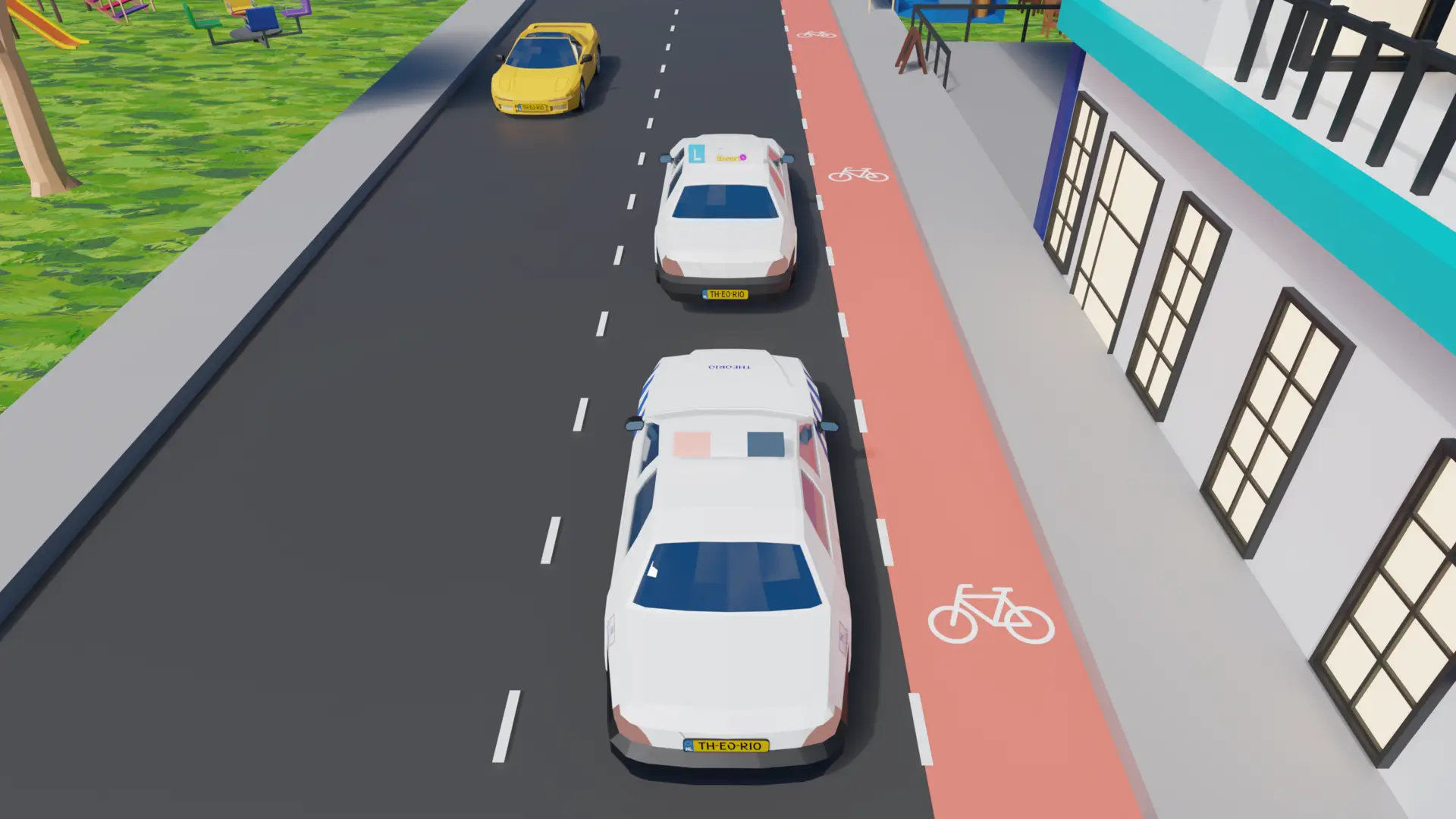
To move aside, you may drive onto the cycle path — even over a continuous line. The condition is that you do not hinder cyclists and you do not put yourself in danger. If there is already enough space to let the emergency service pass, then simply drive on calmly.
Moving aside to the cycle path is allowed, even over a continuous line — as long as you don’t hinder cyclists.
Don’t accelerate
Is there nowhere you can go and is the ambulance behind you? Then don’t drive faster. That’s the reflex of many drivers, but it only creates more risk. Keep your speed and move aside as soon as it’s safe.
To the outer edge of your lane
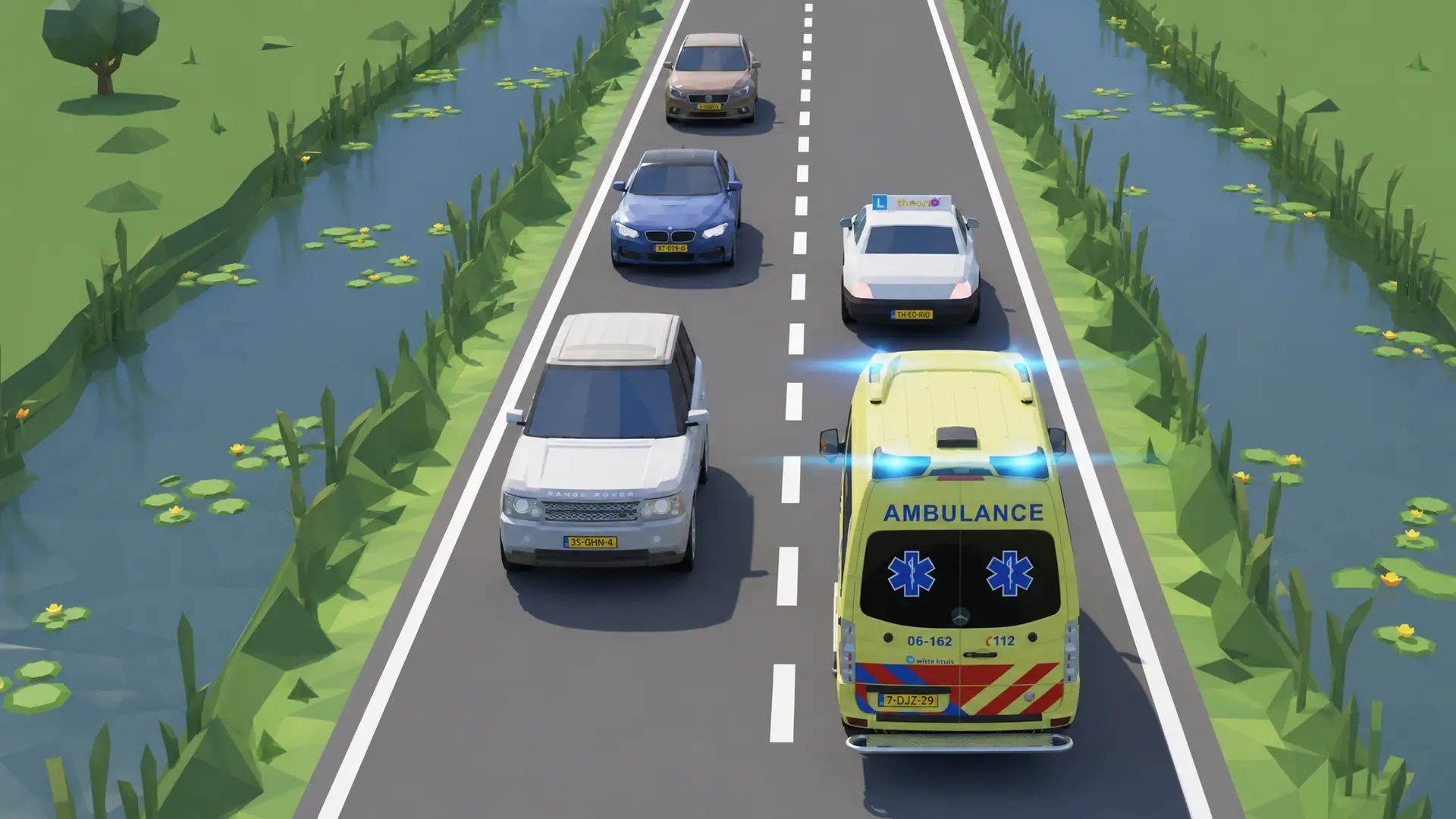
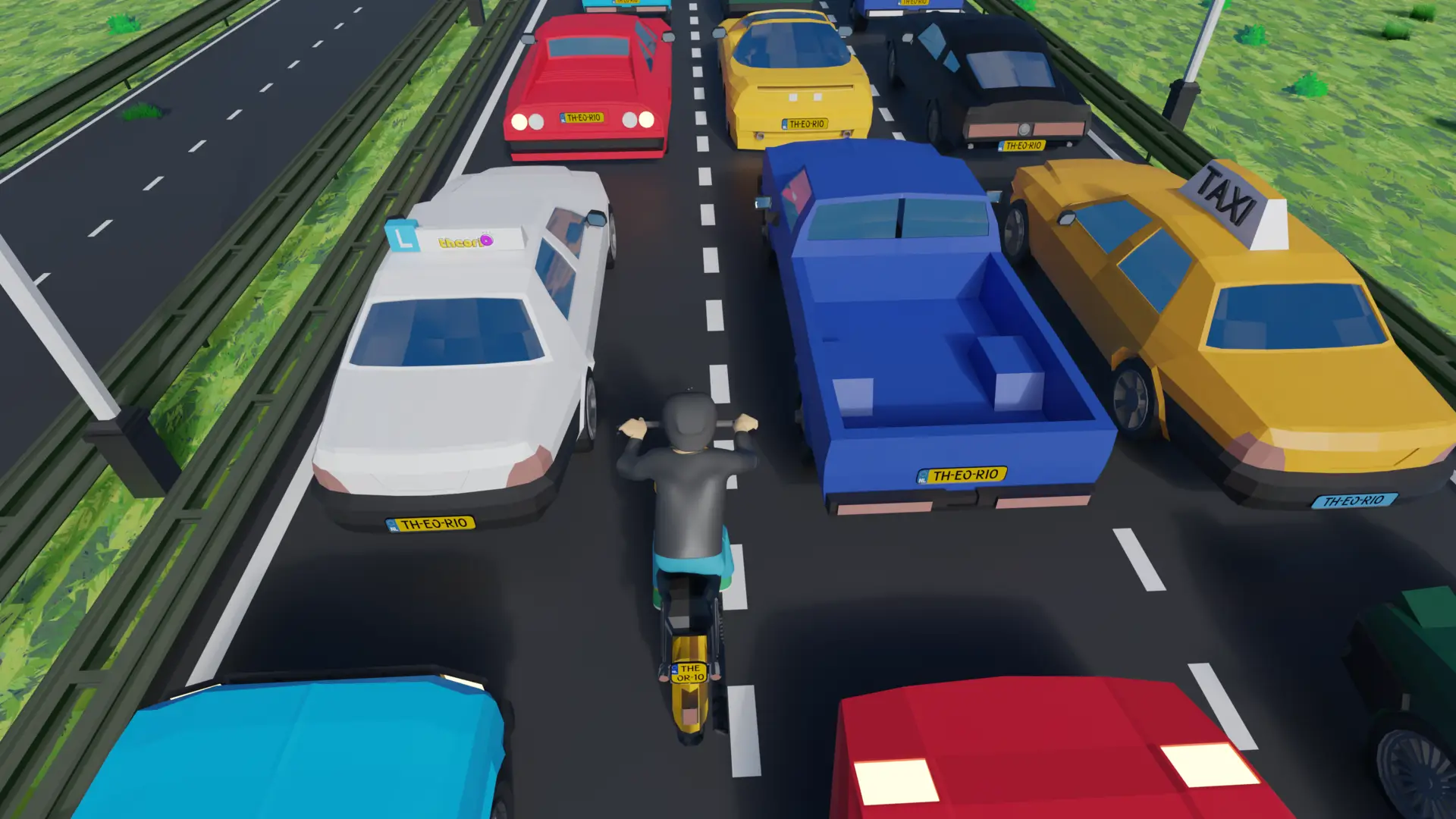
If you are driving on a road with multiple lanes and there is no lane free, then go to the outer edge of your own lane. If everyone does that, a corridor forms in the middle between the two lanes that the emergency vehicle can drive through.
Everyone to the outer edge of their own lane: that’s how space is created in the middle.
Emergency services without optical and sound signals
If an emergency service does not emit a flashing light and siren, it is treated as a normal road user.
In that case, the normal priority rules apply at the intersection. An ambulance without a siren has no special priority.
Sometimes a priority vehicle emits only one of the two signals — for example, it has a flashing light but no siren because it’s at night. Formally, you are then not required to give priority. Still try to do it in practice: that vehicle is not on the way for nothing.
Comparison table: Emergency services and priority
Vehicle and signalling
Is it a priority vehicle?
What must you do?
Blue flashing light + siren
Yes
Give priority immediately and make way
Only blue flashing light (no siren)
No
Normal priority rules (give priority where possible)
Only siren (no flashing light)
No
Apply normal priority rules
No flashing light and no siren
No
Treat it like an ordinary car or lorry
Example situations
Situation 1 — fire engine, cyclist and car
A fire engine with flashing lights and a siren approaches the intersection. A cyclist goes straight ahead on the same road as a car that wants to turn.
Correct order: fire engine → cyclist → car.
Why: a vehicle with both signals always goes first. Then you solve the rest normally: the cyclist goes straight ahead on the same road and therefore has priority over the turning car.
Situation 2 — the fire engine has to wait
A tram approaches; you are driving on a priority intersection with a priority sign and haaientanden in the side road, and from that side road a fire engine without flashing light and siren comes out.
Correct order: tram → you → fire engine.
Why: without signals, a fire engine is just a vehicle like any other. It has haaientanden and therefore must let all drivers on the intersecting road go first.
You've covered Priority Vehicles & Emergency Services. Does it stick?
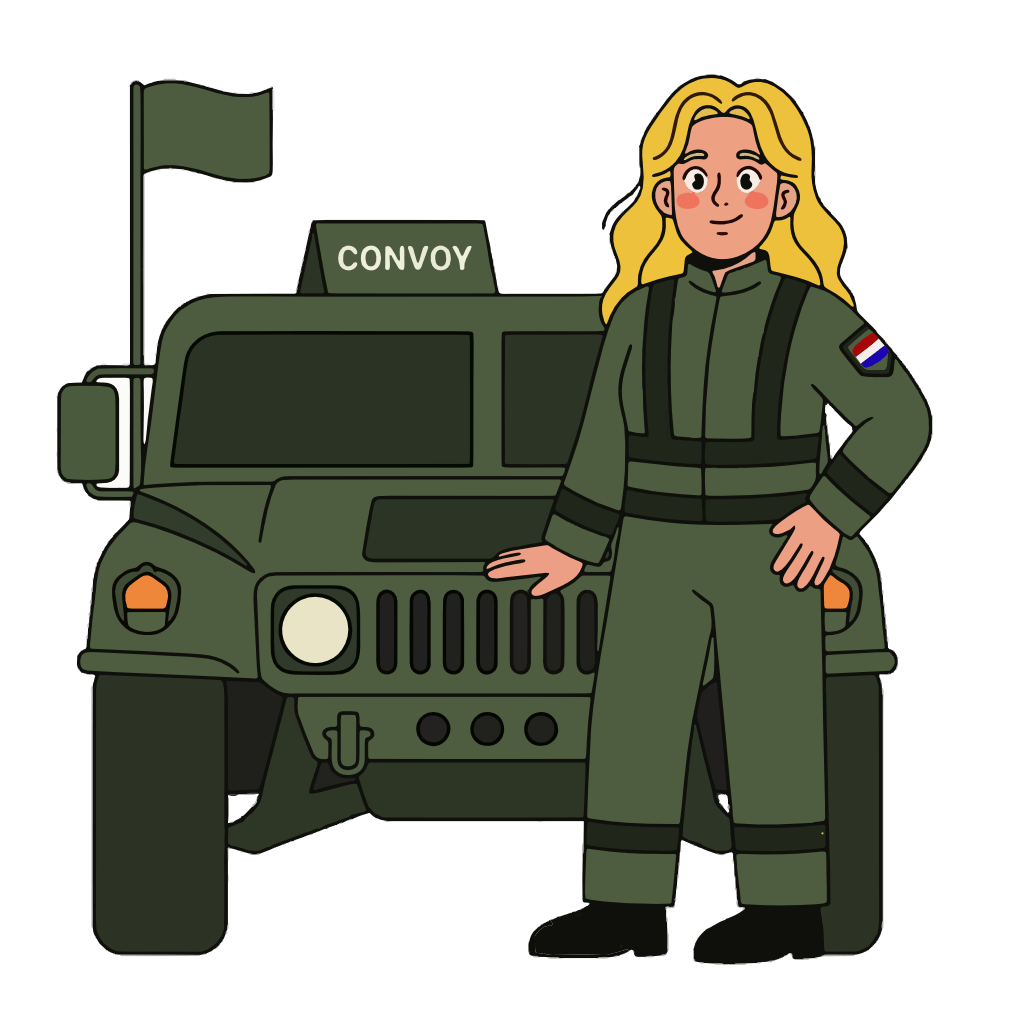
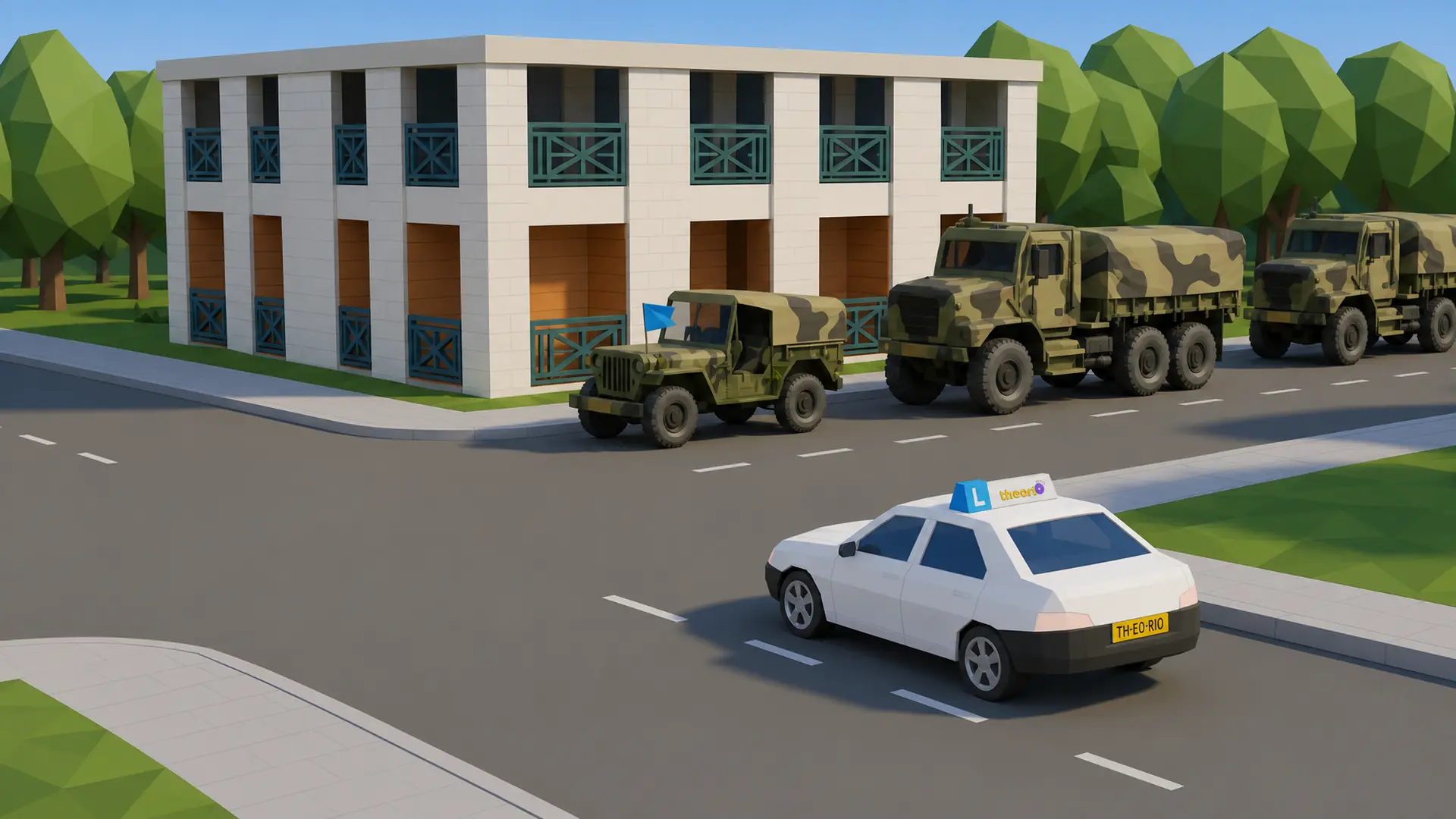
You may not cut through a military convoy at an equal-priority intersection. If the first vehicle has already passed, you must let the entire convoy go first.
For the theory exam, it is especially important that you know the recognition signs: blue at the front, green at the rear.
Priority rules for trams
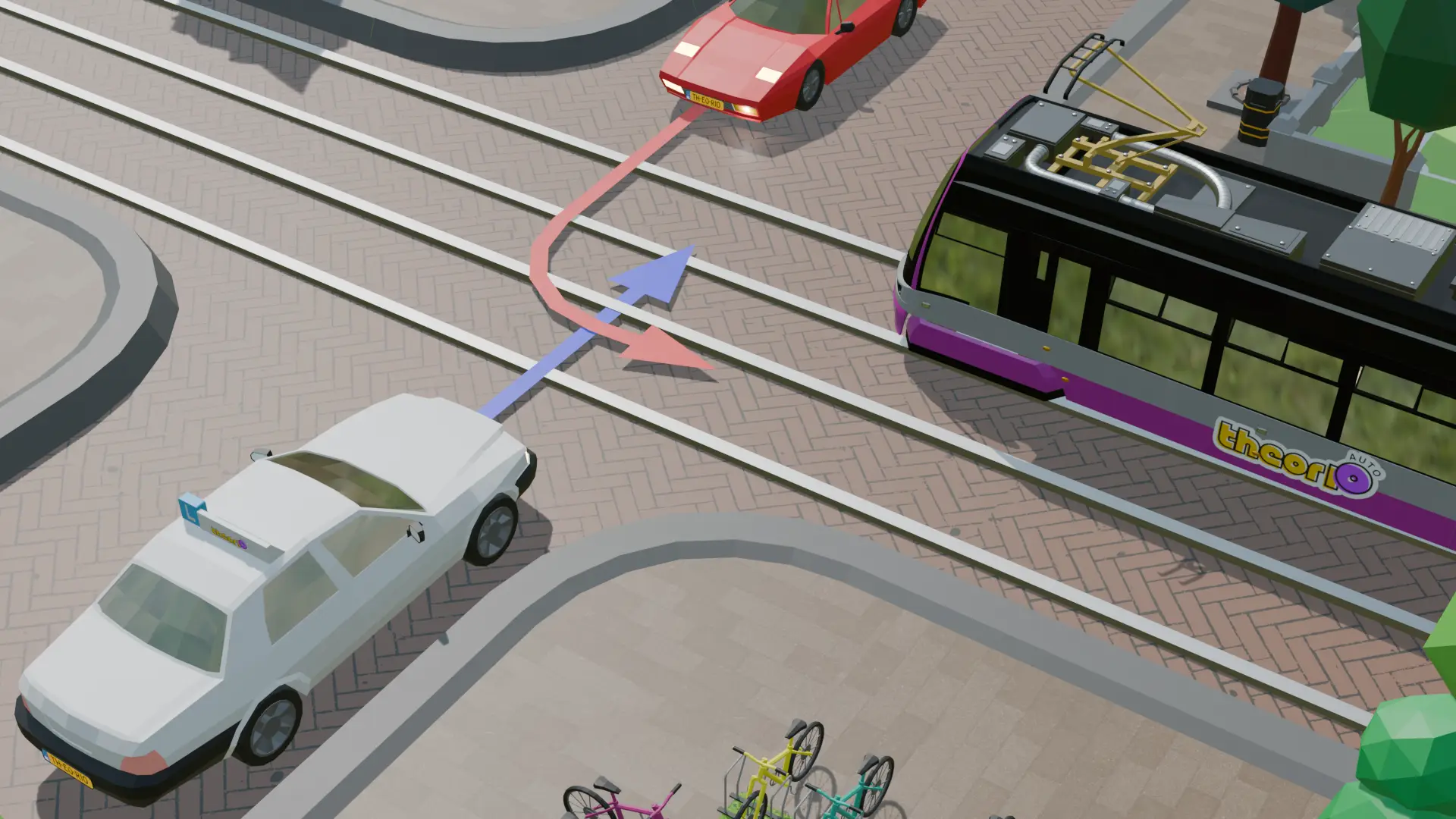
At an equal-priority intersection, a tram always has priority over all other road users. This applies from both the left and the right.
At a priority intersection, the tram must still follow the traffic signs and yield lines / shark's teeth. A tram must also stop at a zebra crossing.
A tram is therefore not an exception to the signs; only to the rule about the right-hand side. If you are driving on a priority road, then the tram must give you priority. And just like you, a tram must stop for a stop sign, for yield lines / shark's teeth, for a zebra crossing, and for a vehicle with flashing lights and a siren.
When a tram is on a priority road, also pay attention to the rest of the traffic: if everyone is on the same priority road, then the tram goes first, then the through traffic (for example cyclists), and only last the driver who wants to turn off from that same road.
First the tram, then the cyclists going straight ahead, and last the car that wants to turn off from the same road.
Rules for a military convoy
A military convoy is a group of military vehicles with special recognition signs. You are not allowed to cut through a military convoy at equal-priority intersections.
Once the first vehicle of the convoy has passed, you must let the rest of the convoy go first.
The important word is als. If the first vehicle of the convoy has not yet passed and you have priority, then you may simply drive — the convoy must continue to follow all normal traffic rules. Only once that first vehicle has passed do you let the entire convoy pass.
Memory aid for the end: the green flag works like a green traffic light. Only when the vehicle with the green flag has passed may you go again.
Recognition signs for a military convoy
First vehicle: Two blue flags and a blue headlamp cover.
Following vehicles: One blue flag on the right-hand side and a blue headlamp cover.
Last vehicle: One green flag on the right-hand side and a green headlamp cover.
Rules for a funeral procession (mourning procession)
A funeral procession consists of vehicles that accompany a deceased person. Each vehicle has two special funeral flags.
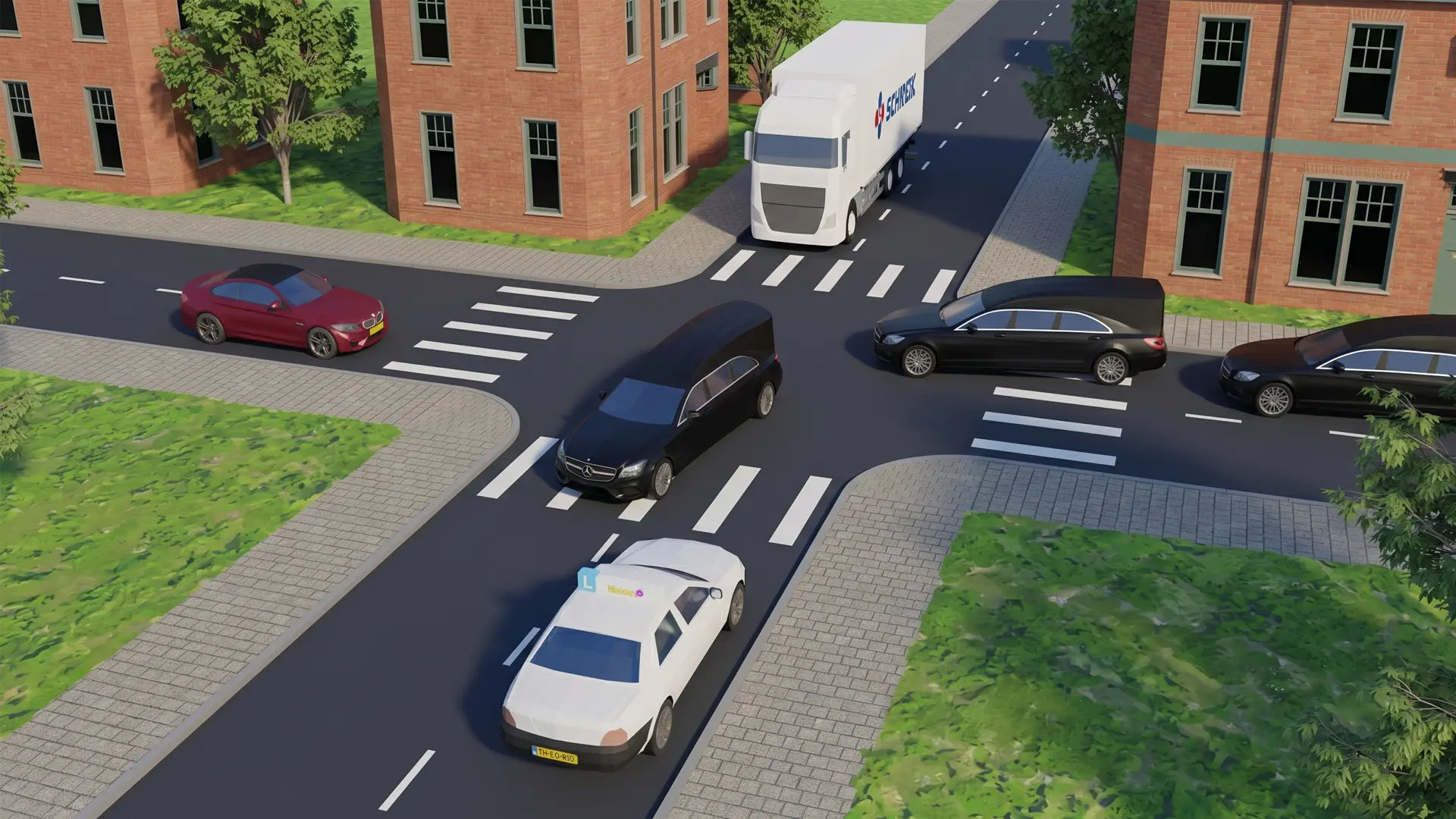
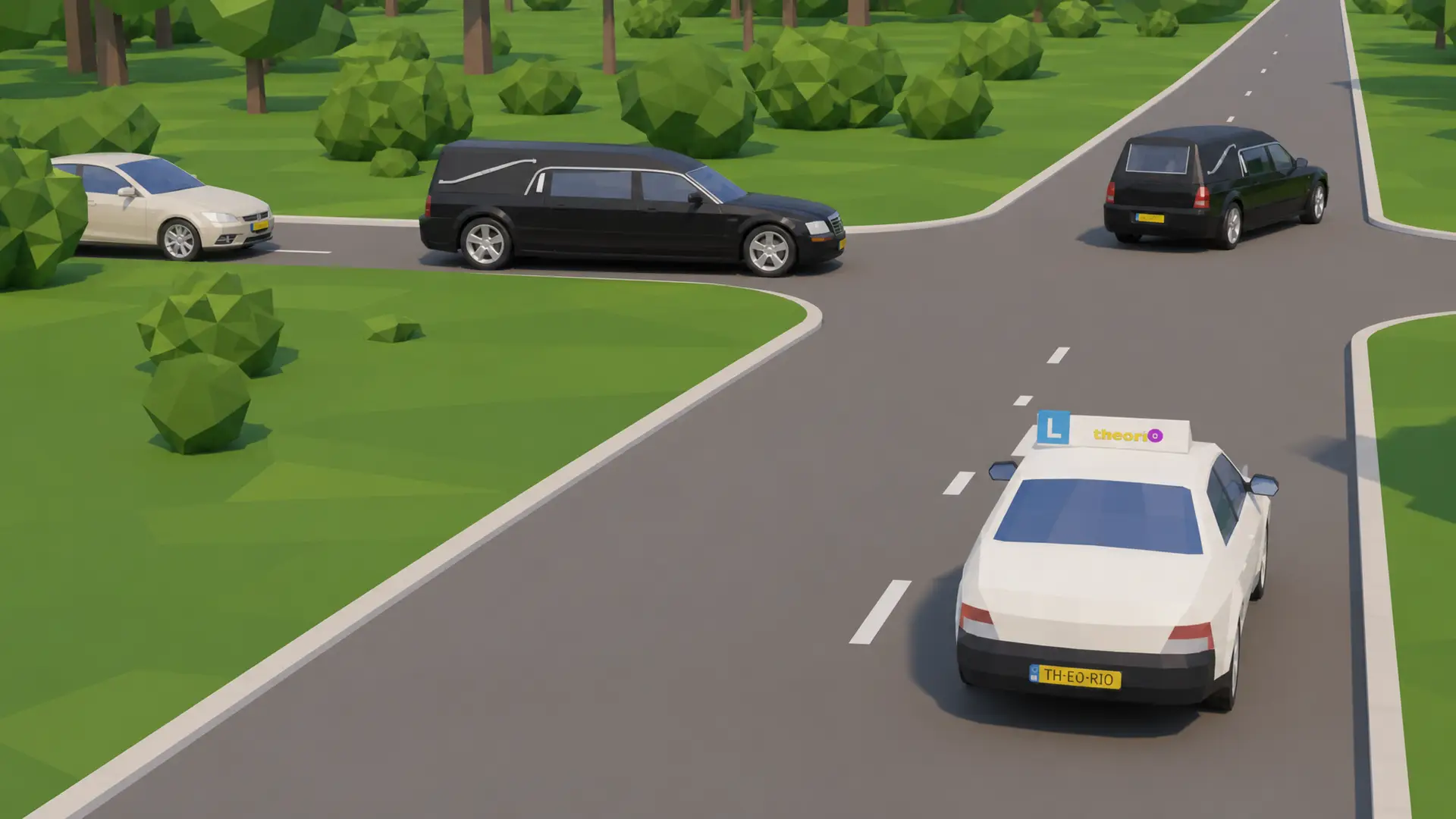
You are not allowed to cut through a funeral procession at an equal-priority intersection if the first vehicle has already passed.
At a priority intersection or roundabout, a funeral procession must give priority to traffic on the main road.
The procession consists of a hearse and following cars and can vary from a few vehicles to a long line. It also often drives slowly. The two flags are on the left and right at the front of each vehicle; both the hearse and the following cars must display those official recognition signs.
Just like with a military convoy: if the first vehicle has not yet passed, then the normal priority rules apply and you may simply go.
Two flags on the left and right at the front of each vehicle: this is how you recognize a funeral procession.
Comparison table: Special traffic flows
Type of special road user
Equal-priority intersection
Priority road (they have yield lines / shark's teeth)
Tram
The tram always has priority
The tram must give priority (signs apply)
Military convoy (first vehicle has passed)
May not be cut through
Convoy must give priority
Funeral procession (first vehicle has passed)
May not be cut through
Funeral procession must give priority
Military convoy or funeral procession (first vehicle has not yet passed)
Normal priority rules — if you have priority, you may simply drive
Tram versus a vehicle with flashing lights and a siren
The tram gives priority to the priority vehicle
Frequently asked questions (FAQ)
Does a tram always have priority?
No, only at equal-priority intersections. At traffic signs, yield lines / shark's teeth and zebra crossings, the tram must follow the rules.
May you overtake a military convoy?
Yes, you may overtake a military convoy on a road with multiple lanes. You are only not allowed to cut between them at intersections.
How do you recognize the last vehicle of a military convoy?
The last vehicle of a military convoy has a green flag on the right-hand side.
May you pass a military convoy if the first vehicle has not yet passed?
Yes. As long as the first vehicle has not yet passed, the normal priority rules apply. If you have priority, you may drive. Only afterwards do you let the entire convoy go first.
You've covered Trams, Military Convoy & Funeral Procession. Does it stick?
In the exam, a traffic controller takes priority over the normal flow at an intersection: you must follow their signals immediately.
You mainly need to recognize when their arm acts like a barrier for you, when they give a stop signal, and when they tell you to slow down.
Traffic controllers & Instructions
What is the order of priority for traffic instructions?
Instructions from authorized persons are at the top of the traffic hierarchy. They override traffic lights, traffic signs and normal priority rules.
Authorized persons include police officers, traffic controllers and customs officers.
The most important hand signals of a traffic controller
On the CBR exam, you must interpret the arm signals of a traffic controller perfectly.
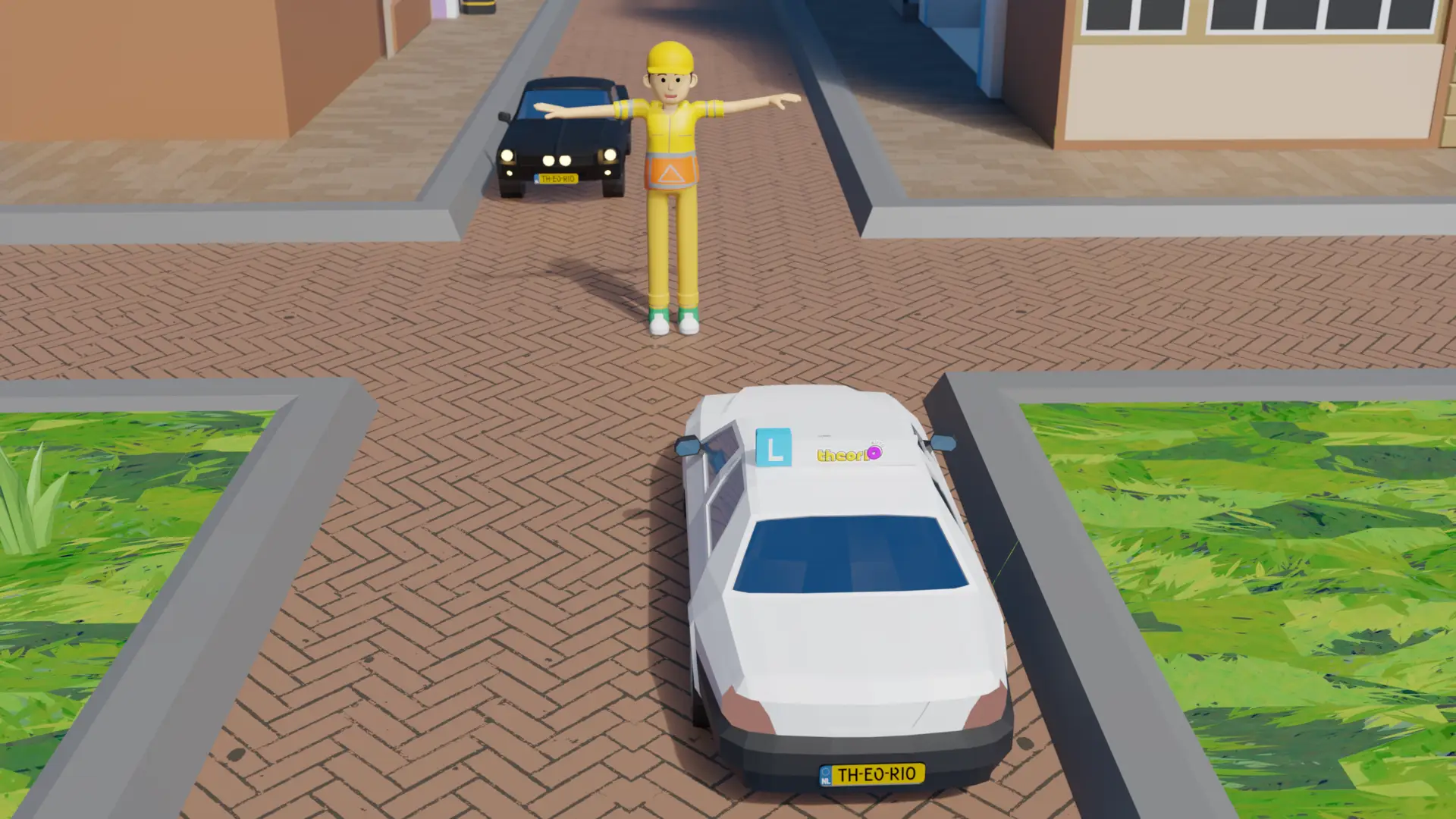
One arm stretched out horizontally: Stop signal for traffic coming from the direction the arm is pointing to. The arm works like a barrier.
Two arms stretched out horizontally: Stop signal for traffic from the front and from the back. Traffic from the side may continue.
One hand held diagonally up: Stop signal for all traffic from all directions.
Arm moving up and down: Reduce speed. This is not a stop signal, but a sign to drive more slowly.
The barrier principle with traffic controllers
See the stretched arms of a traffic controller as a physical barrier.
Are you driving into the chest or back of the traffic controller with stretched arms? Then you must stop.
Overview table: traffic controller signals
Traffic controller signal
Meaning for the driver
Who must stop?
Arm stretched out on your lane
Stop signal (barrier)
Your direction of travel
Both arms stretched out horizontally
Stop signal for front and back
Traffic from the front and from the back
Right hand held up
General stop signal
All traffic from all directions
Arm moving up and down
Reduce speed
No one has to stop (but you must slow down)
Frequently asked questions (FAQ)
What has priority: a green traffic light or a stop signal from a traffic controller?
The stop signal from the traffic controller has priority. Instructions from authorized persons go above traffic lights.
What does an arm moving up and down mean?
This means you must reduce your speed. It is not a stop signal.
Do you also have to stop if a traffic controller turns their back to you with stretched arms?
Yes, if the arms are stretched out, this counts as a stop signal for traffic from the front and from the back.
Priority and pedestrians
Someone who is not driving anything is a pedestrian. This applies to walkers, but also to someone on inline skates, with a rollator, on a step, or with a bicycle in hand.
The most important thing to remember: priority signs and yield lines / shark's teeth only regulate priority between drivers. They do not apply to pedestrians. How it works then depends on the situation.
With a zebra crossing
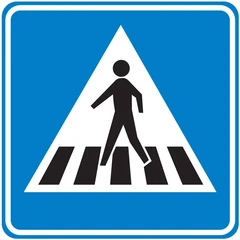
If you see long, white stripes across the road, then that is a zebra crossing (a pedestrian crossing). A pedestrian who is planning to cross must be given priority.
Sign L2 (pedestrian crossing): belongs with the white stripes on the road. Let pedestrians crossing go first.
One exception: if there are working traffic lights next to the zebra crossing, then those lights apply and not the zebra crossing rule.
Without a zebra crossing
If there is no zebra crossing, you fall back on the standard priority rules — and for pedestrians they work differently than for drivers.
Rule 1 (right has priority) does not apply: a pedestrian is not a driver. If they come from the left or from the right, you may go first.
Rule “short turn before long turn” does not apply: pedestrians walk on the pavement and do not make turns on the carriageway.
Rule “going straight on on the same road has priority over turning traffic” does apply — it applies to all road users, so also to pedestrians.
That last point is exactly where the memory aid comes from:
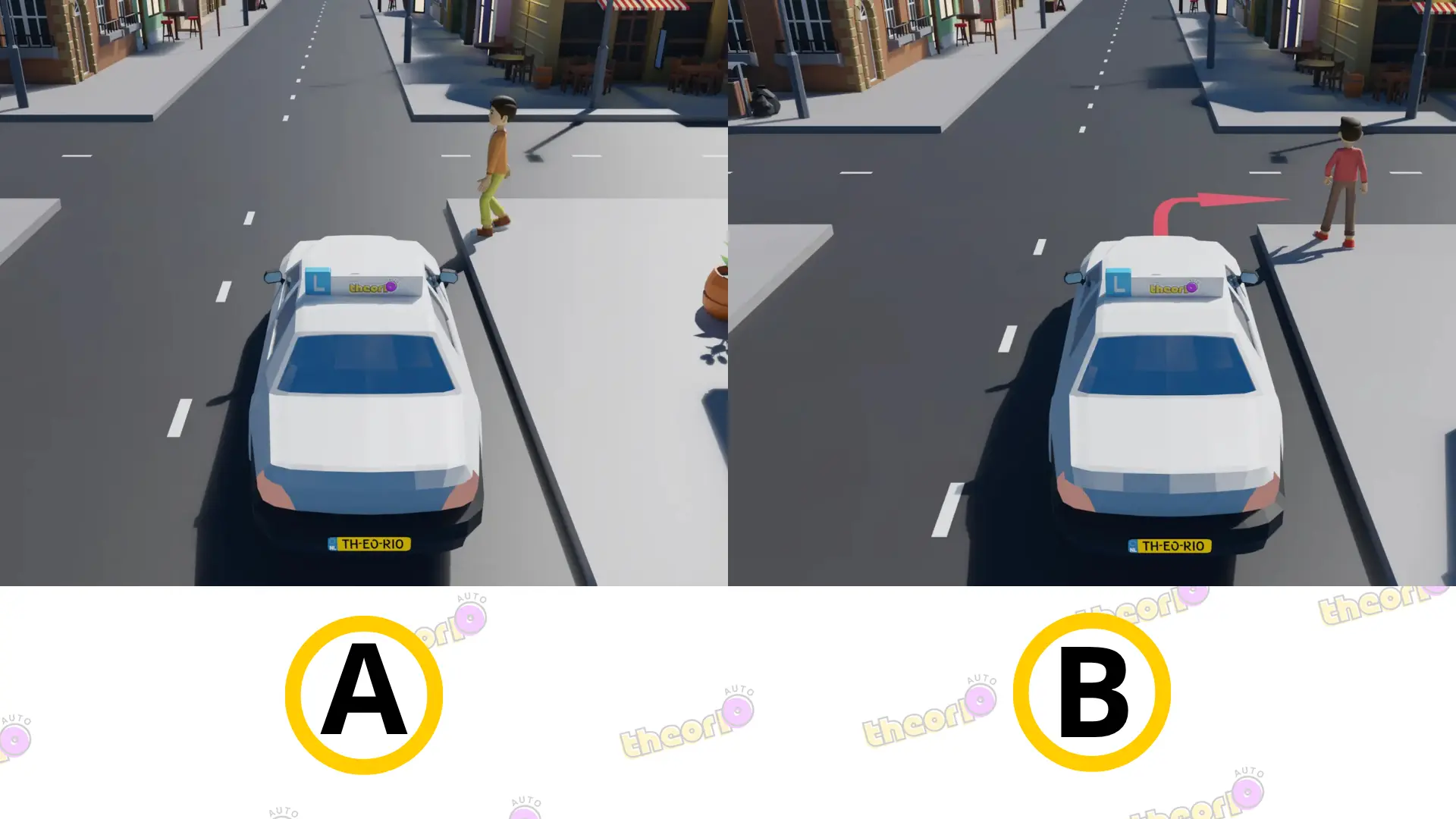
Belly or back = lift off the gas. If you see the pedestrian from the front or from the back, then they go straight on on the same road and you must let them go first.
From the side = put the gas on. If you see the pedestrian from the side, then you may go first.
In that case, look at how you see the pedestrian at the moment you approach — not only when you are already next to them, and not at the direction you are going.
Belly or back = lift off the gas. From the side = put the gas on.
At a roundabout
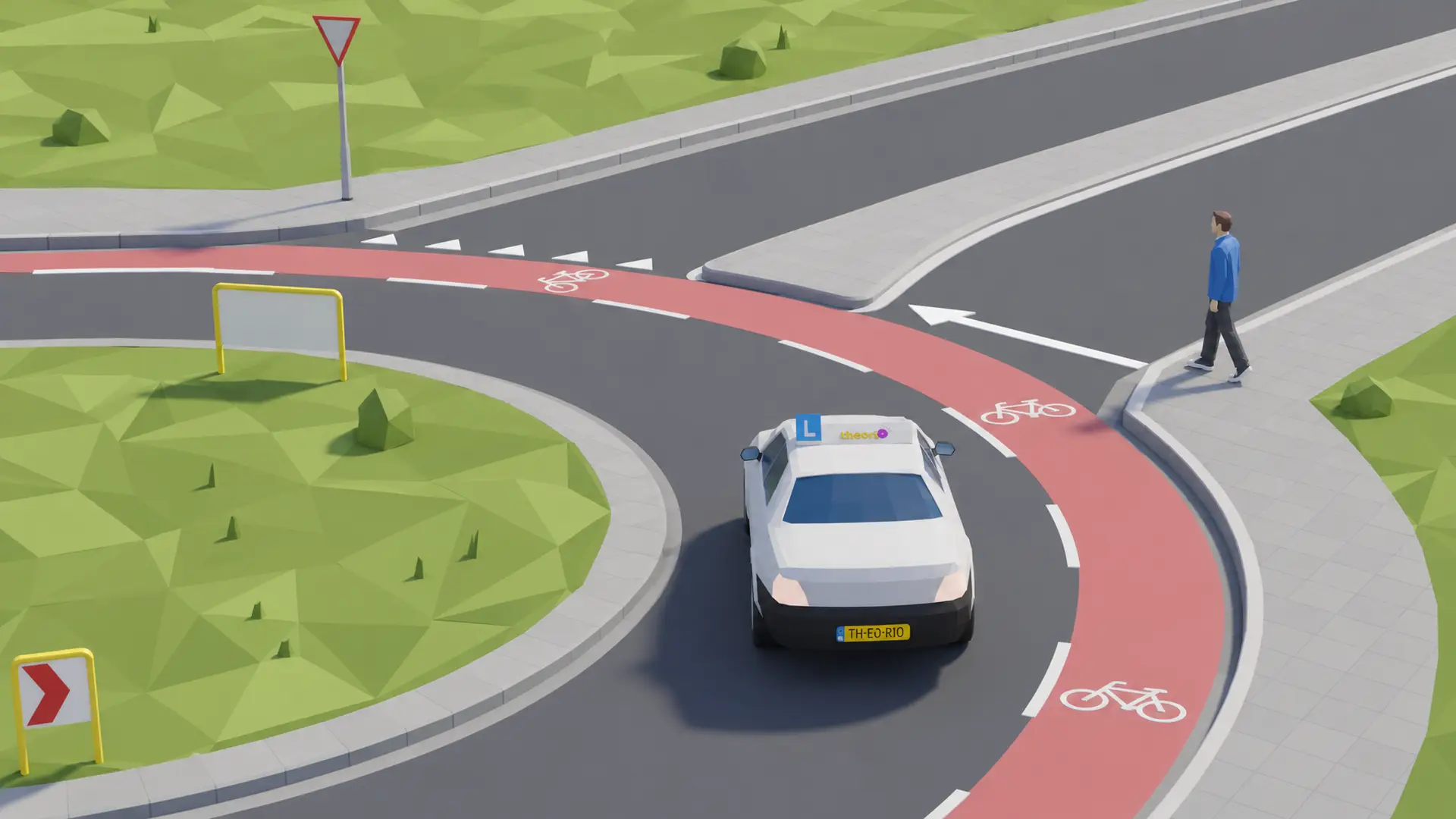
A roundabout goes around, so the perspective changes. The method stays exactly the same: if you see the pedestrian from the front (belly or back), then you slow down. Pedestrians crossing at a roundabout go straight on on the same road.
Also take into account at a roundabout that the cars in front of you must brake if someone is crossing. Therefore reduce your speed and pay close attention.
Also at a roundabout: if you see the pedestrian’s belly or back, lift off the gas.
Where a pedestrian does not have priority
If there are yield lines / shark's teeth on the road and a pedestrian wants to cross, then you do not have to let them go first. Yield lines / shark's teeth only apply between drivers. Again: if the pedestrian comes from the side, lift off the gas.
The same applies in places where many pedestrians think they have priority, but they do not:
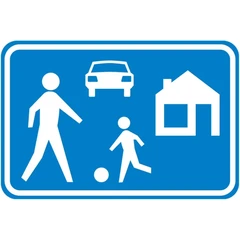
On an erf (living yard), a pedestrian does not have automatic priority. If you see them from the side, you may drive on — although driving at walking pace is the rule here anyway.
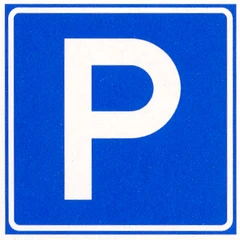
On a parking lot, the same applies: no automatic priority for pedestrians.
The exception that always applies
People who have difficulty walking — due to age or a physical disability — deserve always priority and help. Think of someone with a rollator, crutches or a white cane. It does not matter where they come from or where they are going, and it does not matter what the rules say otherwise. Give them space to cross safely.
Priority with multiple road users at the same time
In real traffic, there are rarely only cars. How do you solve a situation with drivers and pedestrians mixed together? With a fixed order.
Imagine the pedestrian away for a moment.
First resolve priority between the drivers using the step-by-step plan: signs and markings → drivers from the right → straight on / short turn.
Only then look at the pedestrian, and determine whether they go first over the driver who is first in line.
First the drivers among themselves, then add the pedestrian.
Example — lorry, driving school car and pedestrian
A lorry and a driving school car are both driving on a priority road. The lorry makes the short turn, the driving school car the long turn. A pedestrian is crossing who sees the lorry coming straight at them on their belly.
Correct order: pedestrian → lorry → driving school car.
Why: first the drivers — short turn goes before long turn, so the lorry is before the driving school car. Then add the pedestrian: the lorry sees the belly, so lift off the gas. The pedestrian goes first.
Example — tram, pedestrian and driving school car
There are no signs indicating anything else, so the tram has priority. But there is a zebra crossing where a pedestrian wants to cross.
Correct order: pedestrian → tram → driving school car.
Why: a tram must also stop for a zebra crossing. Then the tram goes, and only last the driving school car that wants to turn off.
Who will you encounter on the road?
“Road users” is simply everyone who uses the road. But each group has its own rules, and for the exam you must know which category someone belongs to.
Drivers and pedestrians
The first split is simple: pedestrians drive nothing, drivers do. Drivers then split again, into motor vehicles and non-motor vehicles.
Motor vehicles: cars, lorries, motorcycles, tractors. And the brommobiel — technically not a motor vehicle, but it must follow the rules for motor vehicles. Remember it by sound: “brommobiel” sounds like “car mobiel”.
Non-motor vehicles: bicycles, snorfietsen and horses. Memory aid: if the word “fiets” is in it, then it is not a motor vehicle — except with “motor”, because “motor” is in there. And if “horse” is in it, that speaks for itself.
Who drives on the carriageway?
On the carriageway you do not only encounter cars. Tractors also drive there: agricultural vehicles are usually too large for the cycle path. The same applies to brommobielen — they are also too large for the cycle path and simply drive between the cars.
Who drives on the cycle path?
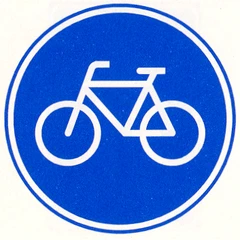
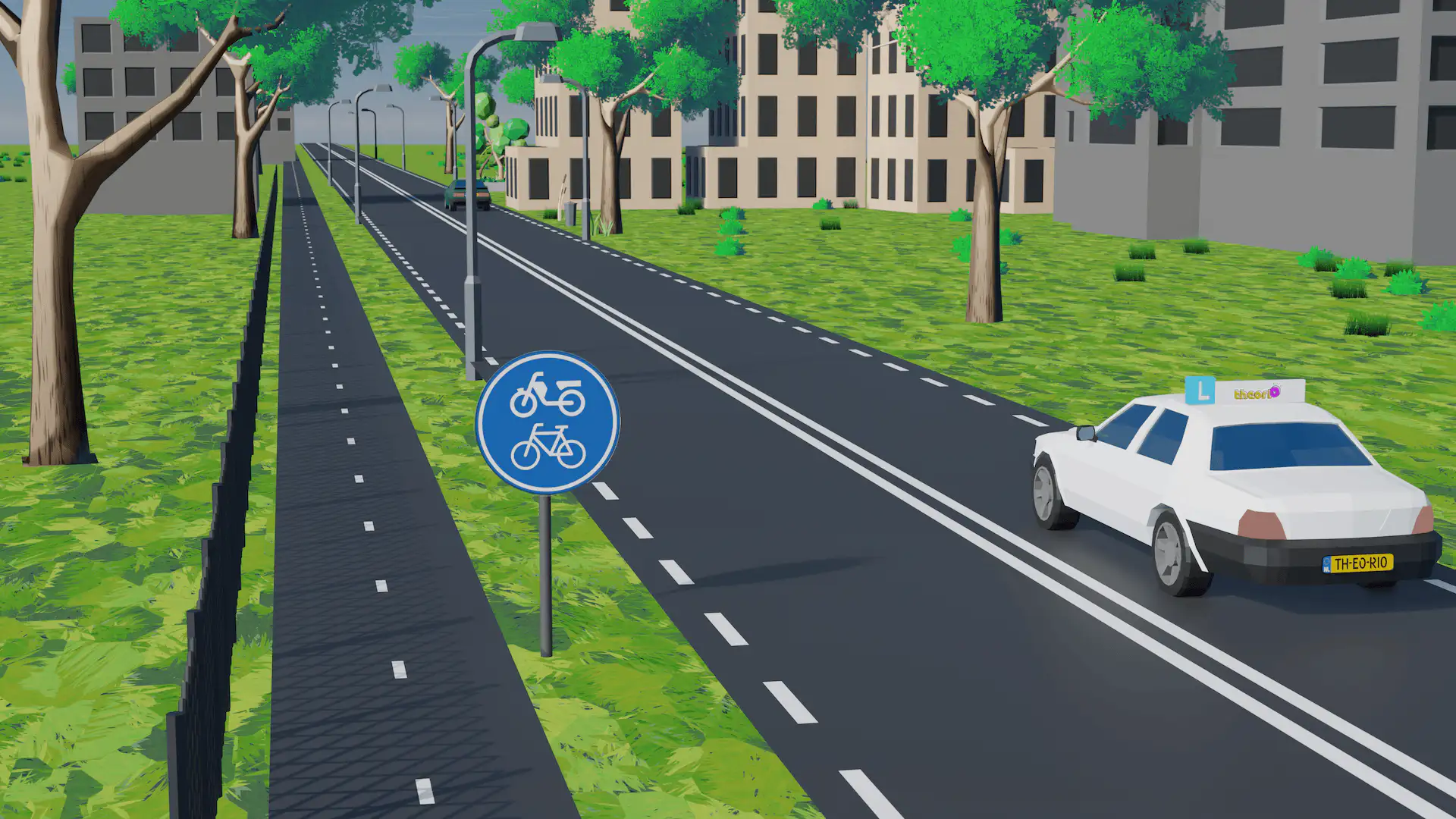
On the narrow red path, cyclists and snorfiets riders ride. Snorfietsen have the same traffic symbol as bicycles, so where you see a bicycle image, it also applies to snorfietsen.
Sign G11 (compulsory cycle path): for cyclists and snorfiets riders. Bromfietsen in principle do not belong here.
Bromfietsen may not just ride there. Bicycles and snorfietsen go at about 25 km/h; a bromfiets can go up to 45 km/h. Because of that speed difference, bromfietsen have their own symbol and ride on the carriageway.
The exceptions for bromfietsen
If, next to a cycle path, there is a round blue sign with a bicycle and a bromfiets on it, then the bromfiets rider may ride there — in fact, the bromfiets rider must use the cycle path and is not allowed on the carriageway.
Bicycle and bromfiets on the sign: then this path is also compulsory for bromfiets riders.
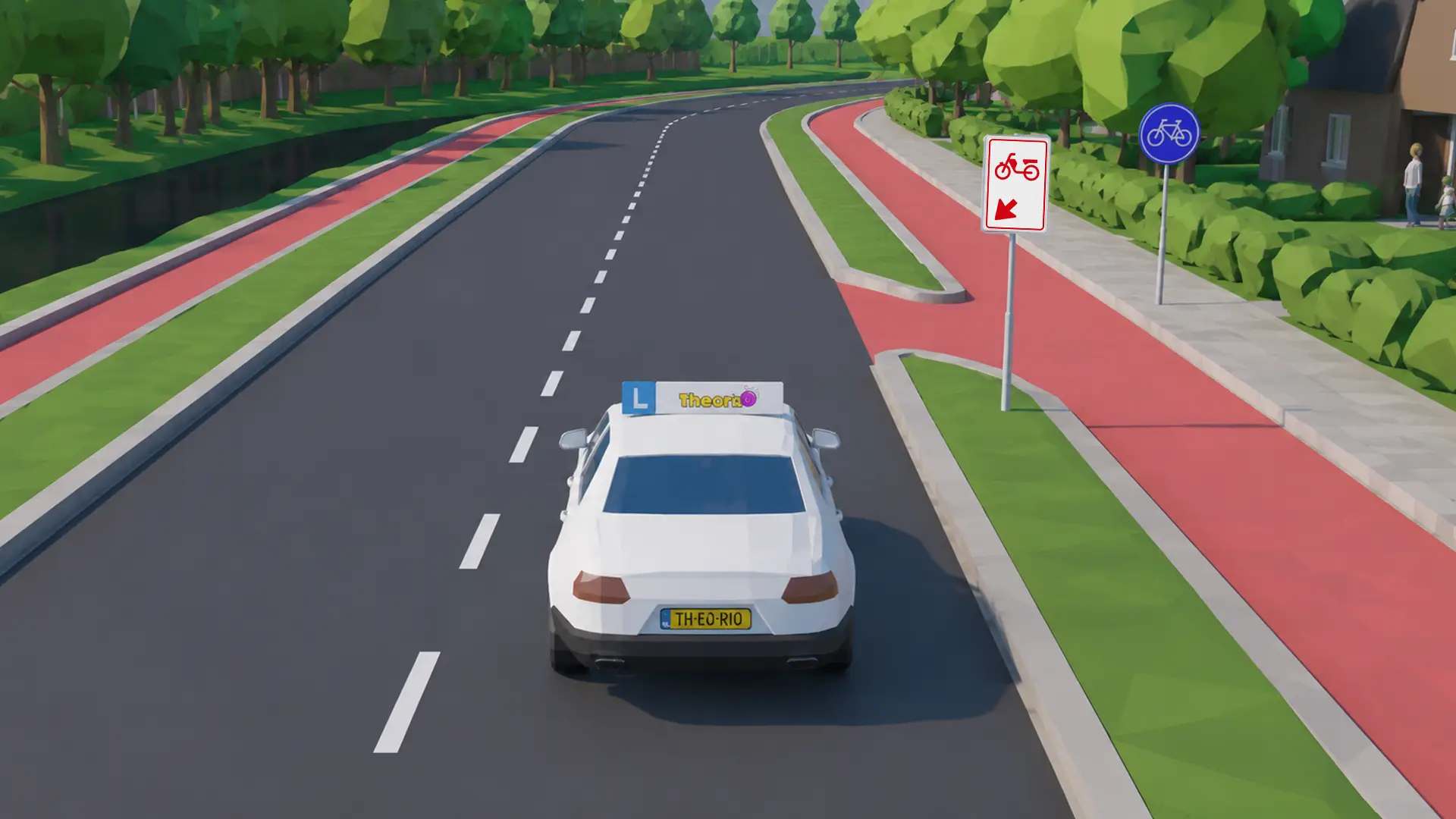
Bromfietsen and speed-pedelecs therefore constantly switch between the cycle path and the carriageway. At the sign that indicates they must go onto the carriageway, they join at considerable speed — up to 45 km/h. Give them space to merge. In that situation, cyclists and snorfiets riders simply stay on the cycle path.
Bromfiets riders go onto the carriageway. The same sign with the arrow pointing the other way sends them back to the cycle path.
Cyclists on a roundabout
On some roundabouts, the cycle path is laid out so that you have to cross it to enter the roundabout and to leave it. So assume that cyclists are riding there and check whether you can cross the cycle path safely.
Disabled vehicles
A disabled vehicle has a special position: it may almost everywhere — on the pavement, on the cycle path, and if there is no cycle path, also on the carriageway.
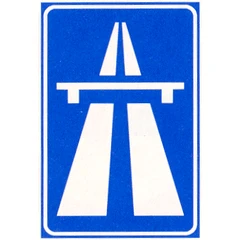
The motorway and the autoweg are prohibited territory for a disabled vehicle.
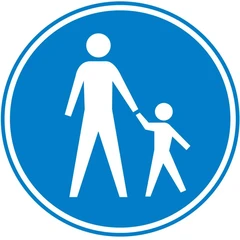
Pedestrians have their own path, so you do not need to expect them on the carriageway. The other way around applies too: all vehicles may use the carriageway, but not all road users.
Sign G7 (footpath): only for pedestrians.
Warning signs for special road users
The misleading cycle sign
You have just learned: where a bicycle image is shown, it is about bicycles and snorfietsen, not bromfietsen. With the warning sign showing a bicycle, that assumption does not apply.
A red triangle always means “watch out”. With this sign you must watch out for cyclists, snorfiets riders and bromfiets riders — all three.
The warning sign also warns for bromfiets riders, unlike the blue cycle path sign.
From two directions
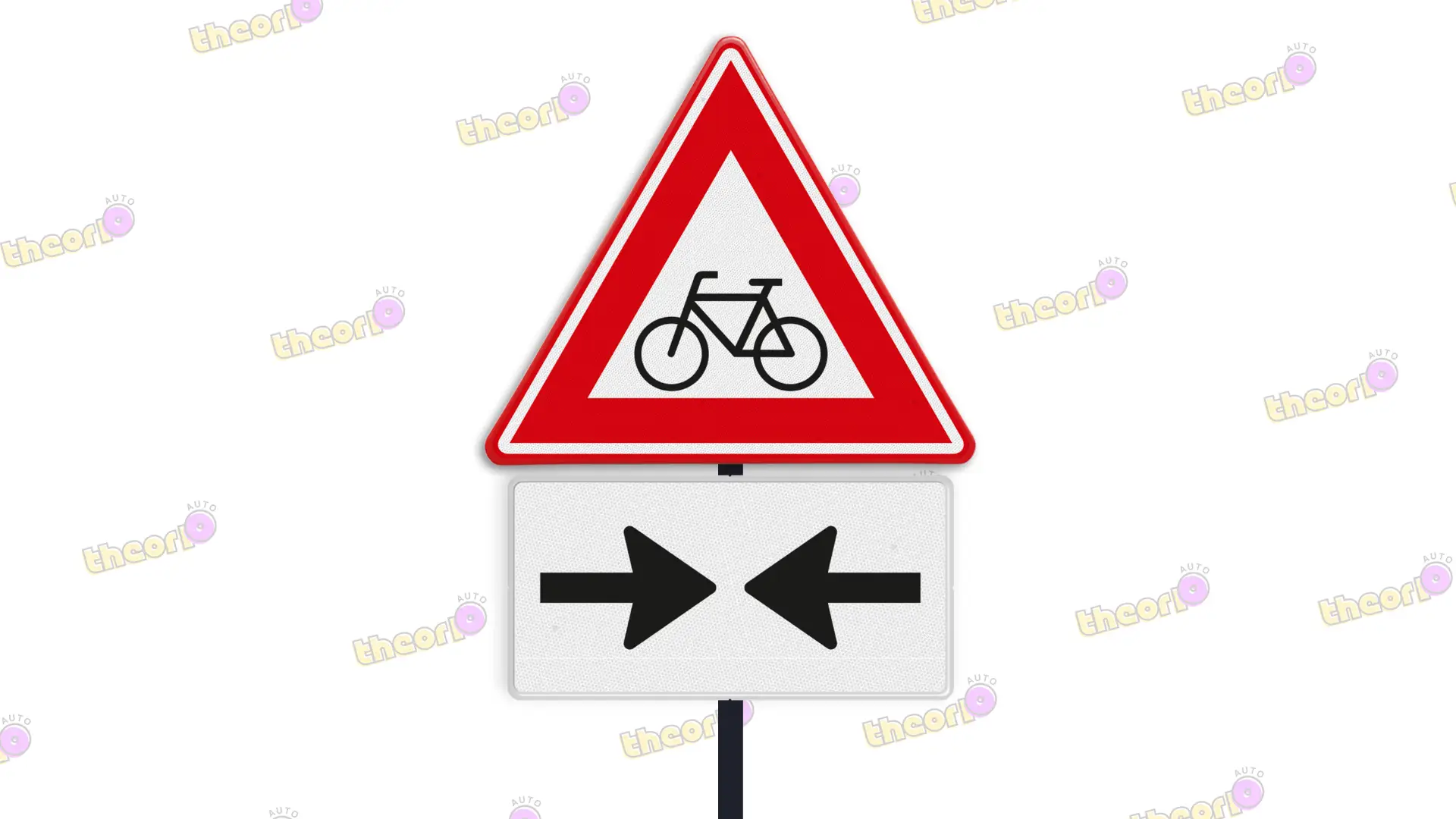
If there is a white sub-sign under that sign with two arrows pointing to the middle (→ ←), then you can expect cyclists and bromfiets riders from both the left and the right. So look both ways before you drive on.
Two arrows pointing towards each other: traffic from both directions.
Even without that sub-sign, you can get cyclists from two directions. A two-way cycle and bromfiets path is recognized by a wide path with a broken line in the middle. If you cross it, expect traffic from both directions.
Horse riders
There is a similar sign for horse riders: an exclamation mark in a triangle with underneath an image of a horse rider and two arrows pointing to the middle. That means that horse riders here can cross from both sides.
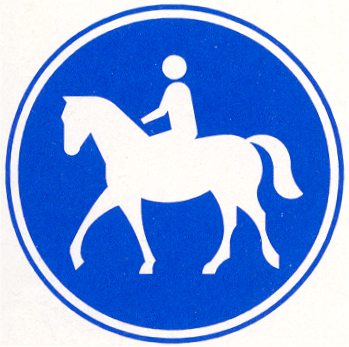
Sign G12 (horse rider path): a round blue sign with a horse rider. Horse riders are required to use this path, so you do not need to expect horse riders crossing here.
Brommobielen
A brommobiel drives like a car on the carriageway, but it does not go faster than 45 km/h. Therefore expect it also on roads where 80 km/h applies: both inside and outside the built-up area you can encounter all kinds of traffic.
On the autoweg and the motorway you do not need to expect brommobielen: a minimum speed applies there.
You've covered Traffic controllers & Instructions. Does it stick?
FAQ
Frequently asked questions
Short answers to common questions about Priority & Special Road Users.
When do you have to give way to a pedestrian?
You give way to pedestrians at a zebra crossing when they are crossing or clearly about to cross. You always give way to blind people with a white cane and to people who move with difficulty, even without a zebra crossing. And when you turn off, pedestrians crossing straight ahead on the same road go first.
When does traffic from the right not have priority?
Traffic from the right does not have priority when you are on a priority road (sign B1), when there are shark’s teeth, a stop sign or traffic lights, or when it comes from a driveway, private grounds, car park or petrol station. In those cases the right-hand rule does not apply and you do not have to give way.
What is an equal intersection (gelijkwaardig kruispunt)?
An equal intersection is a crossing without priority signs, shark’s teeth or working traffic lights: all roads are equally important. Here the right-hand rule applies — you give way to drivers coming from the right, including cyclists and moped riders. Note: a tram always has priority, even when it comes from the left.
Who has priority on a roundabout?
Traffic already on the roundabout has priority over traffic entering from the right, unless signs say otherwise. Give way before you enter, choose your lane early and keep indicating until you leave. The CBR often combines roundabouts with lane choice and priority rules.
Does the short bend have priority over the long bend?
Yes: at an uncontrolled junction, traffic coming from a road that bends less sharply (the short turn) generally has priority over traffic from the road with the longer bend. This is a classic CBR theory question — look at the road layout and who can see and leave the junction first.
Keep practicing with up-to-date material
You have now learned the basics of priority, pedestrians and special road users. Because priority often depends on signs, road markings, behaviour and exceptional situations, you train in our app with up-to-date CBR scenarios to quickly see who really has priority.
Ready to practise?
Test your knowledge of Priority & Special Road Users with 75 practice questions in the app.
Your first quiz is free, no account needed. ·After that from €19.99 for 90 days of access.

 Sign B1 (Priority road): You are driving on a priority road. You have priority over drivers from side roads.
 Bord B2 (End of priority road): The priority road ends. You must again take traffic from the right into account.
 Bord B3 (Priority intersection): You are approaching an intersection where you have priority over drivers from side roads.
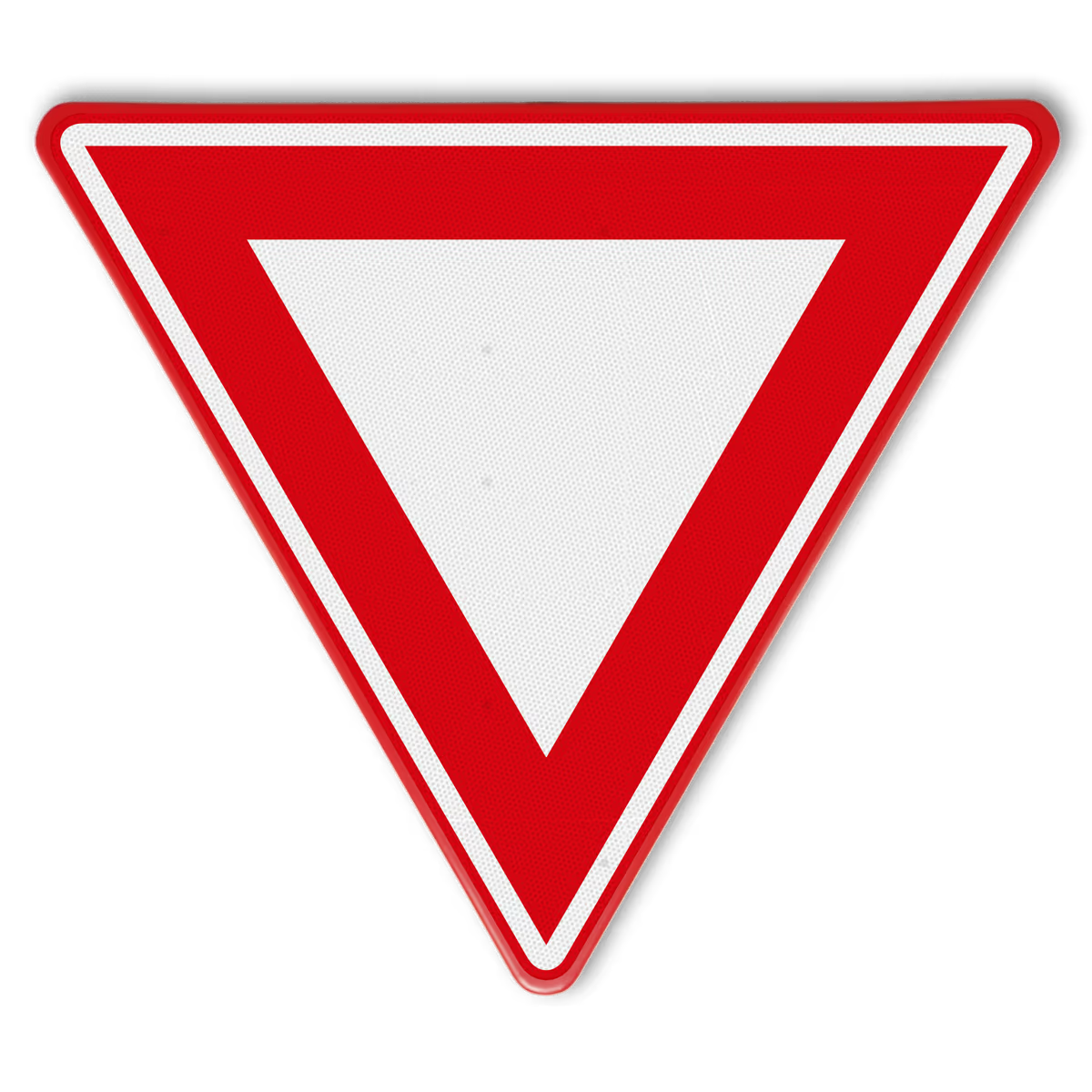 Bord B6 (Give priority): Inverted triangle. You must give priority to drivers on the intersecting road.
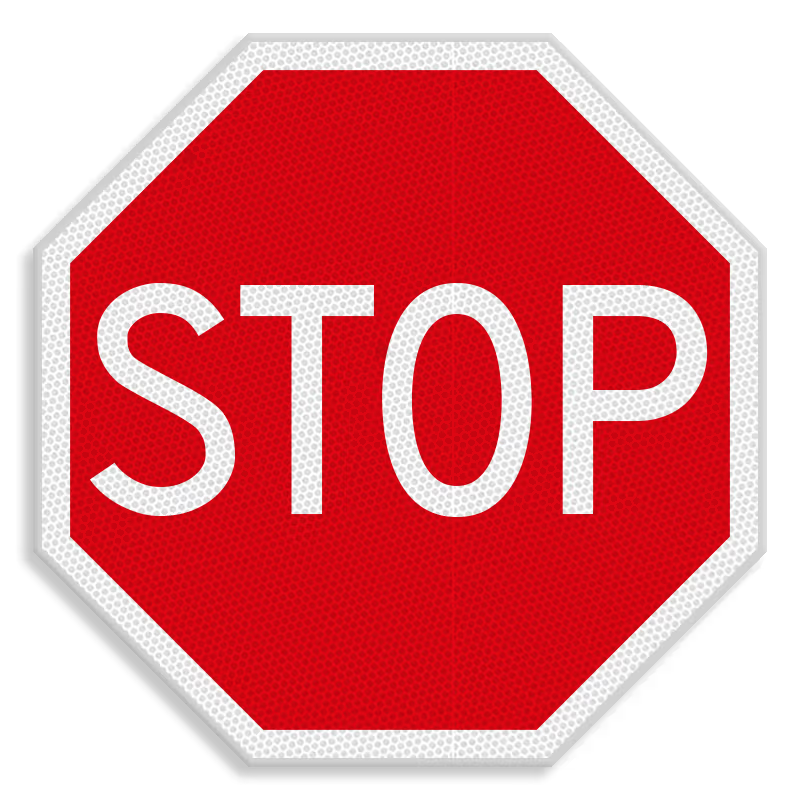 Bord B7 (Stop sign): You must stop for the stop line. Give priority to drivers on the intersecting road.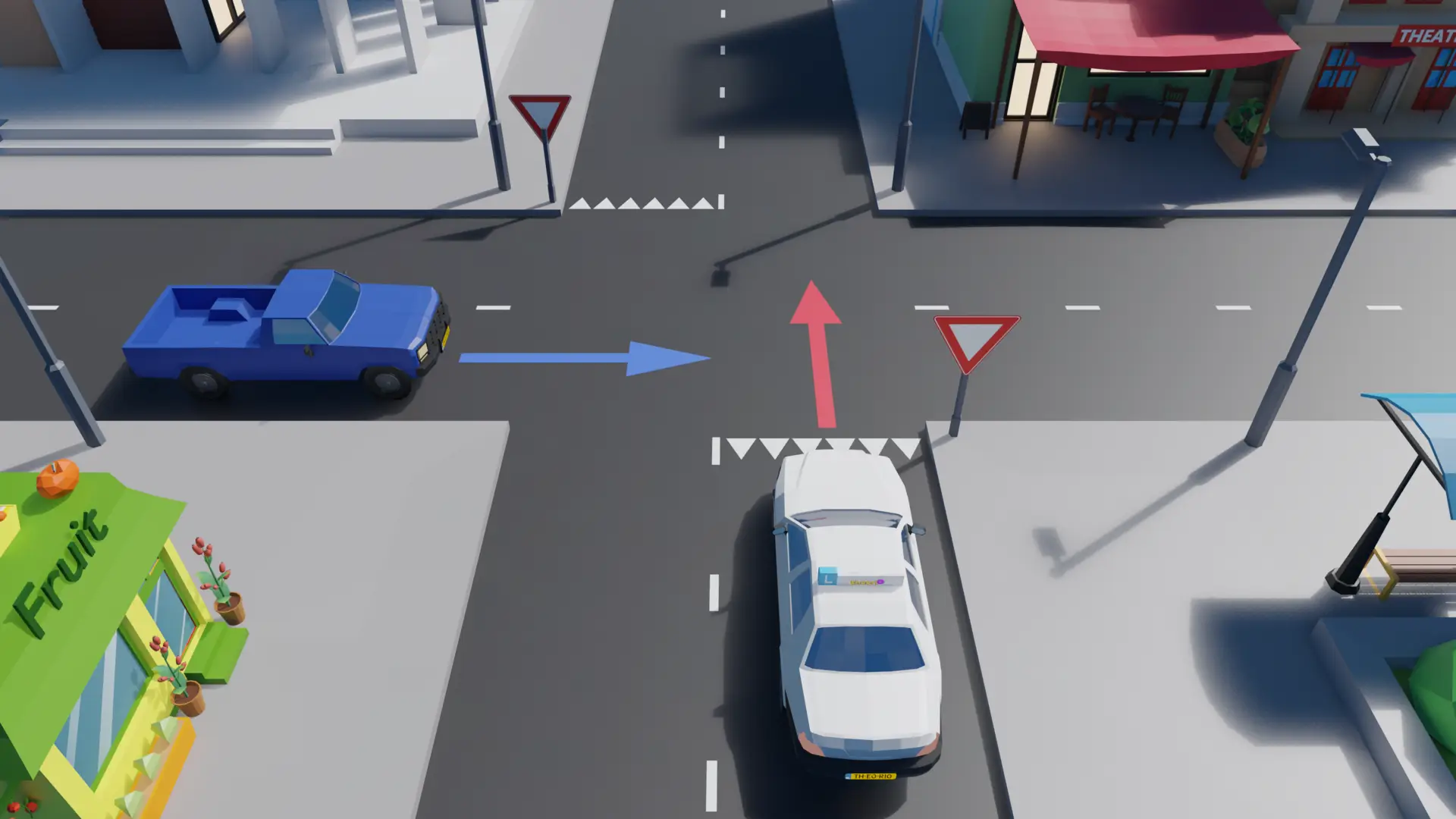
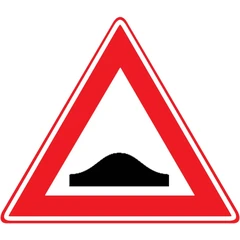
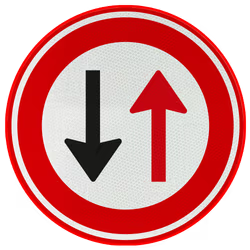 Sign F5 (Round red border with red and black arrow): You must let oncoming traffic go first.
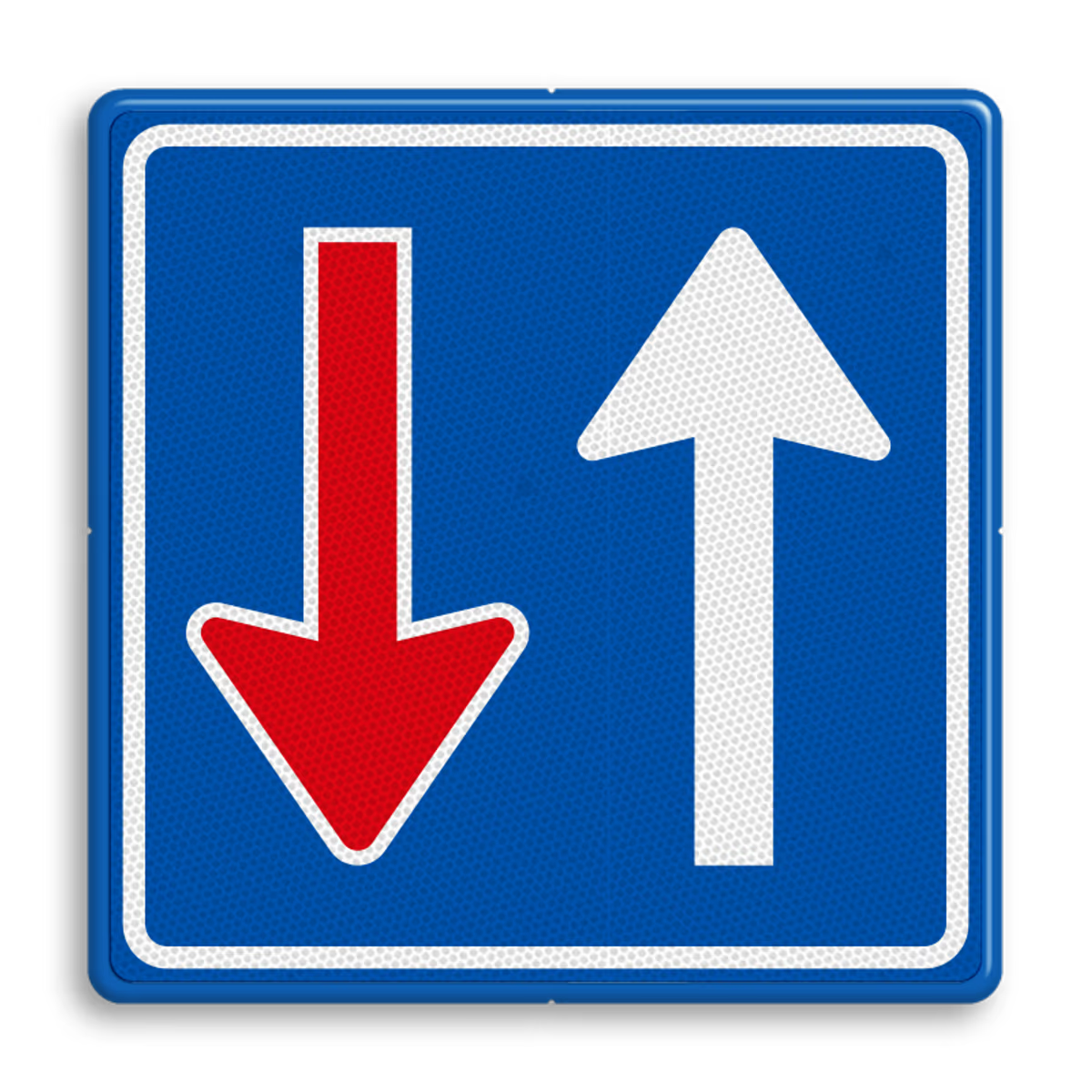 Bord F6 (Blue square with white and red arrow): You have priority over oncoming traffic at the narrowing.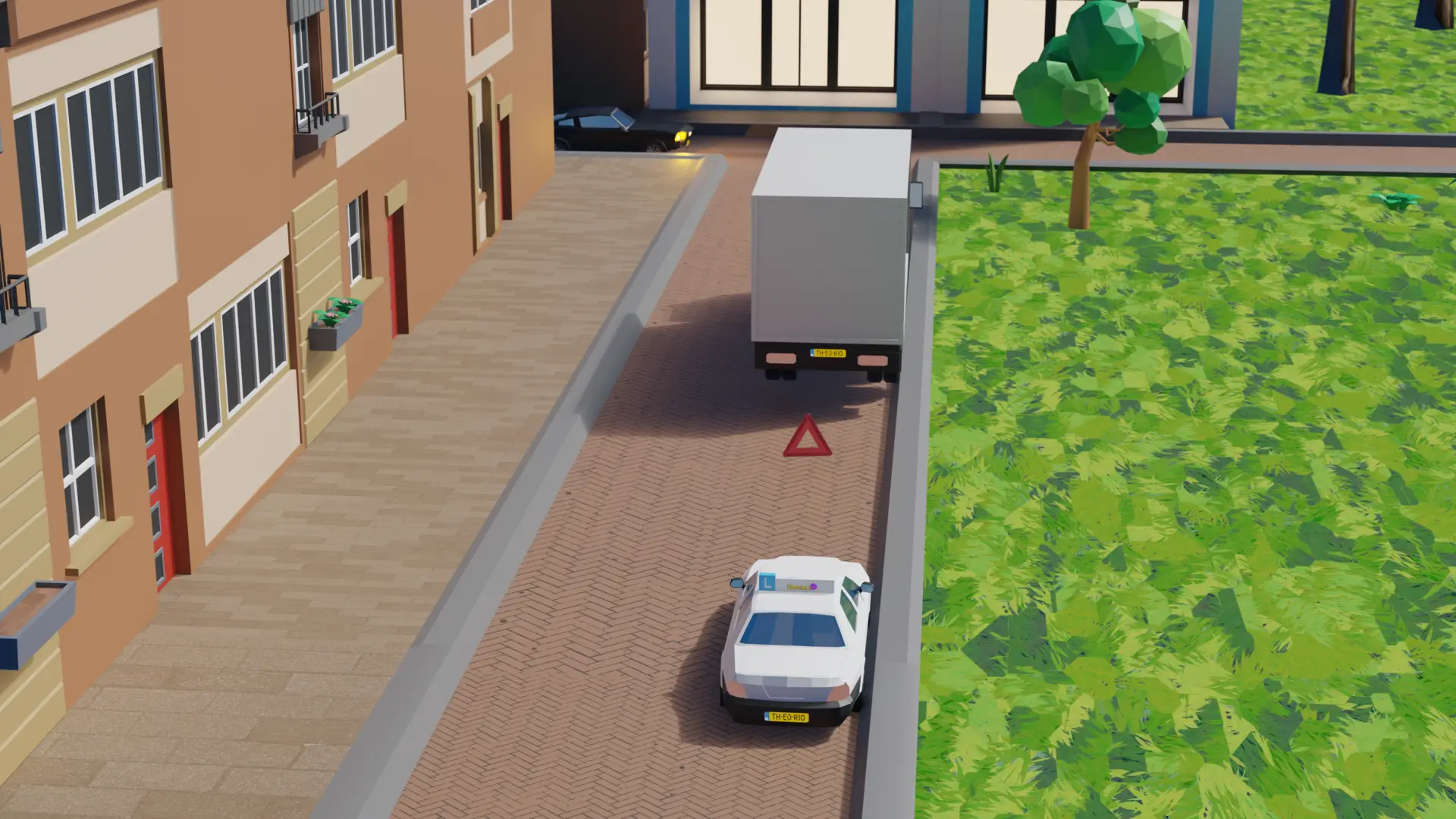
 One arm stretched out horizontally: Stop signal for traffic coming from the direction the arm is pointing to. The arm works like a barrier.