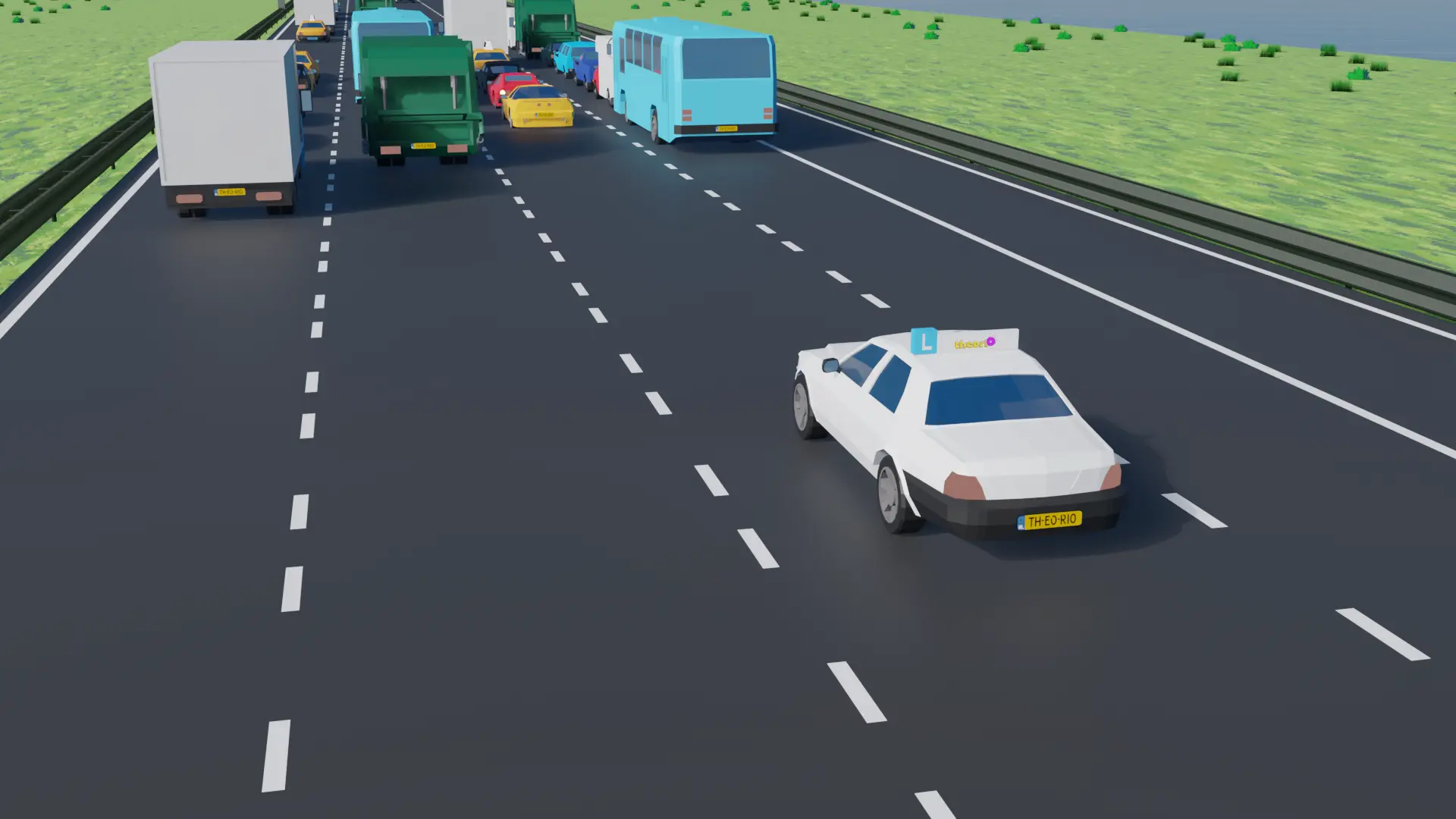
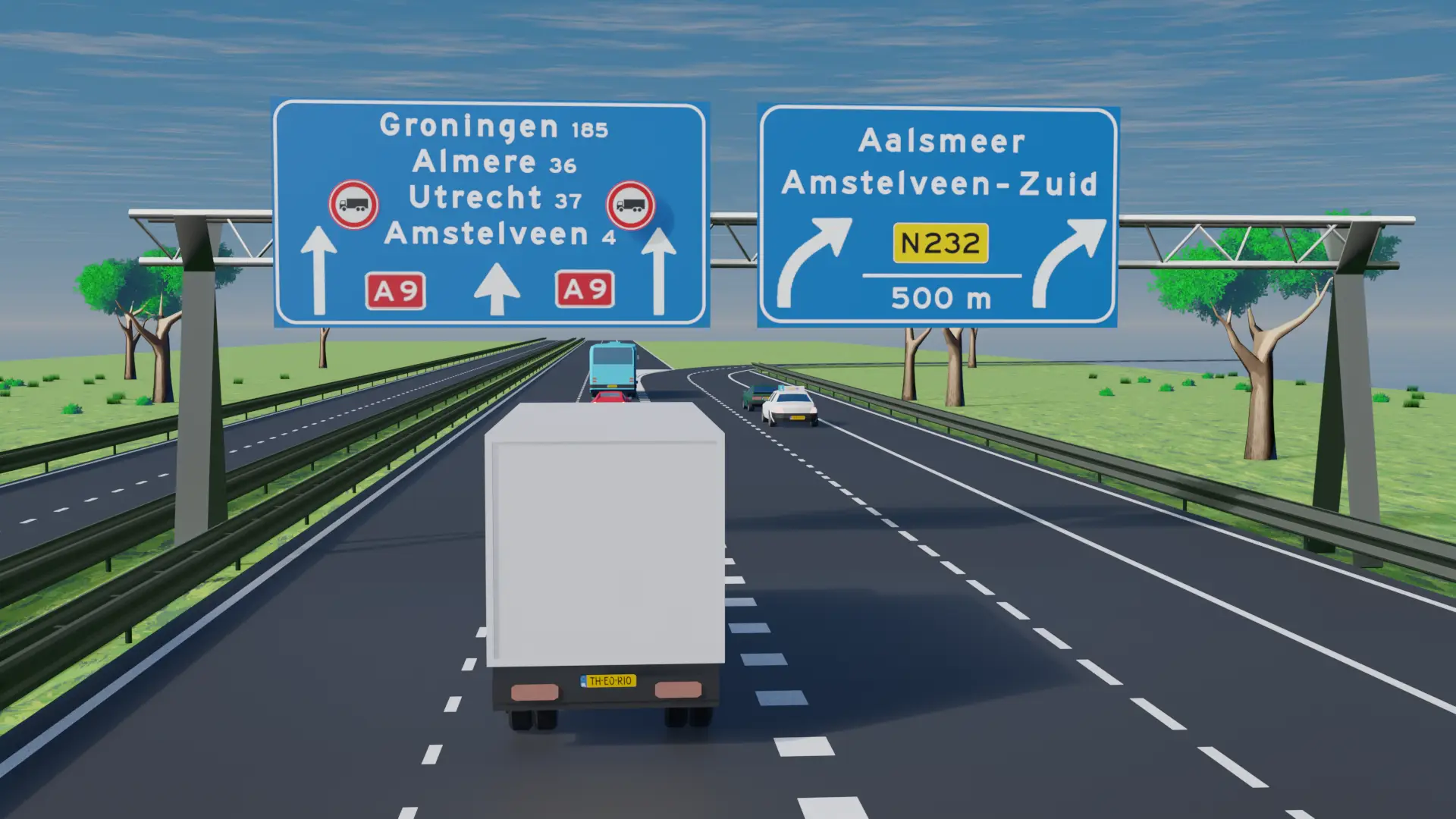
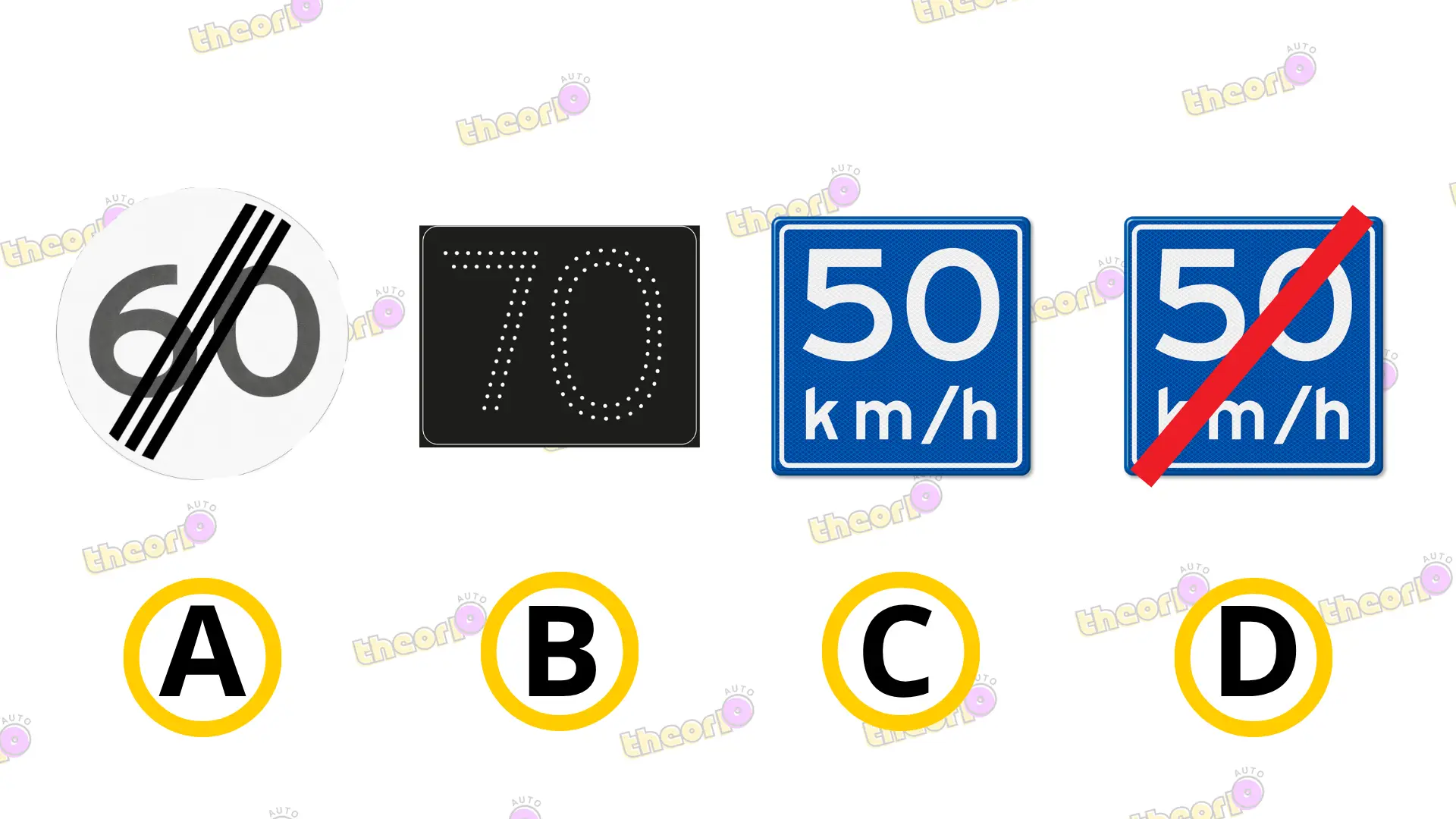
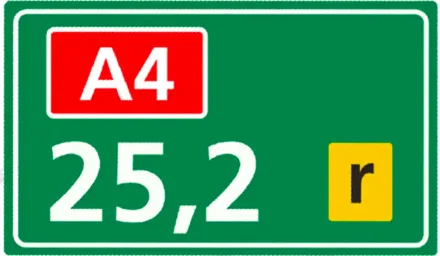
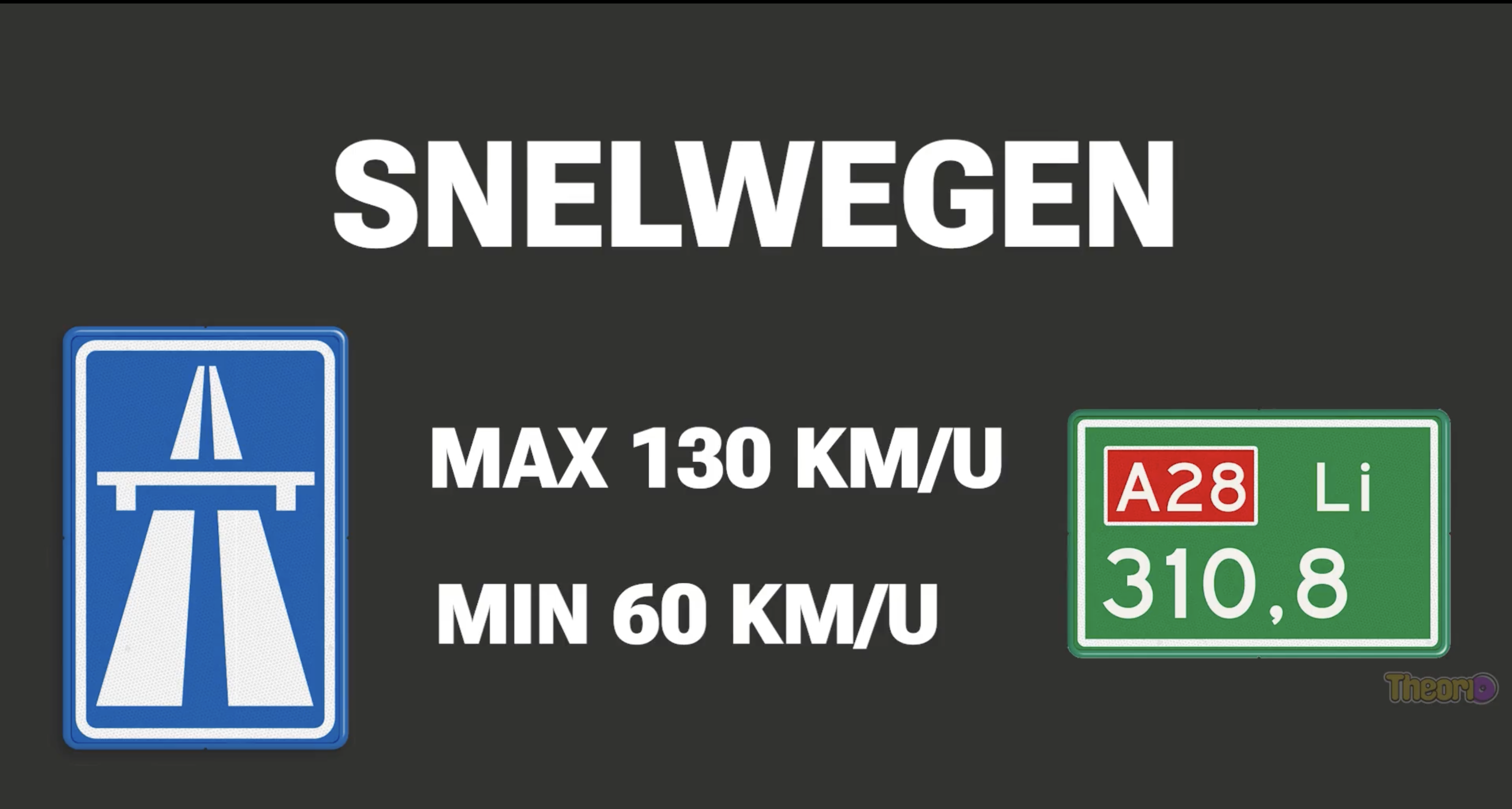
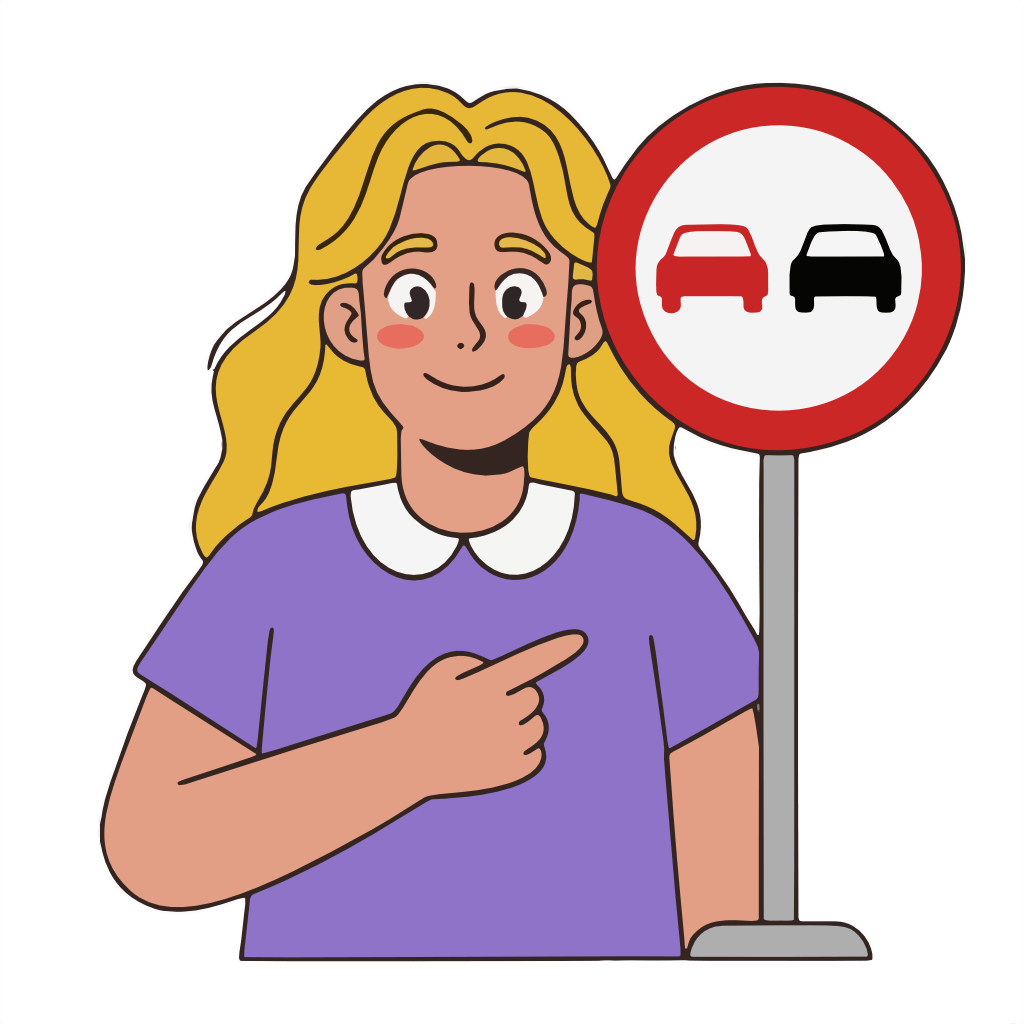
From sign G1, different rules apply than on any other road: in addition to a maximum speed, there is also a minimum speed, slow-moving traffic is prohibited, and matrix signs come before the fixed signs.
The motorway requires specific knowledge about speeds, signs, and safe merging. This module prepares you for that.
Driving on the motorway at a glance
Speed rules on the motorway
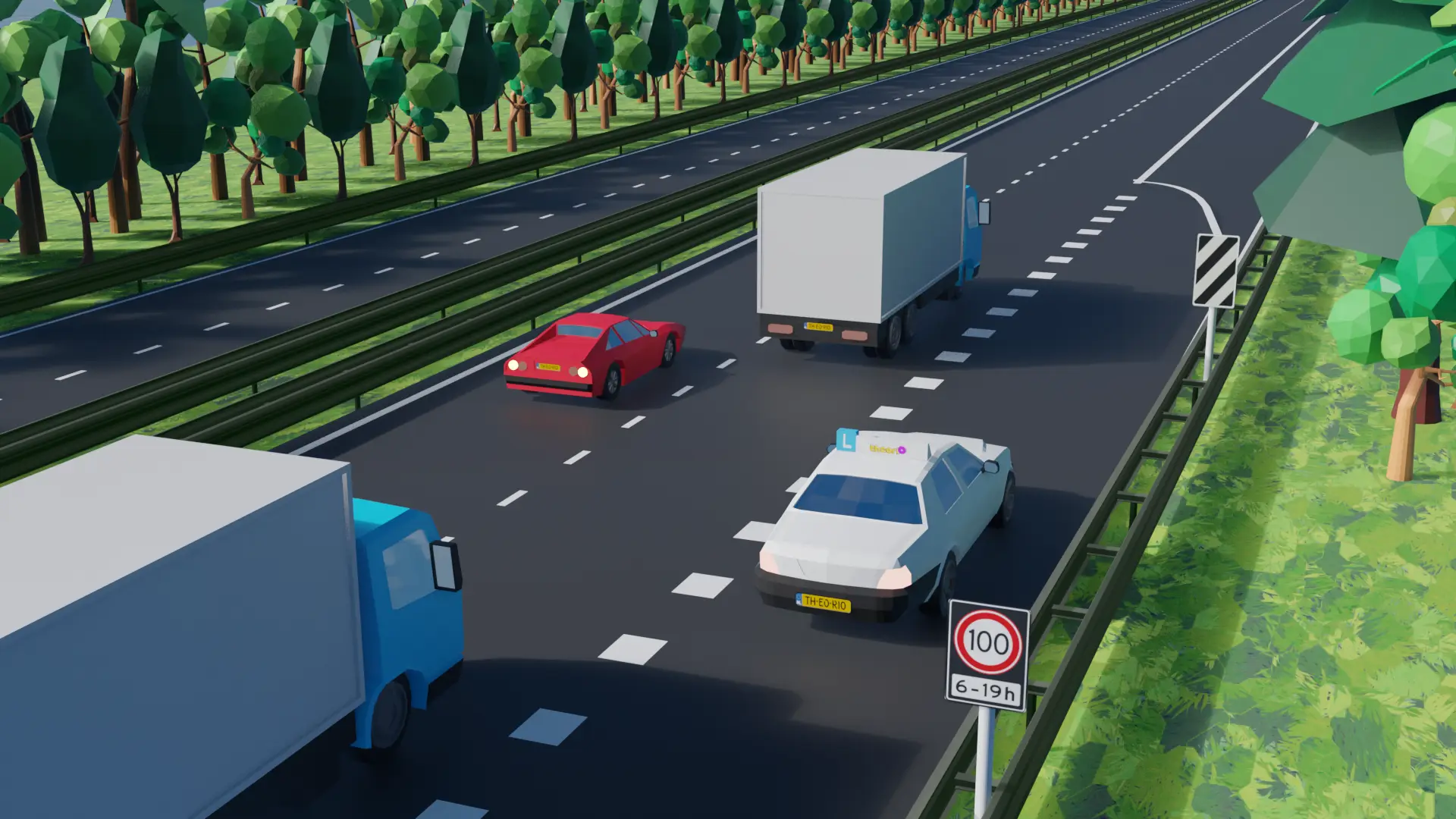
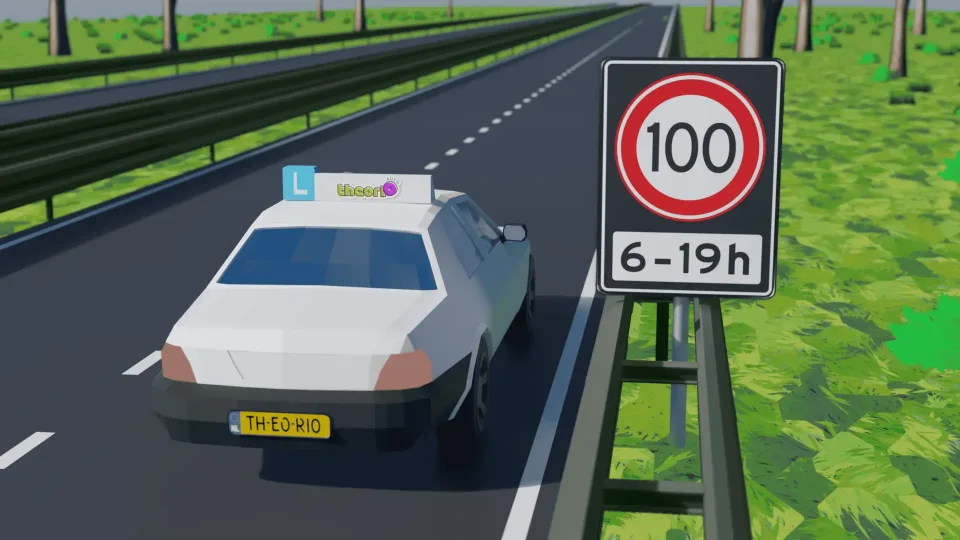
On the motorway (autosnelweg), there is a legal maximum speed of 130 km/h, but in practice it is often 100 km/h between 06:00 and 19:00. The minimum speed is 60 km/h. Matrix signs can temporarily adjust the maximum speed, for example during traffic jams.
Matrix signs and recommended speeds
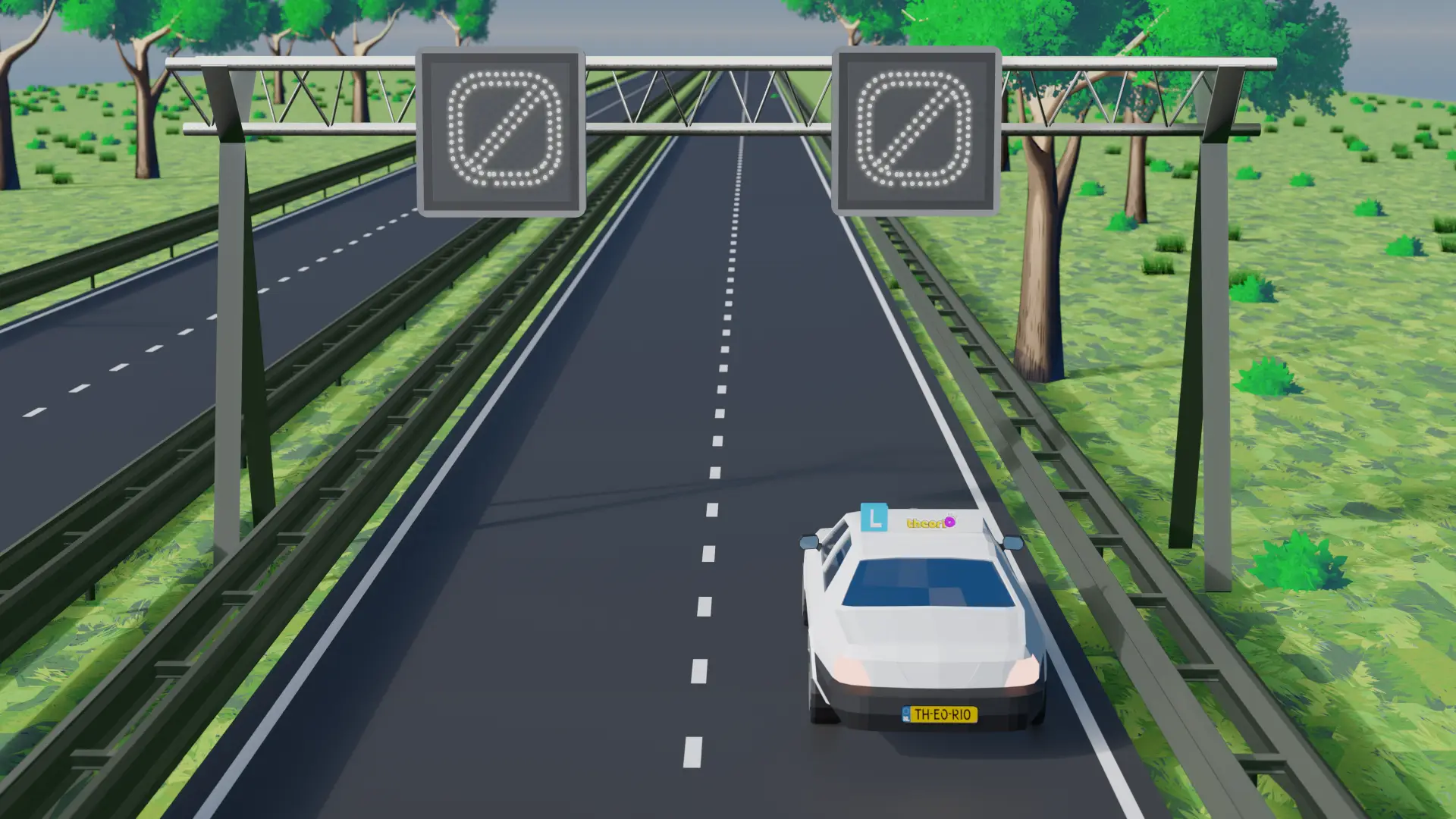
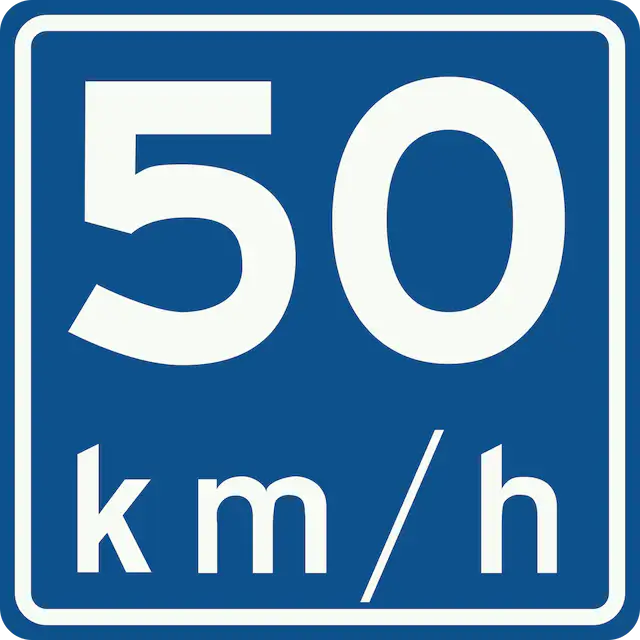
Matrix signs show current speed limits and are leading over fixed signs. They can also indicate the end of a speed restriction with a white square and a diagonal slash. In addition, there are blue signs with recommended speeds, especially near sharp bends. These are not mandatory, but it is sensible to follow them.
Safe merging onto the motorway
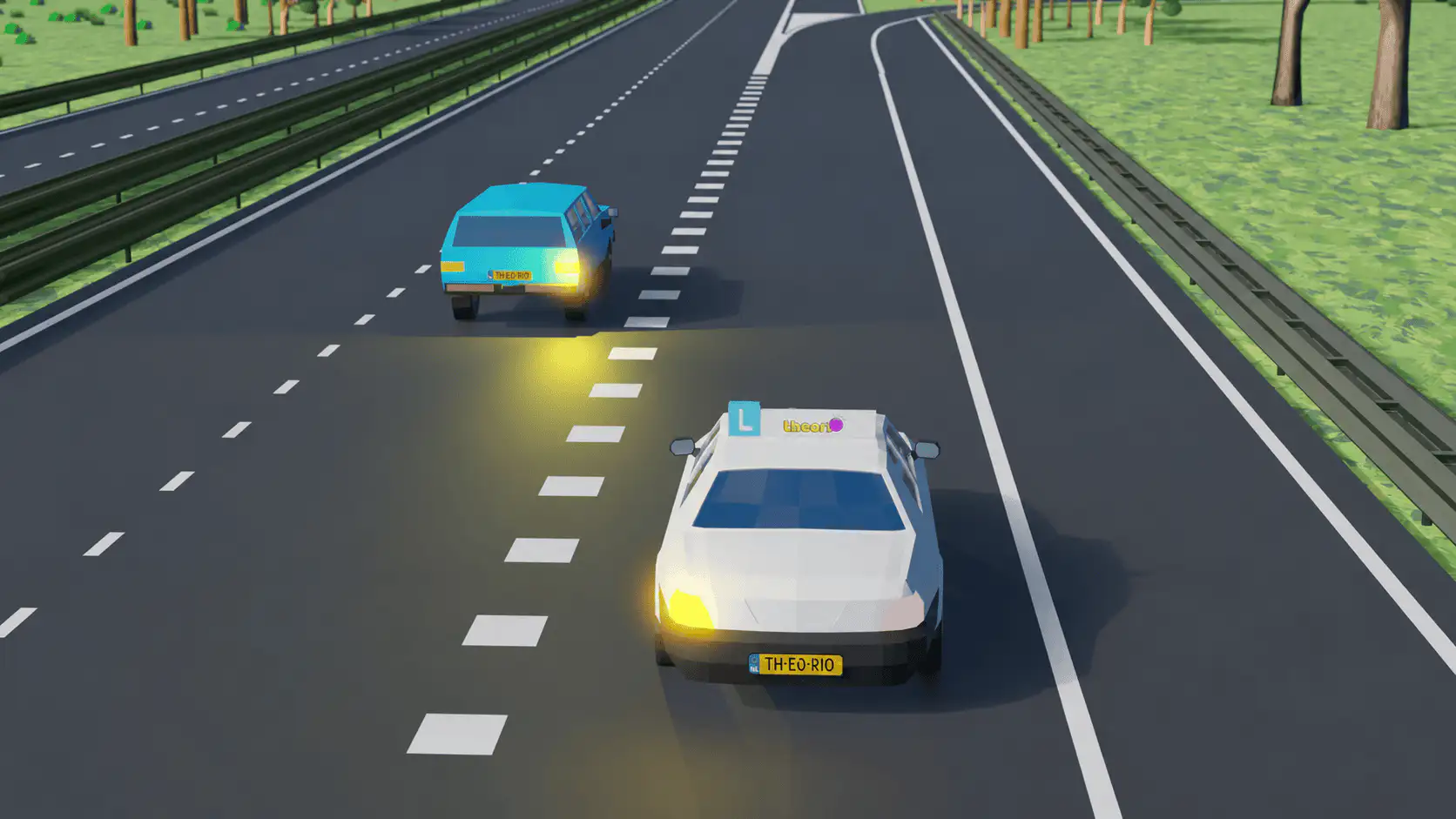
Merging onto the motorway requires that you build up a speed that fits the traffic. Although the minimum speed is 60 km/h, it is safer to match the speed of the through traffic, which may drive up to 130 km/h. Pay close attention to the traffic and use the acceleration lane wisely.
Lanes, rush hour lane, and block markings
Always choose the rightmost lane that leads to your destination. Block markings show where the road splits, and to the right of block markings you may overtake. An open rush hour lane is, at that moment, the rightmost lane—so then you are required to use it.
Keep your distance and the weather
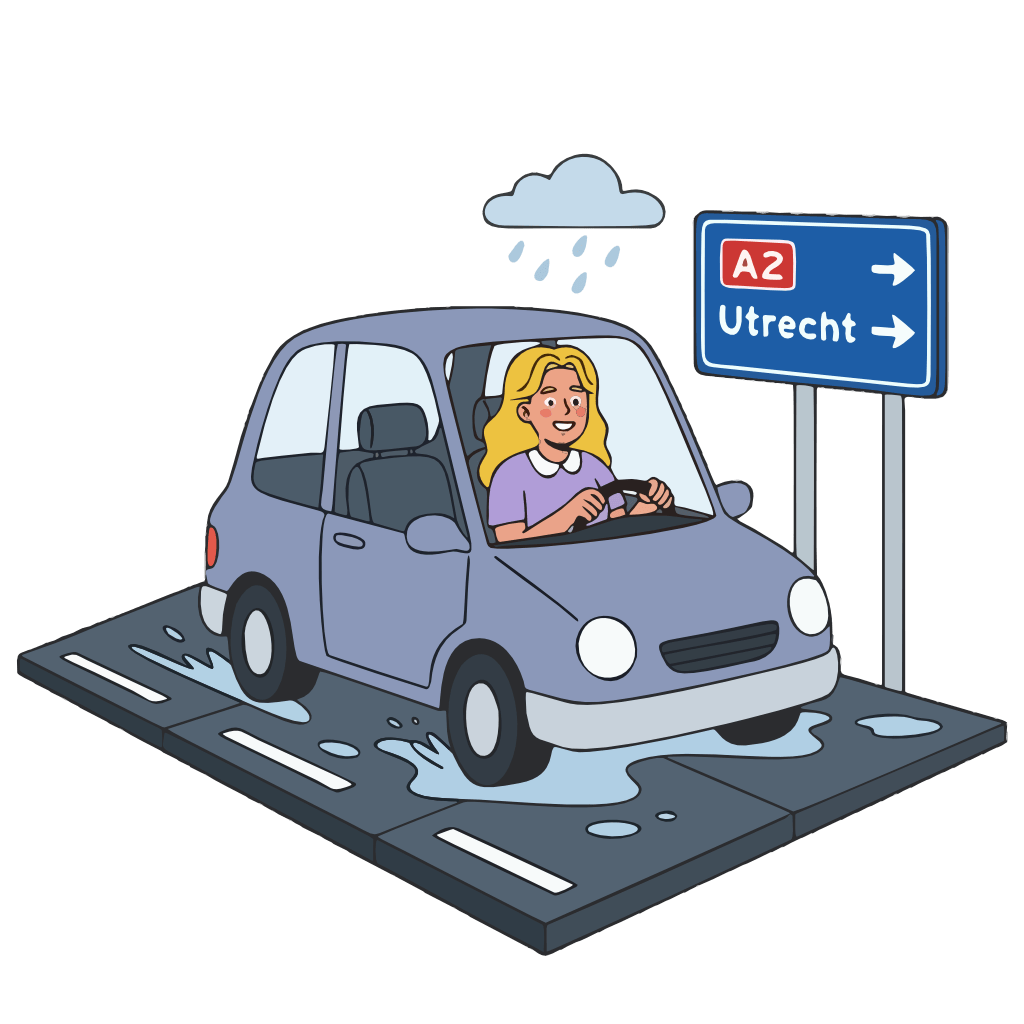
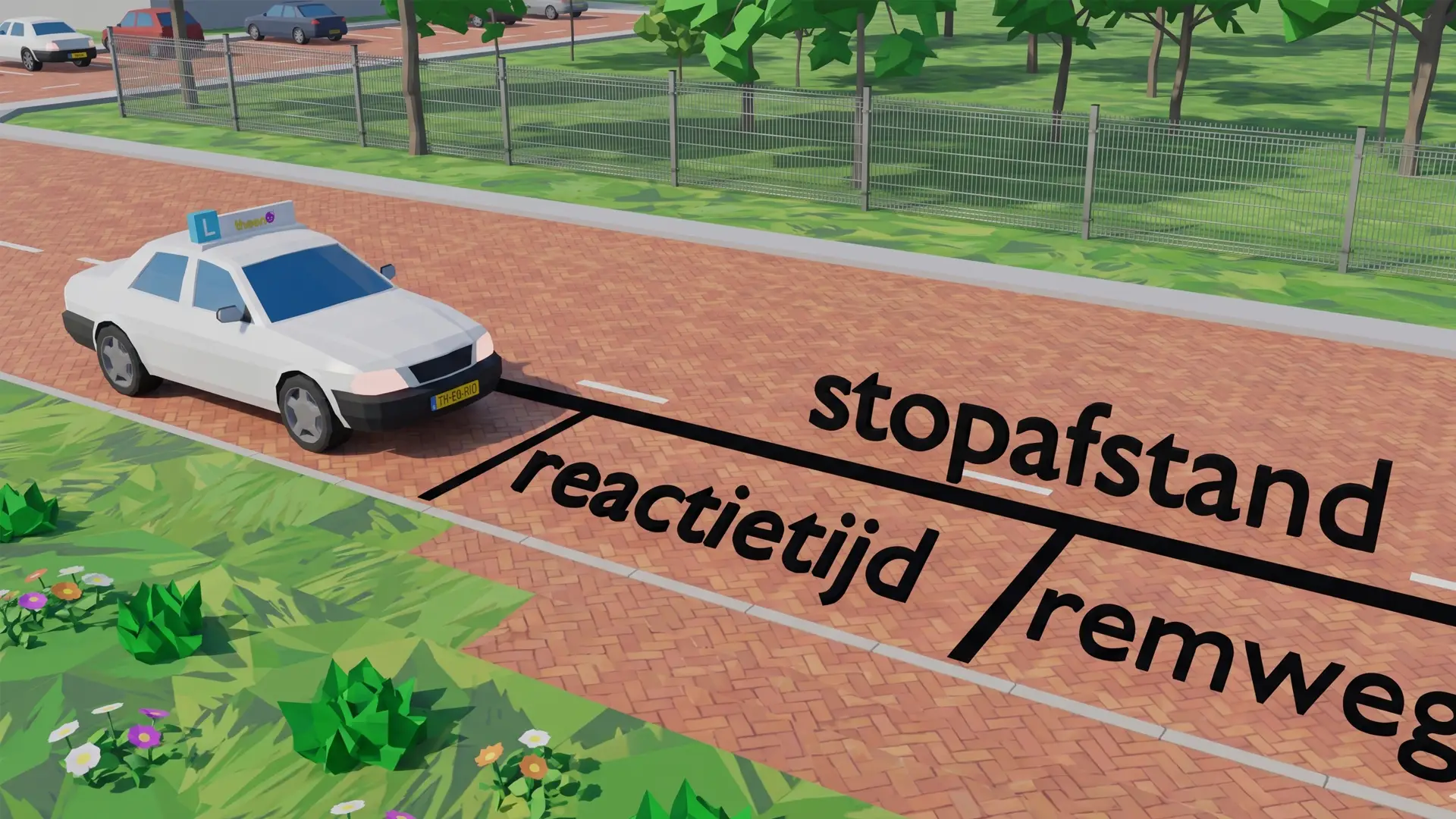
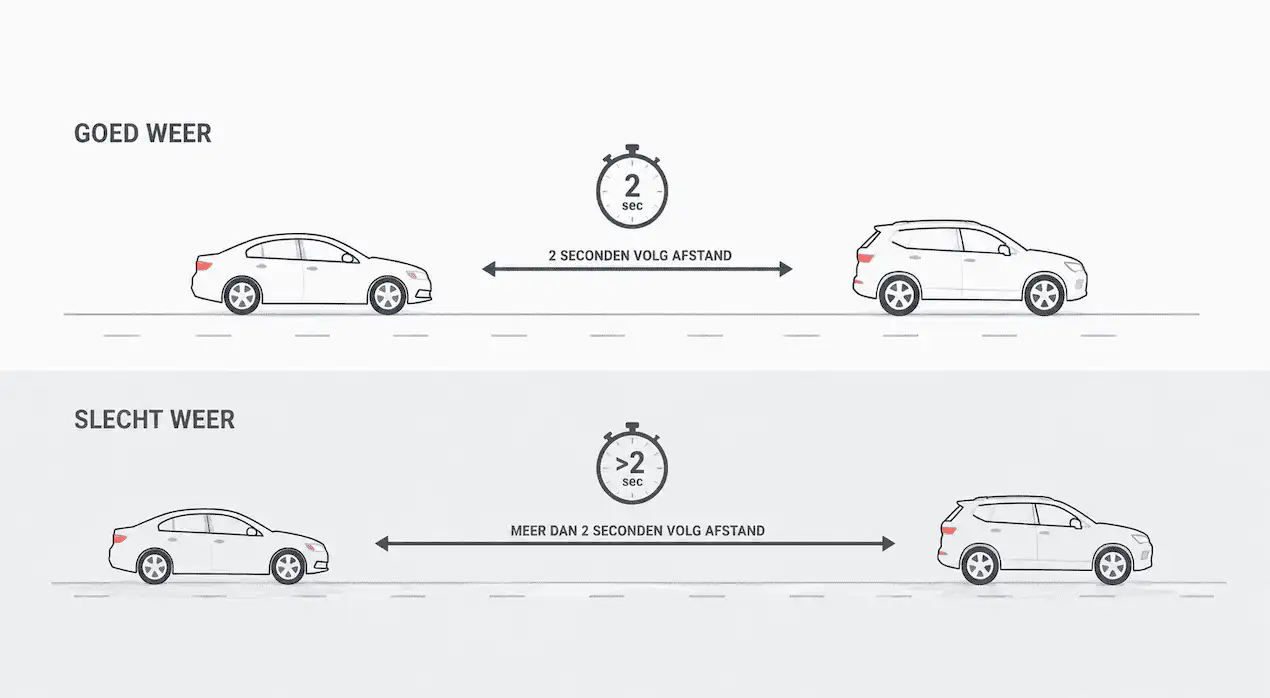
Your stopping distance is your reaction time plus your braking distance; under normal conditions keep at least 2 seconds’ distance. Wet road surface, rutting (spoorvorming), and icy conditions make your braking distance longer. If you risk losing control—due to aquaplaning, a skid, or a blowout—let off the accelerator.
Summary of speed limits
Motorway: max 130 km/h, min 60 km/h (in practice often 100 km/h during the day)
Road (autoweg): max 100 km/h, min 50 km/h
Outside the built-up area: standard max 80 km/h
Inside the built-up area: standard max 50 km/h
erf: max 15 km/h
Merging on and off are special manoeuvres: you give priority to everyone who is already driving on the lane you want to go to.
For the CBR, this part is all about one thing: you build up speed on the acceleration lane and slow down on the deceleration lane—never the other way around.
Key rule for the exam: don’t merge using only the motorway’s minimum speed. Build up speed on the acceleration lane, so that when you merge you have about the same speed as the traffic on the main carriageway.
Recognising that you need to merge
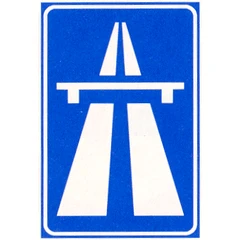
You are on a motorway when you see the blue sign with the double carriageway and the viaduct. An acceleration lane runs alongside the main carriageway and ends; so you have to leave it before the end.
CBR decision rules when merging
Use the acceleration lane to build up speed.
Adjust your speed to match the traffic on the main carriageway.
60 km/h is not automatically safe for merging; it is only the minimum speed of the motorway.
Merging is a special manoeuvre: you give priority to all drivers who are already driving on the lane you want to go to.
You don’t have to drive the acceleration lane all the way to the end. If you have enough speed and there is space, then you merge.
Never merge multiple lanes at once. Merge calmly, wait a moment, look again, and then move one lane further only after that.
The exam question is often: what is safe or not safe here? Then the correct answer is usually that you don’t merge too slowly; first build up speed and then merge in the rhythm of the traffic.
Use the acceleration lane to build up speed, then merge into traffic.
Where is the traffic you will be joining?
“Matching the traffic” is easier when you know how fast that traffic may go. Not everyone drives equally fast on the main carriageway.
Passenger cars: max 130 km/h, in practice often around 100 km/h.
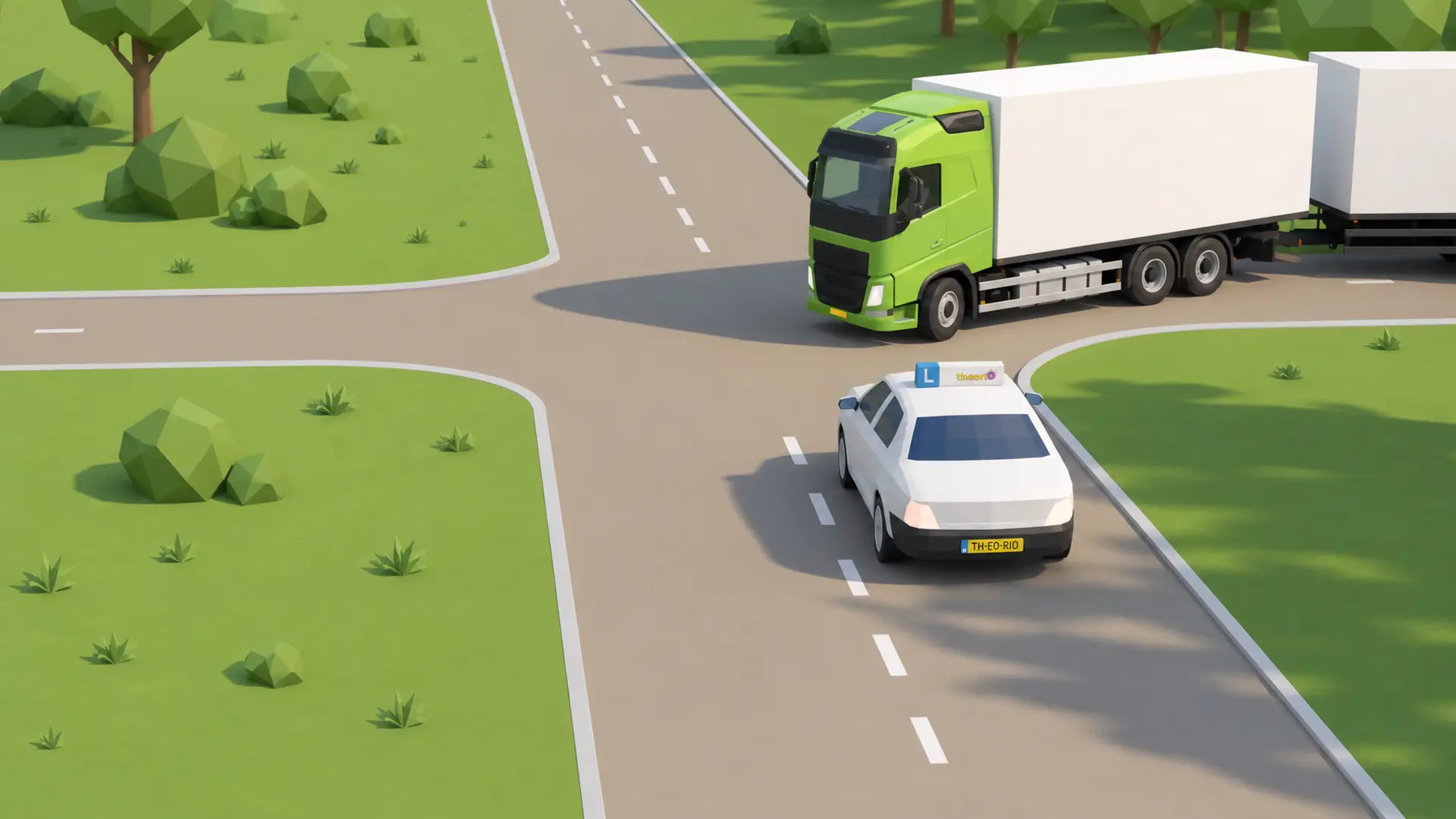
Lorries: max 80 km/h. They usually drive in the right-hand lane—the exact lane where you merge.
Buses and coaches: max 100 km/h.
If you want to merge between two lorries, you therefore adjust your speed to their speed, not to the speed of the fastest traffic. If you don’t, then you have to brake hard again shortly after merging—and that is exactly what you wanted to prevent.
Leaving the motorway: where you slow down
When leaving the motorway, it’s the same idea, but reversed. You brake on the deceleration lane, not before it.
If you start driving more slowly on the main carriageway, you hinder the traffic behind you and disrupt the flow. So keep your speed until you are on the deceleration lane, and only then reduce your speed.
Merging and leaving at the same time
Do you want to merge while someone else wants to leave at the same spot? Then you both perform a special manoeuvre. Think of a bus: first let people get off, then only get on. So you wait until the other one has left.
First let them leave, then merge—just like when getting on and off a bus.
Driving off a traffic jam
If you see a traffic jam further ahead, there is one thing you do immediately: turn on your hazard warning lights—also called alarm lights or emergency lighting. This warns the traffic behind you that something is wrong.
Then let your car roll out calmly and brake in time. This prevents you from having to brake hard at the last moment—the classic cause of a rear-end collision on the motorway.
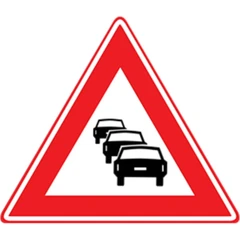
Sign J33 (Traffic jam): you are approaching a place where traffic jams regularly occur. Matrix signs often reduce the speed here well in advance.
Helping the flow yourself
You can’t solve traffic jams on your own, but you can make them worse. Two things help:
Stay as much as possible in the same lane. Every time you change lanes, someone else has to make space for you, and that slows down the entire lane.
Drive at a constant speed. The more predictable the traffic, the better the flow and the fewer accidents.
Hazard warning lights on, roll out calmly, brake in time.
CBR trap
Many students choose this when merging: “On the motorway I may drive at least 60 km/h, so I can merge with 60 km/h.” That is exactly the mistake. On the main carriageway, passenger cars often drive much faster, which can lead to a rear-end collision.
❌ 60 km/h is the minimum speed, so I can merge with it.
✅ 60 km/h is only the lower limit of the motorway. Your merging speed determines the traffic on the main carriageway, not the law book.
You've covered Motorways: merging on and off. Does it stick?
On the motorway, this topic is about overhead signal signs above the lane: if you see an active speed indication on a matrix sign, that speed is leading.
If you see a white square with a diagonal stripe, the previously indicated matrix signs end and you follow the normal speed for that road again, unless other signs indicate otherwise.
Key rule for the exam: block markings show where the road splits. If you drive to the right of the block markings, you may pass the traffic on the left of them—this is one of the five exceptions to “overtaking on the left”.
What are block markings?
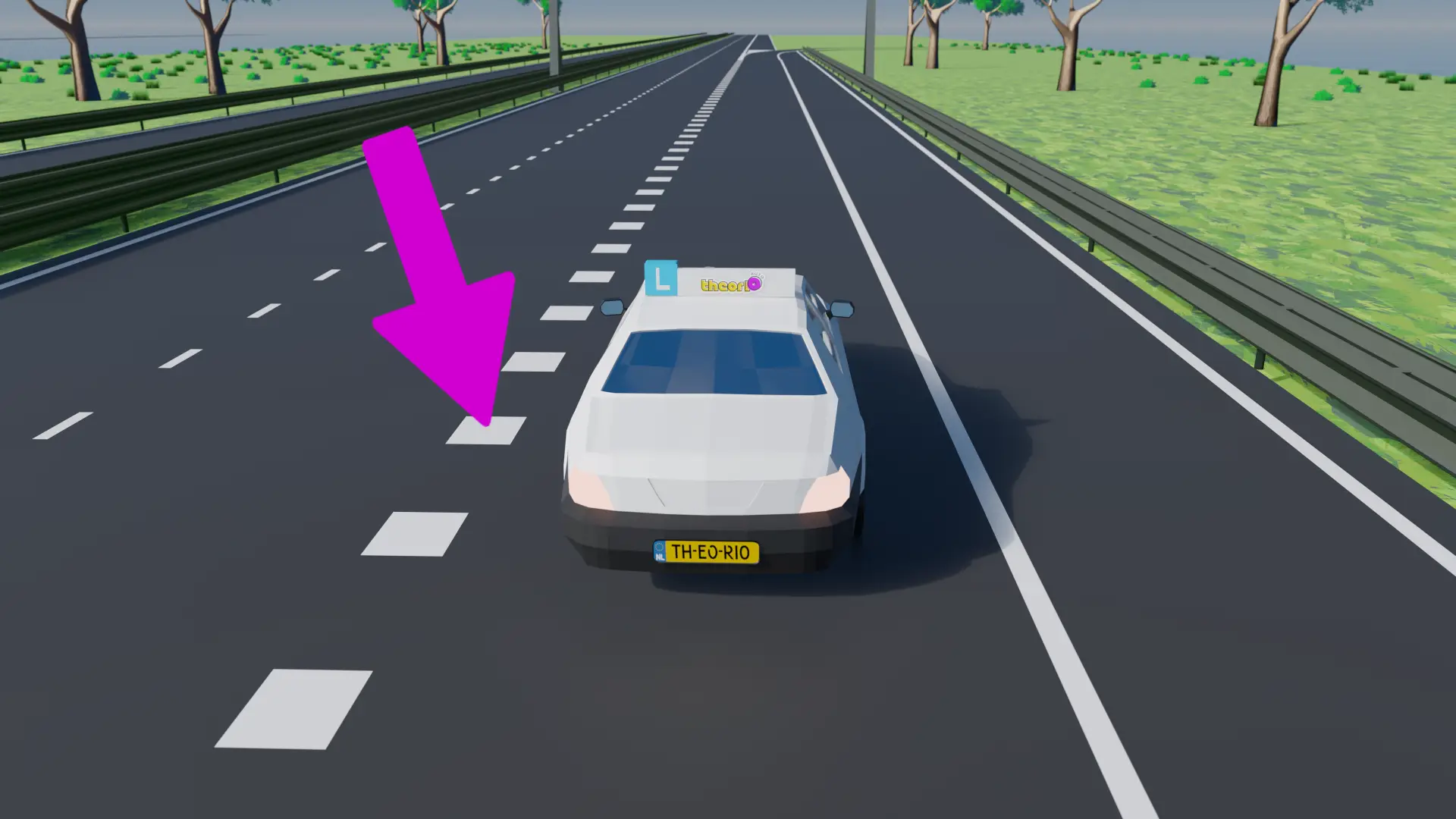
Block markings consist of wide white blocks on the road surface. You encounter them where the motorway splits: at an exit, at a junction, or where one motorway divides into two routes. The blocks show that the two parts of the road truly separate from that point.
For the exam, there are two things you can read from block markings:
Which lane goes where. Together with the blue signs above the road, you can see from the block markings which lanes belong to which route.
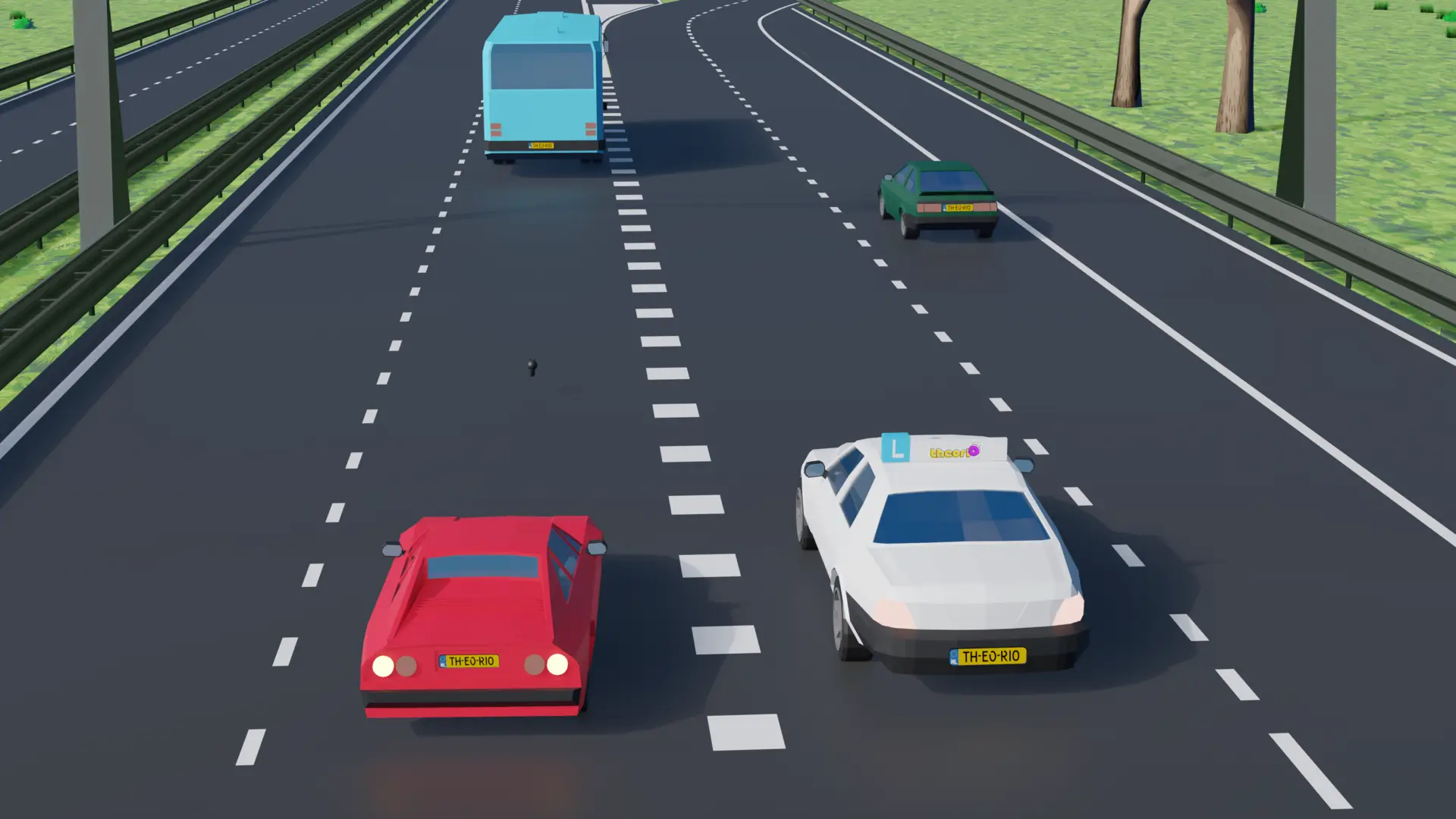
That you may overtake there on the right. If you drive to the right of the block markings, you may pass the traffic on the left of them.
Wide white blocks: from here the two parts of the road separate.
The five exceptions to “overtaking on the left”
Normally you overtake on the left. There are five situations in which you may overtake on the right, and block markings are one of them.
Block markings. If block markings are between you and the person you are passing—for example at an exit—then you may overtake them on the right.
Traffic jam. If the traffic on your lane is driving a bit faster than the traffic to the left of you, as in a traffic jam, then you may.
Roundabout. On or just before a roundabout with multiple lanes, you may overtake on the right.
Tram. You overtake a tram on the right.
Someone who has pre-selected for the left. If a driver is waiting to turn left and there is space on the right, then you don’t have to wait with them. Pay attention: you may only cross a cycle lane if there is a broken line there.
To the right of the block markings: passing is allowed here, even if the traffic on the left of you is driving slower.
Which lane do you have to be in?
You don’t only pre-select at intersections and roundabouts. On the motorway too, you consciously choose a lane, and the rule is the same as everywhere: the rightmost lane that leads to your destination.
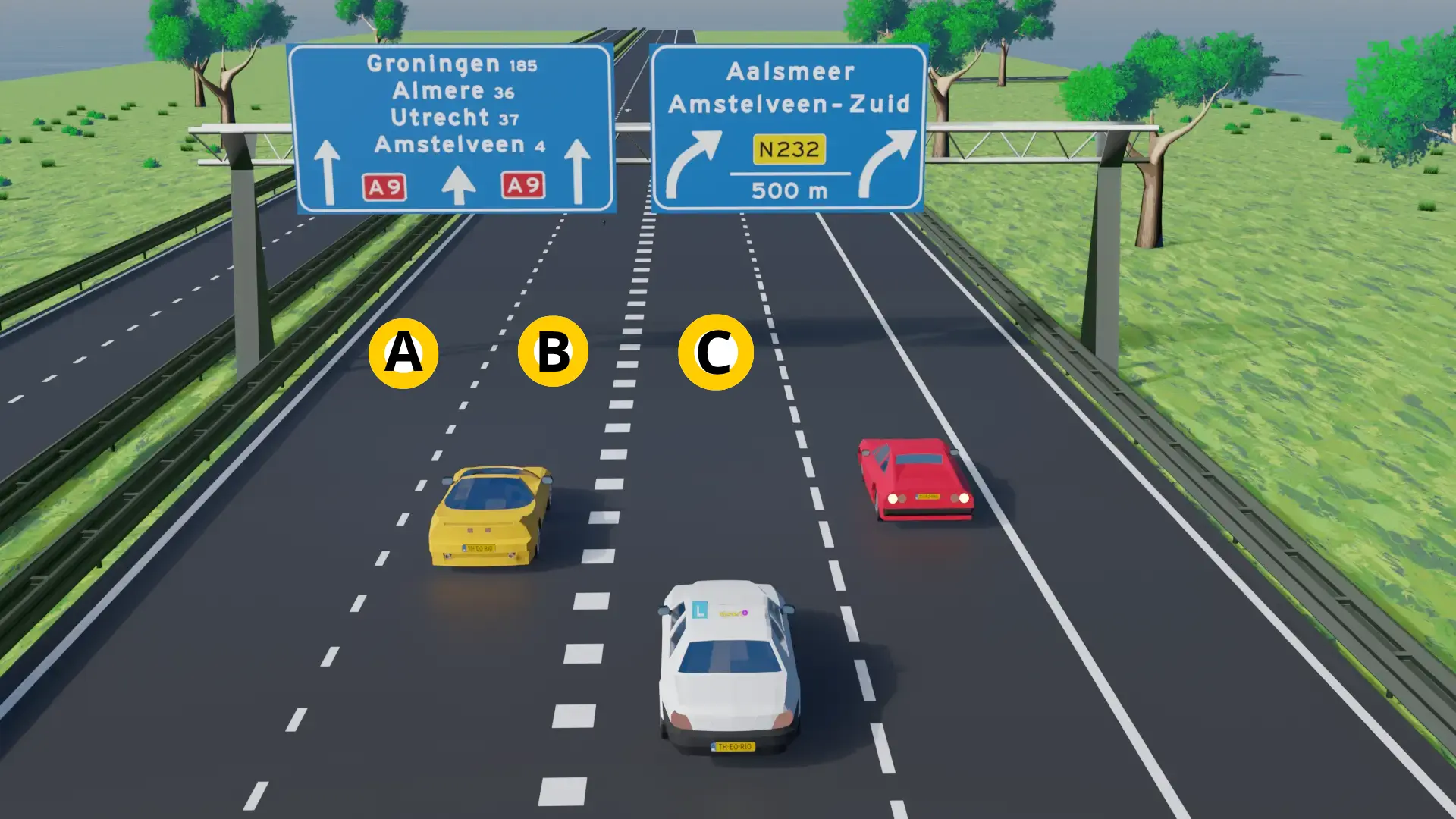
Read that from the blue signs above the road. If multiple lanes go your way, you take the rightmost of them. A lane that doesn’t go your way is eliminated—and the leftmost lane is only there for overtaking.
If you want to go to Nijmegen, lane B is the correct one: A is only for overtaking and C does not go your way.
Example situations like in the exam
Situation 1 — one lane to Breda
Your destination is Breda and you are driving with a trailer. On the sign above the road you can see that only one lane leads to Breda. Further on, the block markings show that this is the leftmost lane.
Correct decision: move to the left in time. Having a trailer makes no difference here; that lane is the only one that goes your way.
Situation 2 — a split where both routes are good
On the way to Rotterdam you come across a split. The block markings in the middle divide the motorway into two parts, and both routes lead to Rotterdam. On the left sign it says that the left route is prohibited for lorries.
Correct decision: with a passenger car you may take both routes, and on the route you choose you keep as far right as possible. Lorries must take the right route here.
The block markings split the road into two routes; both go here to Rotterdam.
You've covered Motorways: block markings. Does it stick?
On a motorway hard shoulder lane, active matrix signs are leading. If you see a red cross above a lane, you may not use that lane; if you see a speed, that maximum speed applies.
For the CBR exam, first look at the signals above the road and only then at the normal motorway situation.
Key rule for the exam: if the rush hour lane is open, then at that moment it is the rightmost lane—and then you are required to use it.
What is a rush hour lane?
A rush hour lane is an extra lane on the motorway that is only opened during busy periods. On many roads, it is the hard shoulder that is released during rush hour; that’s where the name comes from.
If it is open, you may drive over the white continuous line that normally closes it. At that moment, you may temporarily ignore that line.
And then comes the rule that many students miss: at that moment, the rush hour lane is the rightmost lane. Because you always have to keep as far right as possible, you are required to use it. Leaving it unused because “it is actually the hard shoulder” is not allowed.
Three ways you can see that it is open
You don’t have to get it only from the signalling. When a rush hour lane is opened, you can see it in three ways at the same time:
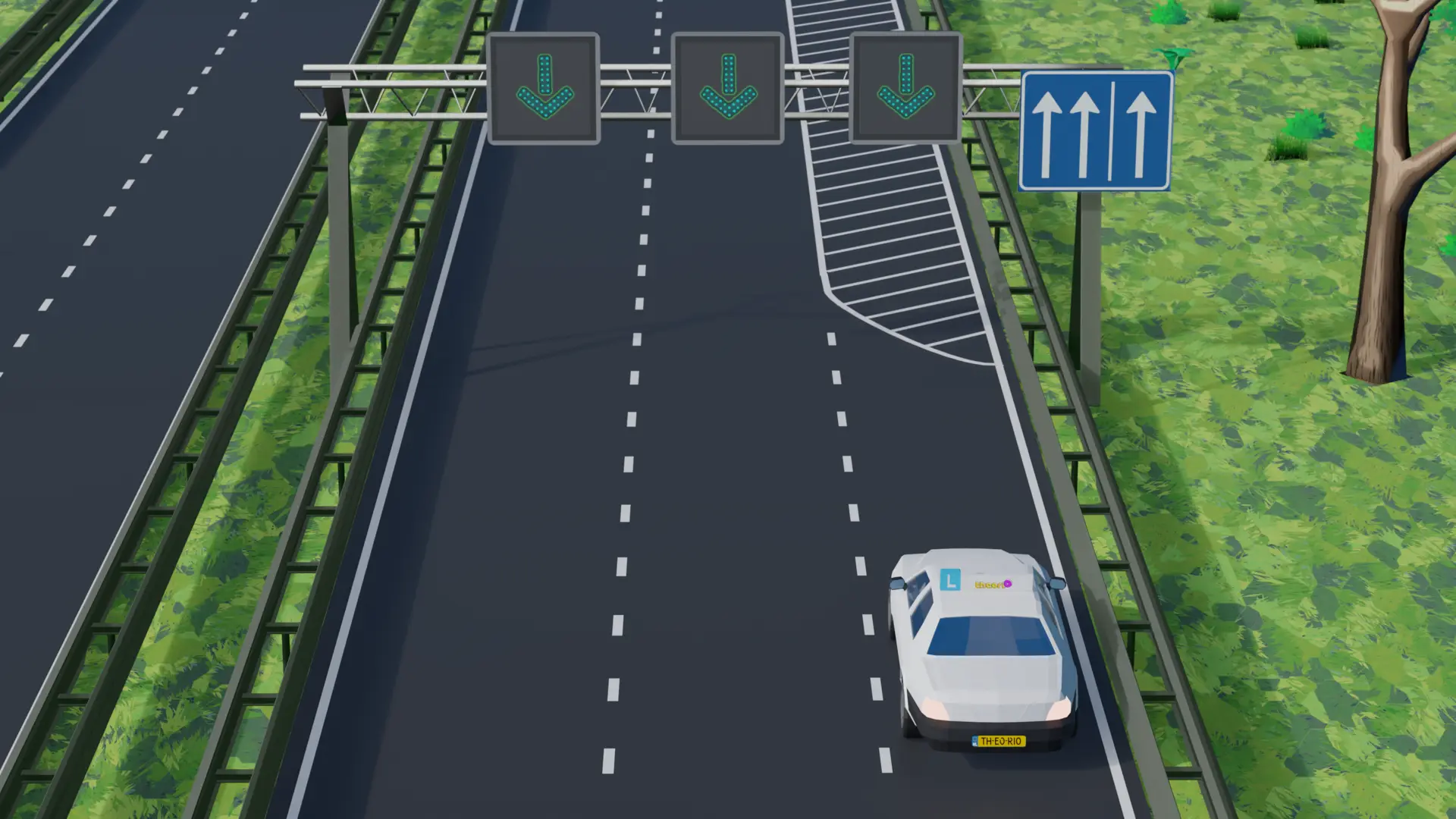
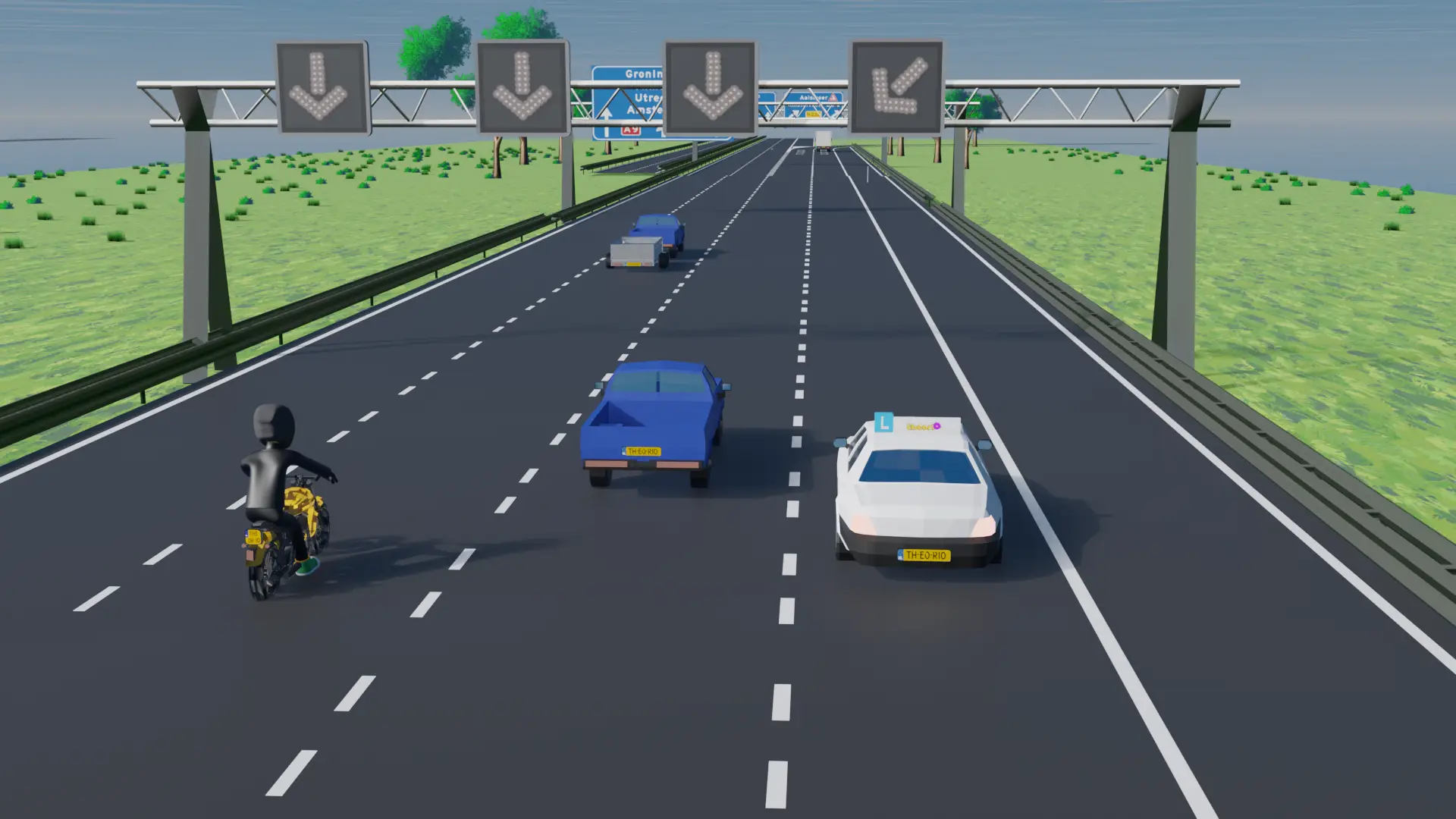
A green arrow pointing down on the matrix sign above the lane. The arrow belongs to the lane underneath and means: this lane is open.
A sign along the road with the text “rush hour lane open”.
A sign with the number of lanes of the normal carriageway (as arrows), followed by a continuous line with the rush hour lane next to it.
Green arrow pointing down: the rush hour lane underneath is open and then becomes your rightmost lane.
The other symbols on a matrix sign—a number, a red cross, a diagonal arrow, the end symbol—work here the same as elsewhere on the motorway. Their meaning is explained under Motorway rush hour lanes.
Three signs that look similar
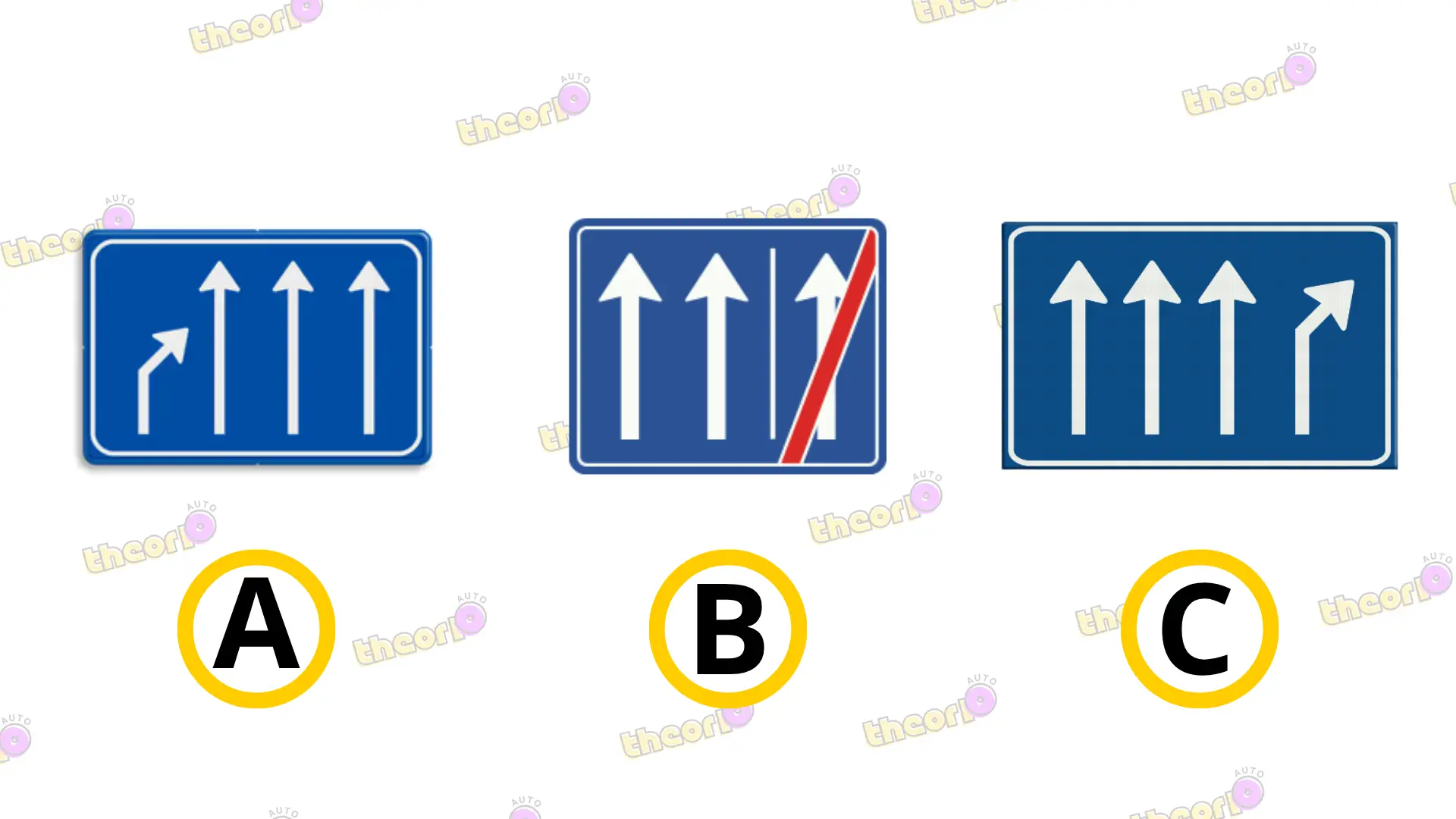
Around the rush hour lane there are three signs that at first glance look almost identical. The difference is what happens to that extra lane.
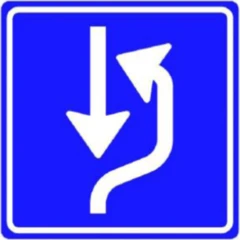
Sign A: you have to leave the lane and go back to the normal carriageway.
Sign B: the rush hour lane is closed; you may not use it.
Sign C: an exit; you leave the lane.
A = leave it, B = closed, C = exit. Look at what happens to the right-hand lane.
You've covered Motorways: rush hour lane. Does it stick?
A matrix sign is an electronic signalling sign above or next to the carriageway. When it is lit, it goes before every fixed traffic sign and before the road’s normal speed.
For your exam, you must keep the four symbols separate—number, red cross, diagonal arrow, and end symbol—and know when a speed is mandatory and when it is only advice.
Key rule for the exam: an active matrix sign is a traffic sign and goes before the fixed signs and the road’s normal speed.
What is a matrix sign?
Matrix signs are the electronic signalling signs above the lanes on the motorway. They can also be located next to the carriageway. They are square, but they have their own function: they can indicate something different per lane and change while you are driving.
Pay attention to the shape difference. A normal square sign usually means something is allowed; with a matrix sign, that rule does not apply.
A matrix sign is not a separate type of rule: it has the same meaning as a normal traffic sign—it just comes first.
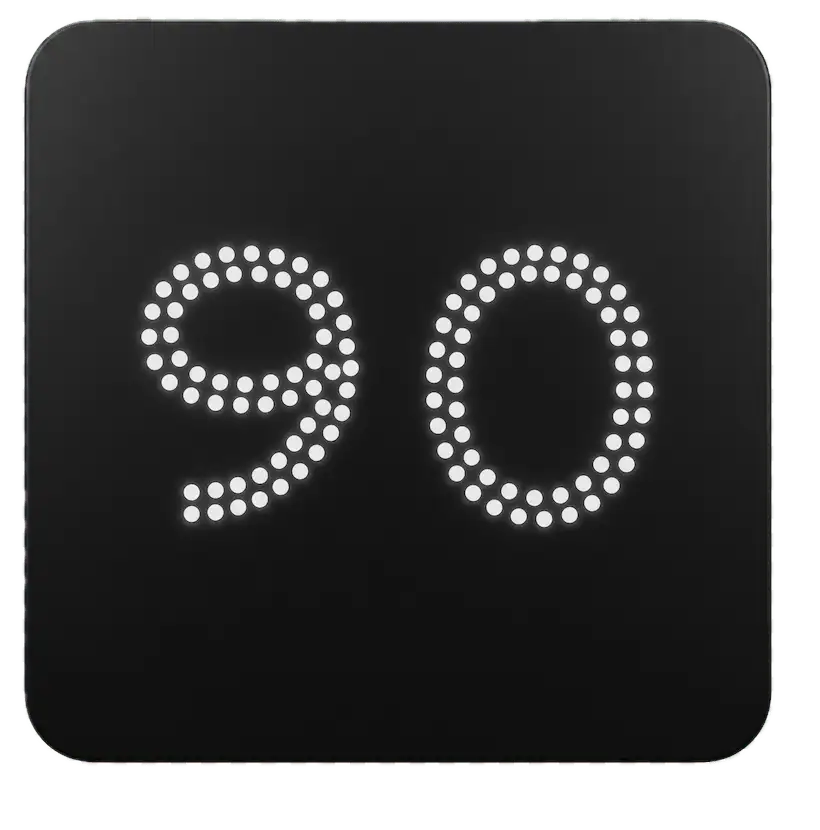
If a number is lit above your lane, then that is the applicable maximum speed.
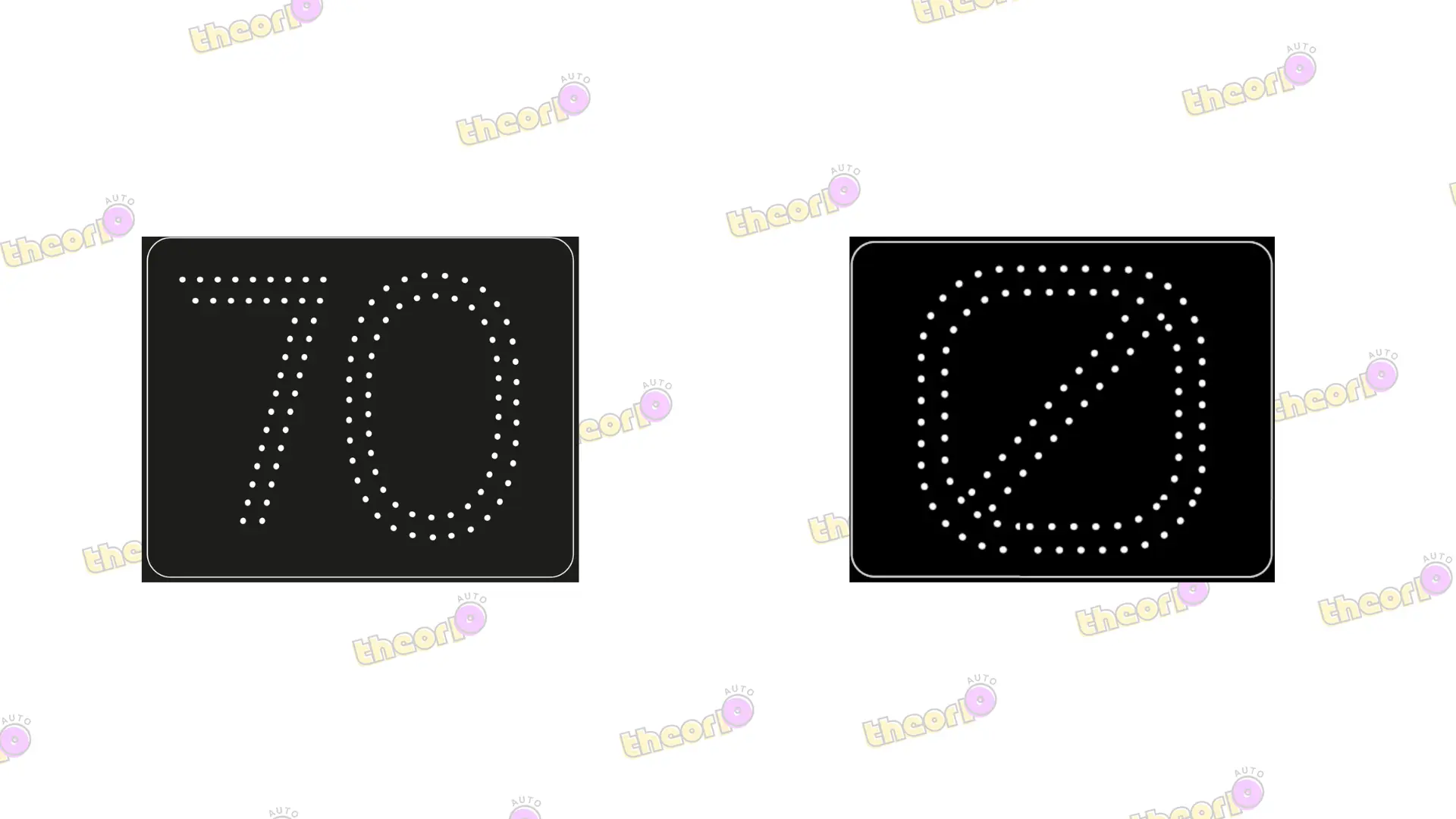
Concretely: if there is a fixed sign along the road with 100 km/h and above your lane a matrix sign shows 70, then you drive 70. You keep to that 70 until you see the end symbol; after that, the 100 from the fixed sign applies again.
Back from 70 to the road’s own speed: that is what the end symbol on the right does.
The four symbols you must recognise
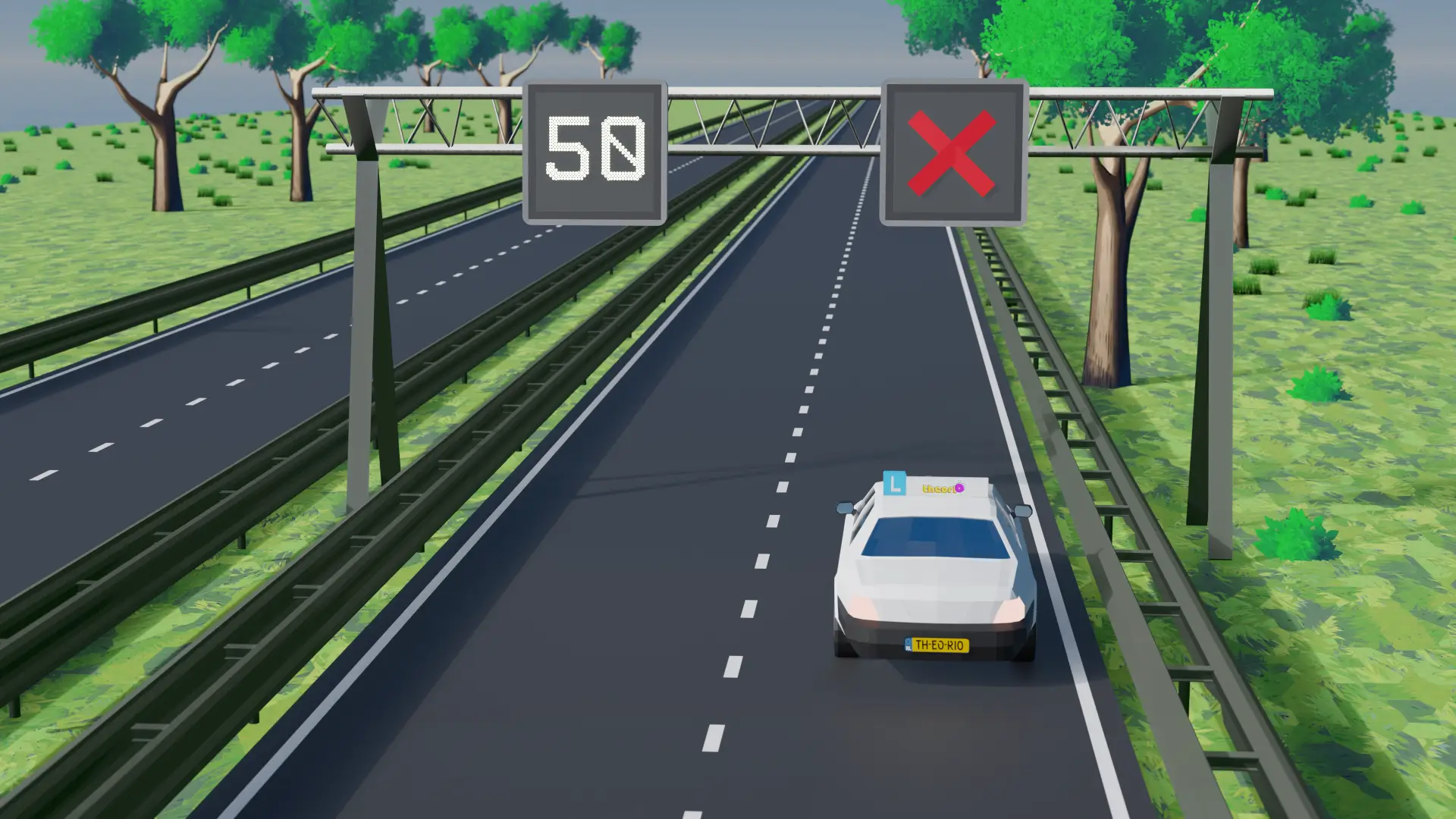
Number — a mandatory maximum speed for that lane. No advice.
Red cross — you may not use that lane.
Diagonal arrow — leave this lane in the direction of the arrow.
White square with a diagonal slash — end of all previously indicated matrix signs. After that, the normal road speed applies again, unless another sign indicates something else.
White square with a diagonal slash: all earlier matrix indications become invalid.
Diagonal arrow and red cross: the difference is the timing
The diagonal arrow and the red cross both seem to say “don’t drive here”, but they are shown at a different moment.
Diagonal arrow: you are not there yet. The lane ends soon, and you still have room to merge into the lane next to it in the direction of the arrow. This merging is called ritsen.
Red cross: you are already at the closure. It is too late to merge in. You must stop and wait until there is space. If you drive on under a red cross, you risk a fine.
Two symbols, two moments: the arrow is still possible, the cross is not anymore.Diagonal arrow: your lane ends, merge in by ritsen.
Why they switch on
Matrix signs usually switch on automatically. They warn for a traffic jam or a closed lane further ahead and reduce the speed well in advance, so you can slow down calmly instead of having to brake fully at the last moment.
Above an open rush hour lane you can see a fifth symbol: a green arrow pointing down. What that means is explained under Motorway rush hour lanes.
Mandatory or advice?
This is where, in the exam, it goes wrong most often. Three signs give a speed, and only two of them are mandatory.
Sign
Meaning
Mandatory?
Active matrix sign with a number
New maximum speed
Yes
Around a white sign with a red border
Mandatory maximum speed
Yes
Square blue sign with white numbers
Recommended speed
No
White square with a diagonal slash on a matrix sign
End of earlier matrix indications
Yes, you follow the normal speed again
Diagonal arrow on a matrix sign
This lane ends like this—merge in by ritsen
Yes
Red cross on a matrix sign
Lane closed; too late to merge in, so stop
Yes
Four speed indications next to each other—only for B is the mandatory matrix speed applicable.
The recommended speed
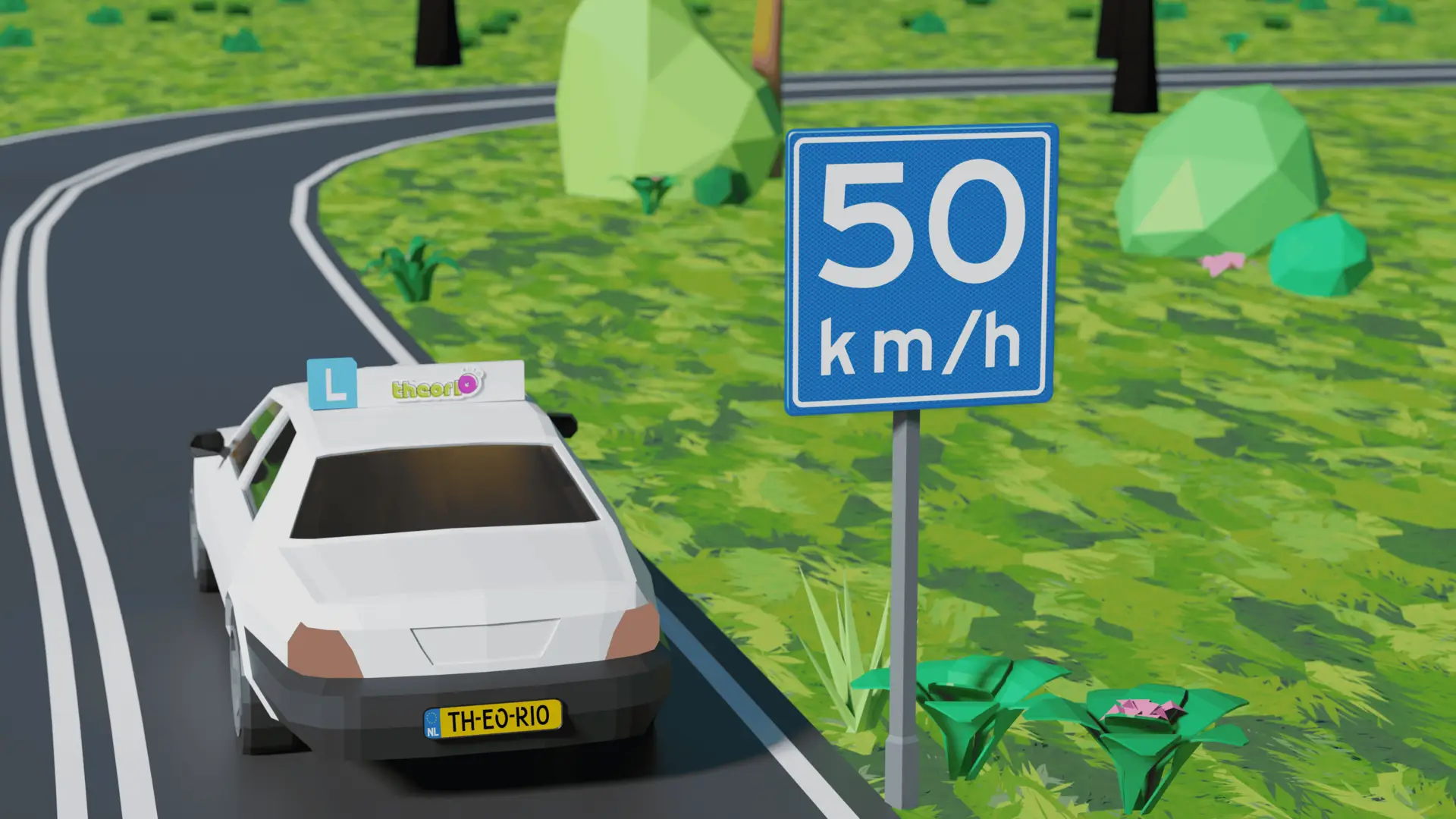
A square blue sign with white numbers is advice. You mainly come across it before a sharp bend. It is sensible to follow it, but you are not penalised if you drive faster—provided you stay within the actual maximum speed.
Square and blue: this is advice, not a maximum.In practice, the advice sign is usually placed just before a bend.
Other electronic signs above the motorway
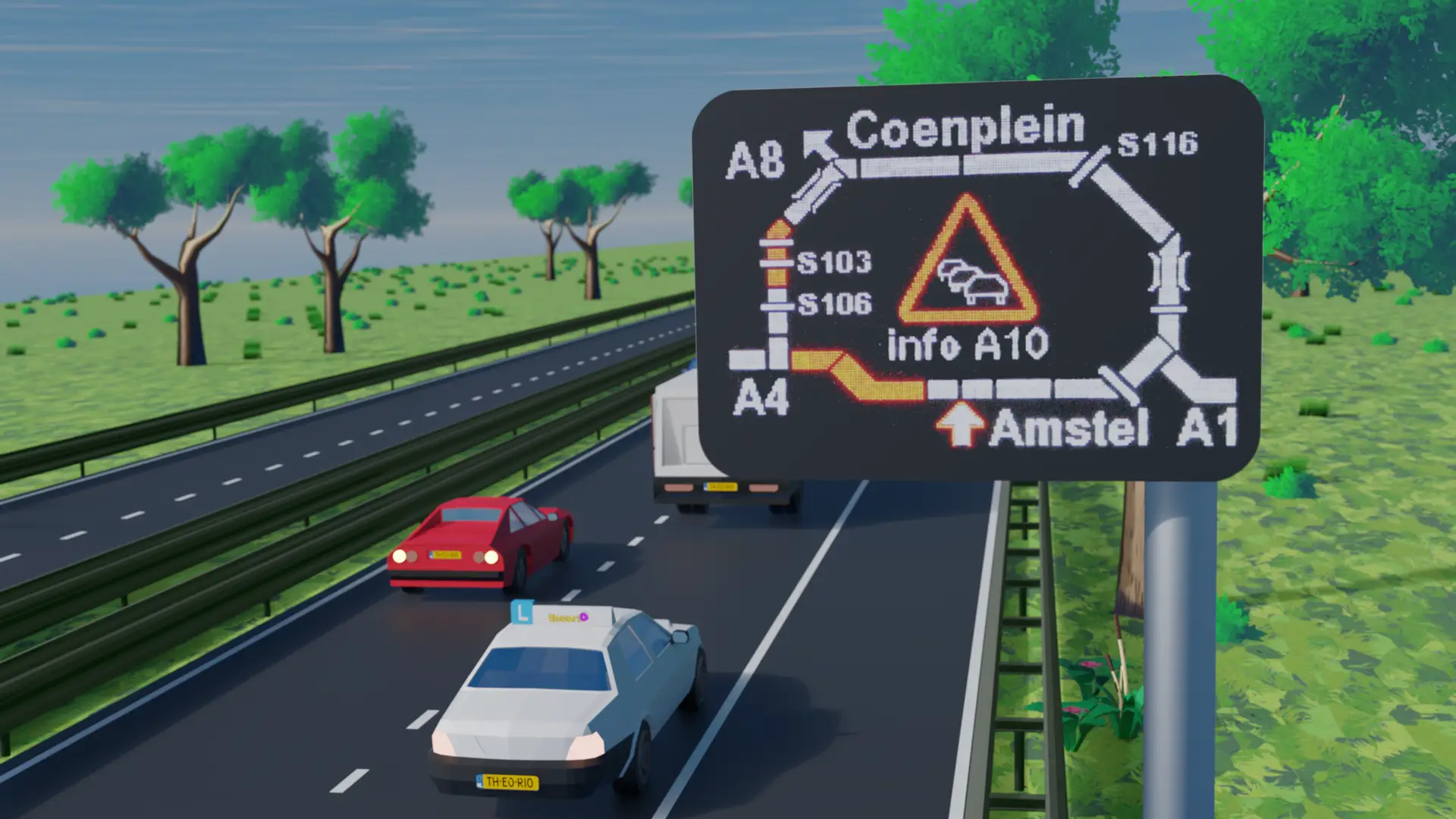
Traffic jam signs on a ring road
Large cities often have a ring road: a motorway that runs around the city and where all motorways in the surrounding area come together. Convenient connections, but traffic jams occur regularly.
Then there is a schematic sign above the road. On it you can see, from the coloured and white lines, what is fixed and what is not. If the route clockwise is full and the route anticlockwise is white, then it is better to go anticlockwise.
The ring road scheme: the marked route is fixed, the white one is free.
Travel time signs
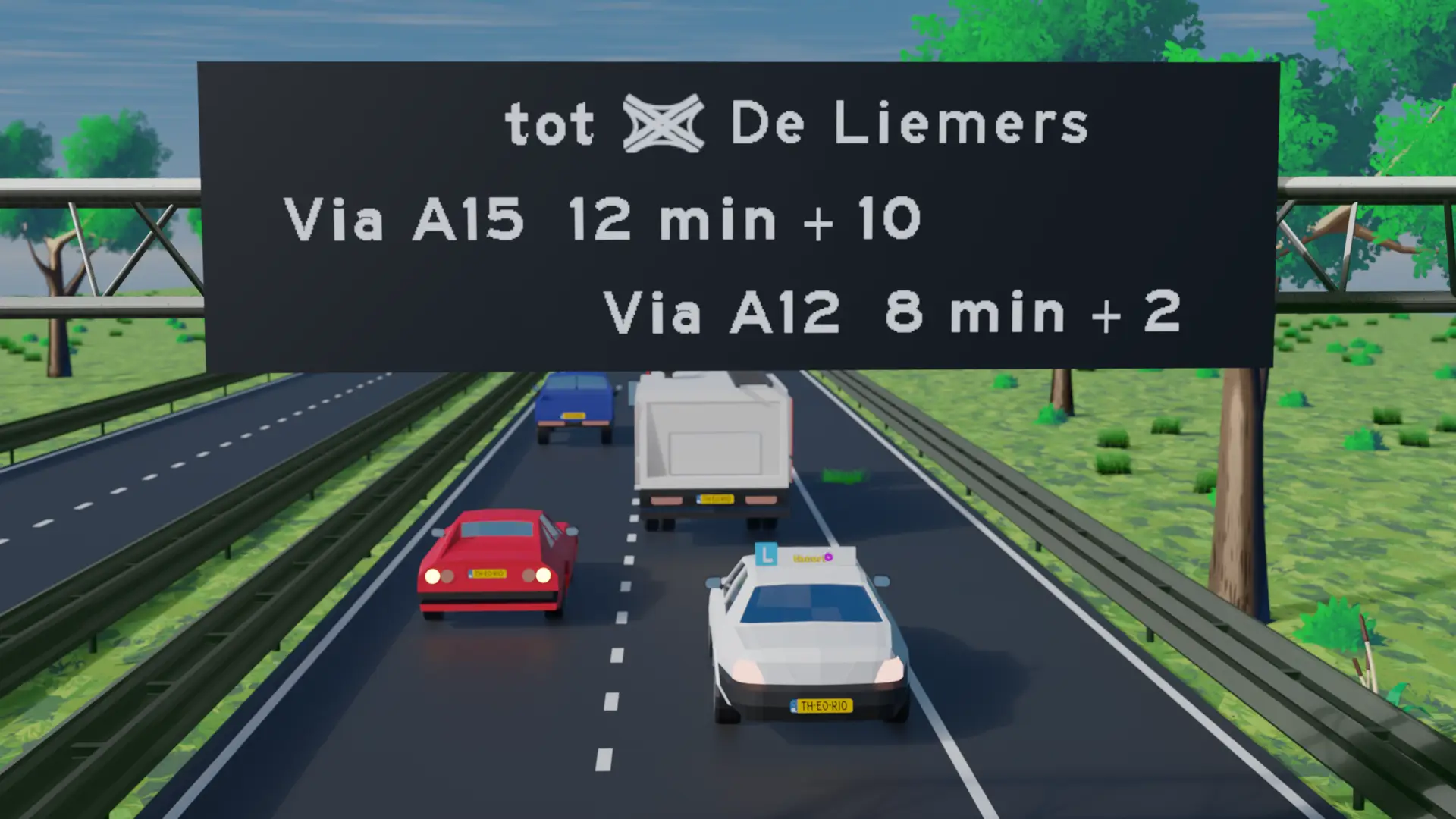
You also come across signs that give the travel time per route, with the delay included. If it says next to the A50 “22” with “+3” behind it, then that route is normally 22 minutes and now there is a 3-minute traffic jam. If there is no plus sign next to the A15, then that route is faster at the moment—even if it is normally longer.
Travel time plus delay: the normally fastest route is not always the one now.
CBR trap
The most common mistake is thinking that after a white square with a diagonal slash, the last shown lower speed remains valid. That sign actually means the opposite: the end of all previously indicated matrix signs.
❌ Square sign with a speed, so this is mandatory.
✅ Look at the colour: a blue square is advice, a lit matrix sign is mandatory.
You've covered Motorways: matrix signs. Does it stick?
The weather doesn’t change what you may, but it does change what is sensible. What you may is stated on the sign—and a sub-sign can add a condition, such as “only on wet road surface”.
One rule keeps returning in this section, in different packaging each time: losing control = let off the accelerator.
Key rule for the exam: if you are about to lose control, let off the accelerator. Don’t steer, don’t brake fully, don’t use the handbrake.
What the weather does to your car
The weather can change quickly and it immediately changes how you have to drive. Strong wind, low sun, rain, and fog all make driving more difficult in their own way. But the road itself also matters: nobody wants aquaplaning or a car that starts to skid.
For all those situations, there is one rule you have to know by heart, because the CBR tests it in dozens of variations:
Loss of control = let off the accelerator.
No matter what goes wrong: first let off the accelerator. Don’t steer, don’t brake fully.
Skidding
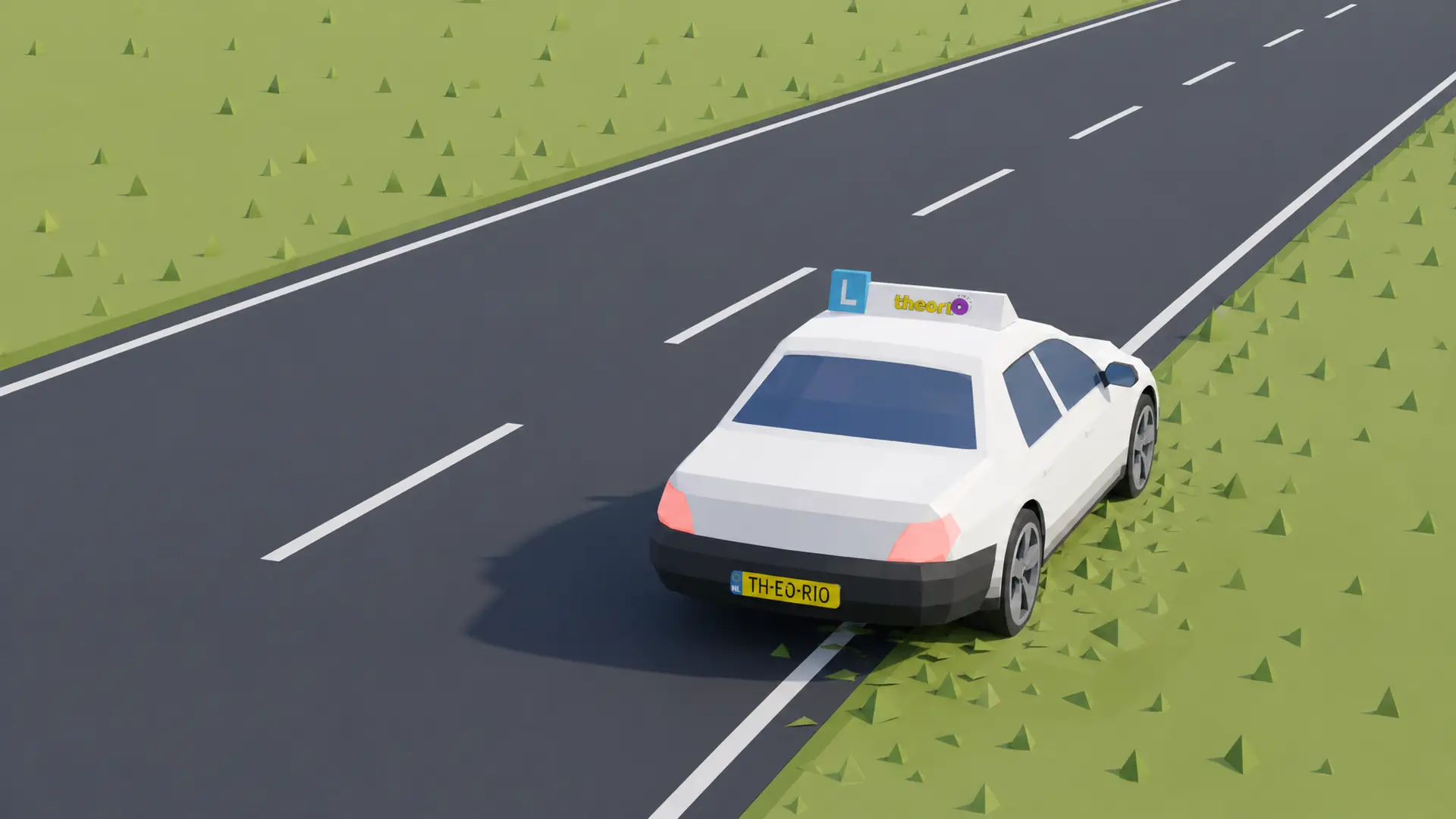
If your car starts to skid, first let off the accelerator. That allows your tyres to regain grip. If you keep giving gas, your wheels will only skid harder.
What you should not do: brake hard or use the handbrake. That locks your wheels, and then they all slide.
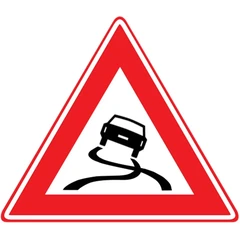
Sign J20 (Skid risk): the road surface may be slippery. Remember: skid risk always means a longer braking distance than normal.
Slipperiness: also above freezing point
Ice formation can already occur even if, according to the thermometer, it is not freezing. So pay extra attention at low temperatures, and especially on bridges and viaducts: they are exposed to the air, cool down faster, and therefore become slippery earlier than the road before and after them.
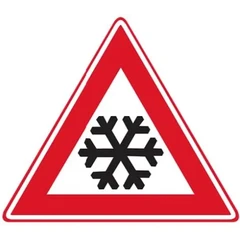
Sign J36 (Black ice or snow): expect slipperiness, even if it is not freezing.
Side wind
With strong side wind you must drive more slowly and leave more space. Especially lorries, buses, and coaches catch a lot of wind because of their large side area, and as a result they can start to sway. If you pass such a vehicle, or if you come out of the shelter of a viaduct, the wind can suddenly hit you hard.
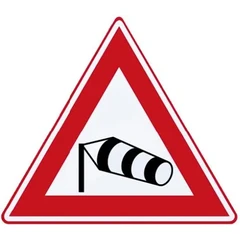
Sign J31 (Side wind): keep your steering wheel steady and keep extra distance from high vehicles.
About to lose control: three situations
The answer is always the same, but the CBR hides it in different scenarios.
Two wheels in the verge
You are driving at 80 km/h, an oncoming vehicle appears, and you end up with two wheels in the soft verge.
Correct choice: let off the accelerator. Continuing to drive lets the car skid, steering to the left lets the car skid, and strong braking only makes it worse. Only letting off the accelerator gives you back grip.
A blowout
You are driving calmly on a nice day and suddenly you get a flat tyre. The car starts to sway.
Correct choice: let off the accelerator.
Your car starts to skid
On a slippery stretch of road you feel the back end sliding away.
Correct choice: let off the accelerator. No handbrake, don’t brake fully.
The sub-sign determines the condition
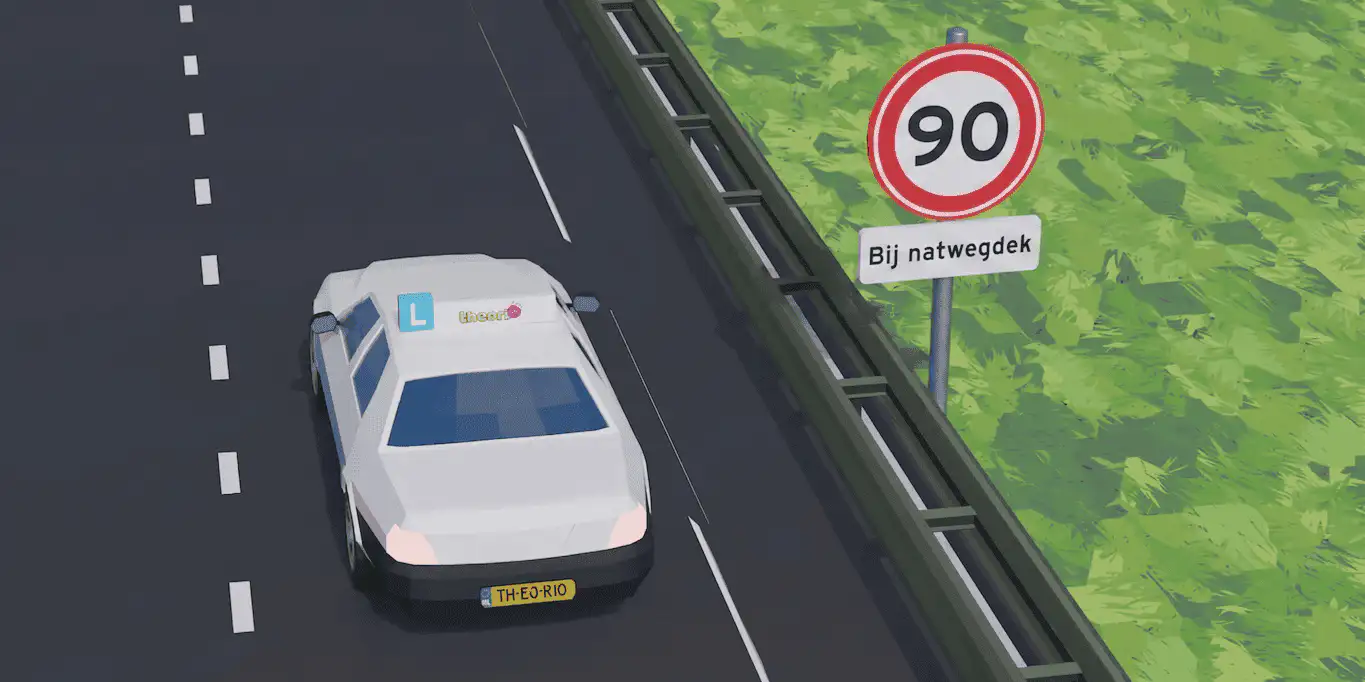
If there is a white sub-sign with a condition under a speed sign, then that sign applies only in that situation. A well-known example is a sub-sign for wet road surface: if the road surface is wet, then the indicated speed applies; if it is dry, then that restriction does not apply.
The same applies to times. If it says 6-19h under a sign, then that speed applies only within that time period.
If the road surface is dry, then this 90 km/h does not apply.
Situation
What applies?
Exam answer
Speed sign with sub-sign “on wet road surface”, road is wet
The condition is met
Follow that lower speed
The same sign, but the road is dry
The condition is not met
That restriction does not apply
Speed sign with sub-sign 6-19h, it is 20:30
Outside the time period
That restriction does not apply
Your car starts to skid or you are about to lose control
No sign question but a behaviour question
Let off the accelerator
Strong side wind next to high vehicles
Drive more slowly and keep more distance
Adjust speed and following distance
If a matrix sign is lit above the road, then it goes before every fixed sign and every sub-sign. See Motorways: matrix signs.
You've covered Motorways and weather conditions. Does it stick?
Aquaplaning is when your car slides over a layer of water instead of driving through it. At that moment, your steering and braking do nothing.
For the exam, you need to know what causes it—especially speed, and in addition your tyre tread depth, the width of your tyres, and rutting in the road surface.
Key rule for the exam: aquaplaning is losing control on a layer of water. Speed is by far the biggest cause — more speed = more chance of aquaplaning.
What aquaplaning really is
Aquaplaning is when your car slides over a layer of water instead of driving through it. Your tyres no longer make contact with the road, and at that moment your steering and braking do nothing.
The biggest culprit is speed. At low speed it almost never happens; the faster you drive, the bigger the chance. Other factors also play a role — low tyre pressure, ruts in the road — but speed is by far the most important.
And what do you do when it happens? Aquaplaning is nothing more than losing control on a patch of water, so the same rule applies here as everywhere: take your foot off the accelerator. Don’t brake, don’t steer.
The tyres lose contact with the road surface: at that moment, steering and braking have no effect.
Your tyres and aquaplaning
The tread pattern
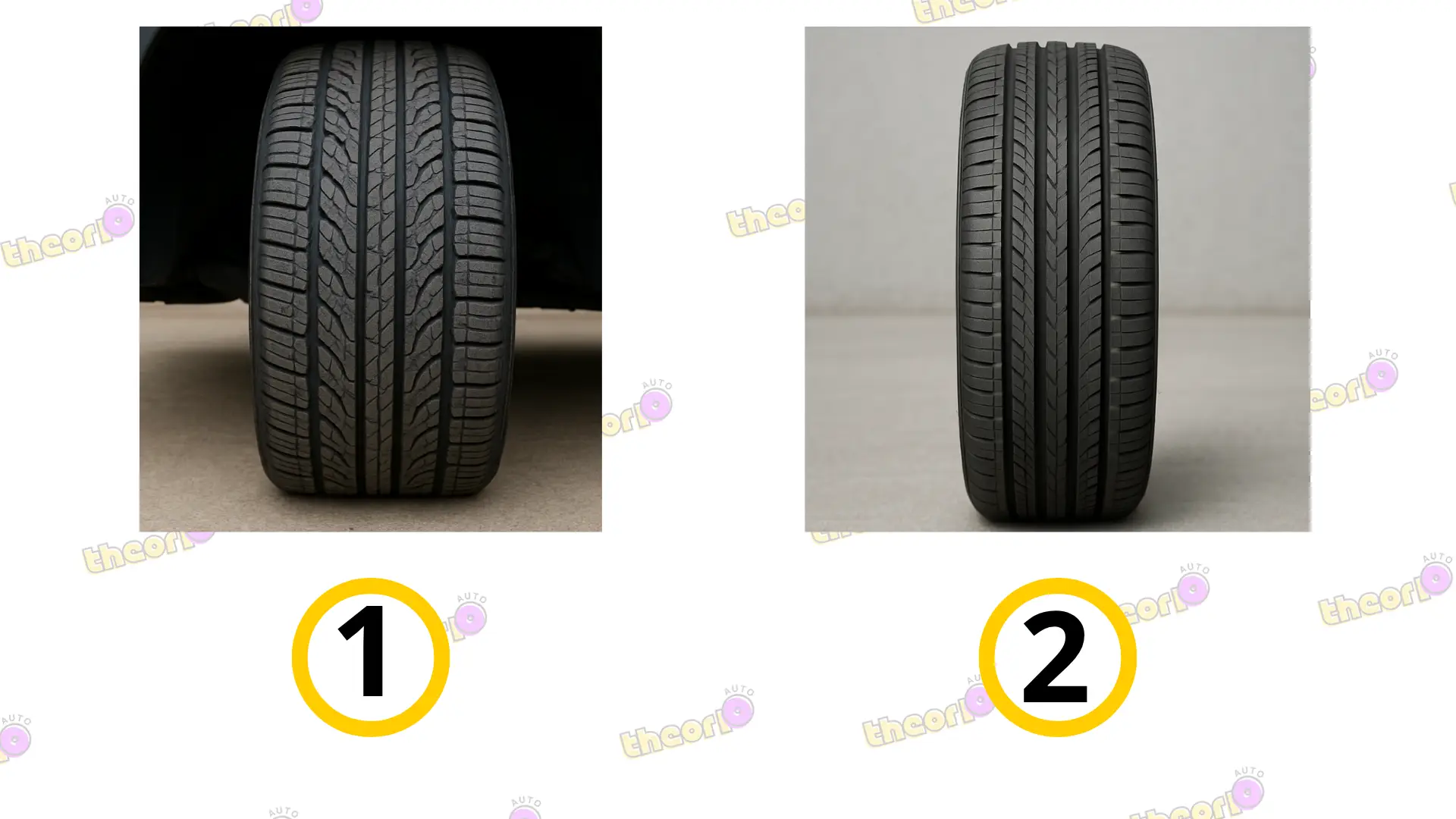
The grooves in your tyre — the tread pattern — have one job: to channel water away from under the tyre. If the tread is too shallow, the water can’t drain away quickly enough and you slide off sooner.
The width
Here, the intuitive answer often goes wrong on the exam:
Narrow tyres cut more easily through the water. So they are better against aquaplaning.
Wide tyres slide more easily over the water. That gives more chance of aquaplaning.
Narrow cuts through the water, wide slides over it.
Rutting: where the water stays
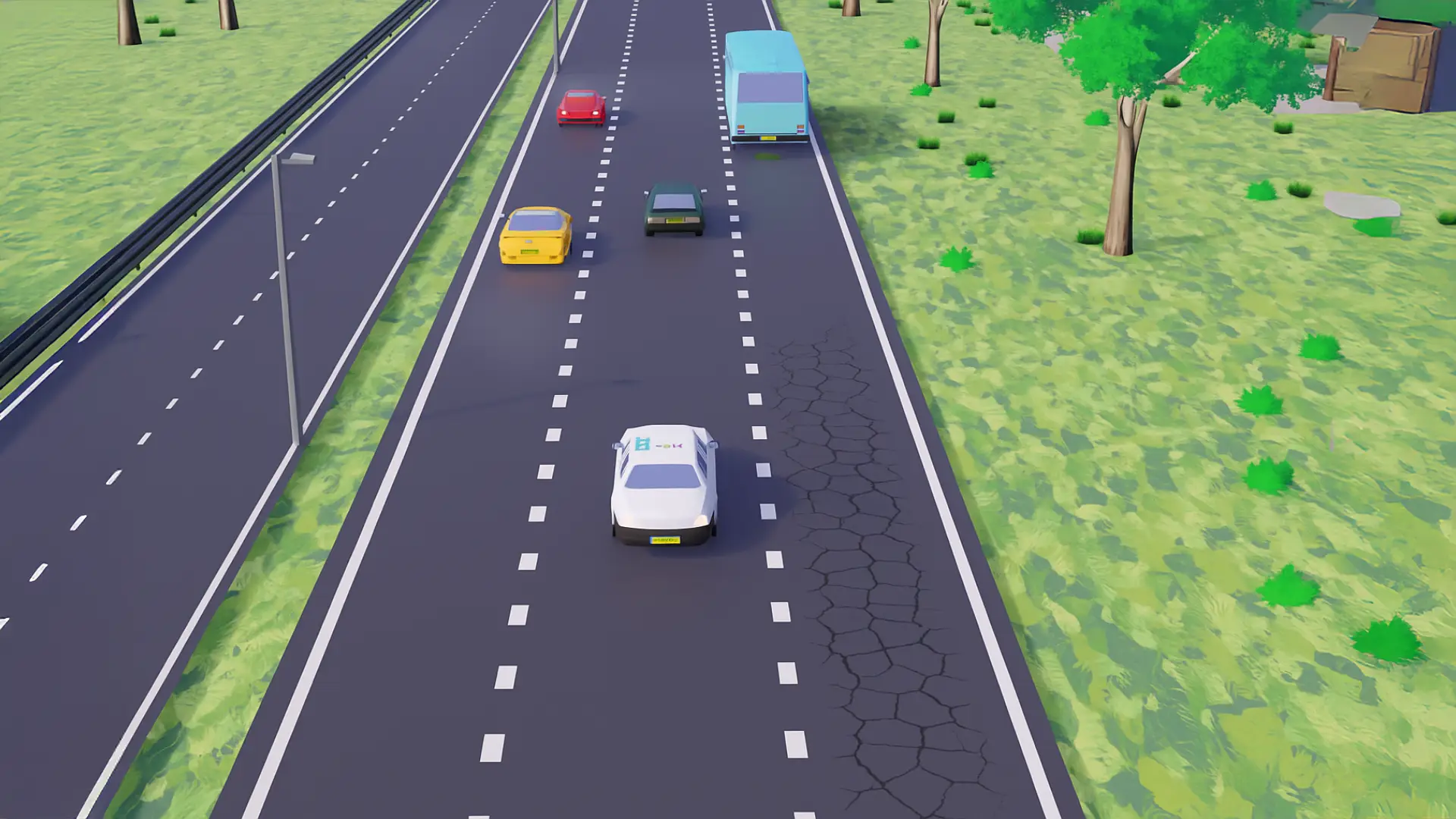
Take a close look at the road surface on the motorway, especially the right-hand lane. You often see two shallow ruts there. They are caused by the heavy lorries that always drive there — just like a pothole forms in the bank at the spot where you always sit.
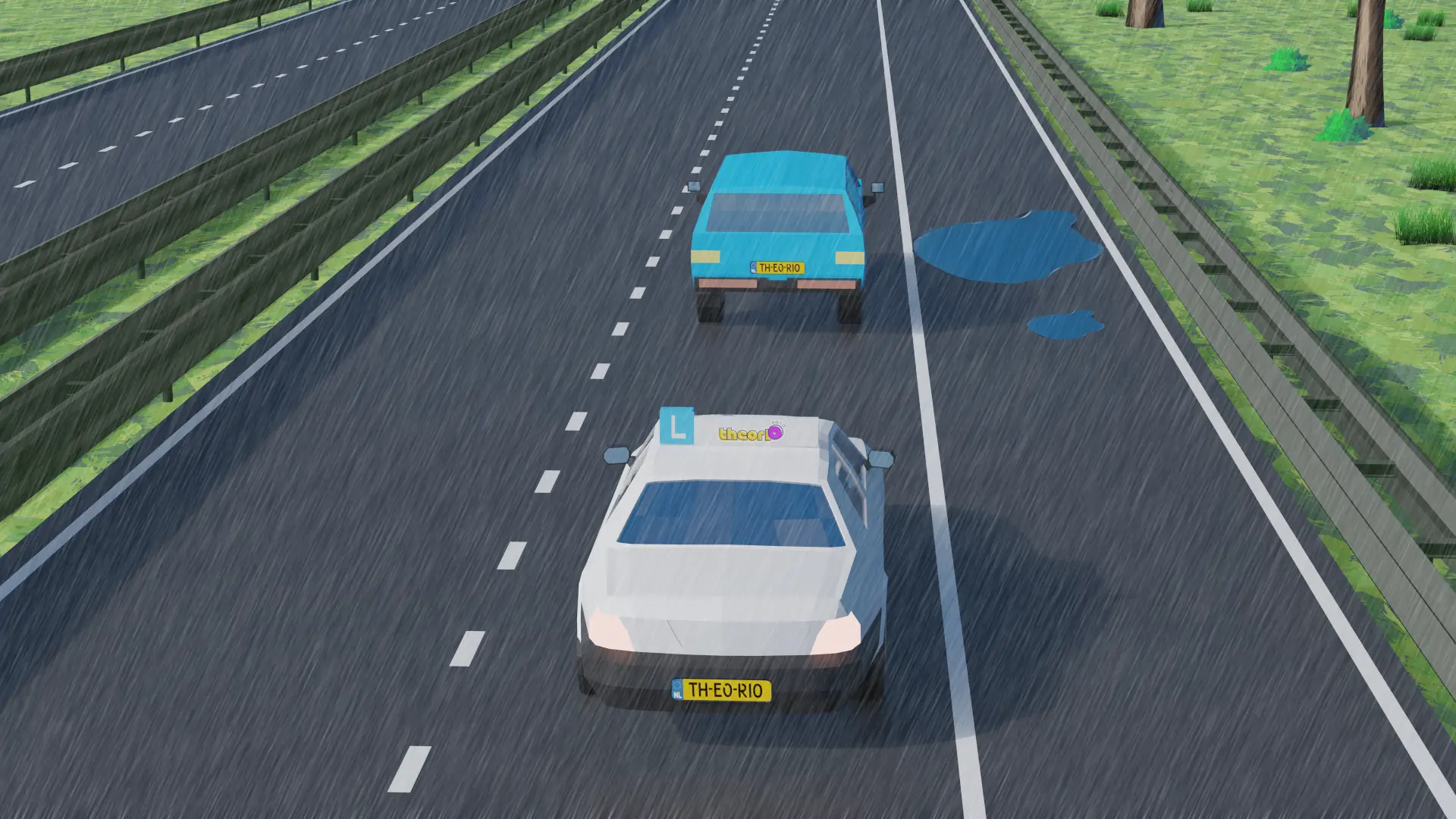
Because those ruts are slightly deeper than the rest of the road, water remains there after a shower. And that’s why: aquaplaning happens most often on a road surface with rutting.
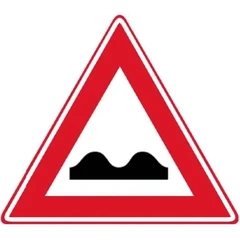
Sign J1 (Poor road surface): warns about an uneven or worn road surface — exactly the kind of road where water stays.
Ruts from heavy goods traffic in the right-hand lane: this is where the water collects.
Summer or winter tyres
In the Netherlands we rarely have extreme winters, so winter tyres are not compulsory. Still, your tyre choice makes a difference — in your braking distance.
Both summer and winter tyres are designed to provide as much grip as possible in their season. If you drive with the right tyre for the season, you come to a stop sooner. If you drive in summer on winter tyres, or in winter on summer tyres, it takes longer before you stop.
Summer tyres in summer: shorter braking distance.
Winter tyres in winter: shorter braking distance.
The wrong tyre in the wrong season: longer braking distance.
CBR trap
The CBR rarely asks for a technical explanation of aquaplaning here. The question is almost always: do you adjust your speed?
If there is no sign at all, but you see puddles or rutting, then lowering your speed is the right answer. A sign that allows 100 km/h doesn’t make 100 km/h sensible — the indicated speed is a maximum, not an instruction.
And if there is signalling above the road, then that is leading; on a wet road surface the speed is often reduced for that reason. The meaning of those signs is explained under Motorway Matrix signs, and an underpanel that only applies on a wet road surface is explained under Motorways and weather conditions.
You've covered Motorways: aquaplaning and road surface. Does it stick?
On the motorway it’s not only about how fast you’re allowed to drive, but about how much space you need to stop. That space is your stopping distance: your reaction time plus your braking distance.
For the CBR you have to keep the three reaction terms separate, know what extends the braking distance, and be able to give the following distance in seconds and in metres.
Key rule for the exam: stopping distance = reaction time + braking distance. Anything that increases your reaction time or reduces your grip makes that stopping distance longer.
Reaction speed, reaction ability and reaction time
Three words that almost sound the same and all appear in the exam. You have to know the difference.
Term
What it is
When you’re tired, or with alcohol, drugs or medicines
Reaction speed
How quickly you react to what happens around you
Decreases — you react more slowly
Reaction ability
How well you react: can you correctly judge the situation?
Decreases — you judge it worse
Reaction time
The total time you need to react
Increases — it takes longer
Watch out for the reversed movement in the last column, because that’s where the trap question is:
Reaction speed decreases = reaction time increases.
Reaction speed increases = reaction time decreases.
A normal reaction time is about 1 second. That sounds short, but at 130 km/h you cover almost half a football pitch in that one second — before you’re even on the brake.
Condition of the driver
The main rule is short: if you are not able to drive safely, you may not drive. This applies to a broken leg in a car with a manual gearbox just as much as it does to alcohol.
Everything that affects your reaction time and reaction ability: alcohol, drugs, medicines with a yellow sticker, fatigue and phone use.
Alcohol, drugs and medicines
Even if you notice nothing yourself, these substances can affect your driving ability — and if you still drive, you are punishable. Medicines with a yellow sticker include sleeping and calming medicines and strong painkillers; always check the package leaflet.
Don’t believe in tricks: there is no way to become sober faster. Coffee, a shower or fresh air changes nothing about the time it takes to sober up. Even eye drops can temporarily make it harder to see properly.
One more thing the CBR tests: young, new drivers are involved in accidents more often than experienced drivers. This is not always because of alcohol or drugs, but mainly because they underestimate the risks in traffic.
Fatigue and rest
Fatigue makes you slower. The rule of thumb you have to know by heart works both ways:
2 hours of driving = 15 minutes of rest. 15 minutes of rest = 2 hours of driving.
Phone use
Calling with your phone in your hand is forbidden — everyone knows that. But it goes further: even just touching your phone while driving can lead to a fine. You don’t even have to make a call.
If you really have to call, then use hands-free, with a car kit or headset. But watch out for the exam question: even hands-free calling distracts you and slows down your reaction speed, just like calling with your phone in your hand. The best answer remains: drive on to a parking lot and call from there on the way back.
Stopping distance = reaction time + braking distance
The stopping distance is the distance you cover from the moment something happens until you are completely stationary. It consists of two parts:
The distance you cover during your reaction time — about one second, in which you simply keep driving.
The braking distance: the distance from the moment you are on the brake until you come to a stop.
For the first part you keep driving at full speed: it simply counts.
Factors on the road
The braking distance is not always the same. Anything that reduces grip makes it longer:
Wet road surface. Less grip, so longer braking distance.
New road surface. It still has to be “worn in” and is smoother than older asphalt — compare it with an ice rink where the floor-cleaning machine has just been over it.
A shower after a dry period. Cars leave oil residues behind. When it rains, they come loose and mix with dust and water; the road surface becomes greasy, and grease is slippery.
Loose stones and mud. Less grip, and mud can even create a risk of skidding.
Snow. The tyres slide over the road as soon as you brake hard.
Remember one hard connection: the risk of skidding always means a longer braking distance than normal.
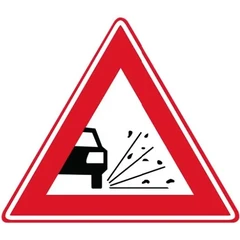
Sign J25 (Loose stones): less grip, so expect a longer braking distance.
Influence of the vehicle
Two properties of your car determine the rest:
Higher speed = longer braking distance. And not proportionally: if you drive twice as fast, your braking distance becomes four times as long.
More weight = longer braking distance. A caravan, extra passengers or heavy suitcases push the car forward when braking, like a train with many wagons.
Extra weight also costs more fuel: your car has to work harder to move forward.
And the driver themselves
Even with a perfect road and a perfect car, you can still extend the stopping distance. The braking distance is fixed, but the reaction time is not: fatigue, alcohol, medicines and drugs make it longer, and that also makes your stopping distance longer. If you’re well prepared, you react faster and therefore come to a stop earlier.
Following distance
The following distance is the space between your car and the one in front of you. The basic rule is based on time, not distance:
Under normal circumstances at least 2 seconds — regardless of how fast you drive.
You measure it like this: choose a fixed point along the road, for example a hectometre marker post. Start counting when the car in front passes that point, and stop when you pass it yourself.
A hectometre marker post is the most convenient counting point you have on your journey.
In bad weather — rain, fog or strong wind — you drive more slowly and leave more space. When there is strong side wind, pay extra attention to large lorries and buses: they catch a lot of wind and can start to sway.
If you’re too close to the vehicle in front, that’s called tailgating. It’s dangerous because you don’t have time to react, and it results in a hefty fine. The collision that follows is a rear-end collision: the front (nose) of one car against the rear (back) of the other. Increasing your following distance prevents this in most cases.
In bad weather you leave more space than the two seconds you normally keep.
Following distance in metres
If the exam asks for seconds, the answer is 2 and your speed doesn’t matter. If it asks for metres, your speed does matter. The calculation:
speed ÷ 2, add 10% to that.
Example at 100 km/h: 100 ÷ 2 = 50, and 10% of 50 is 5. Together that’s 55 metres.
If you can’t calculate it quickly, remember the rule of thumb: about half your speed in metres, plus a bit. For comparison: that’s a little more than half a football pitch, or a little more than half the distance between two hectometre marker posts.
If you can’t make space
Sometimes you can’t move sideways: all lanes are full, or there is a continuous line. Suppose your lane ends and you can’t move to the right because there’s a bus driving there.
Then there’s one thing left: adjust your speed. Take your foot off the accelerator so that space appears in front of or behind that bus, and you can still change lanes. In that case you don’t create space next to you, but lengthwise.
Sometimes driving more slowly isn’t enough and you really have to stop. If a city bus pulls away from a stop and leaves, then the bus has priority — but it accelerates slowly. Then you wait patiently until it’s up to speed and has merged safely, instead of trying to squeeze in right behind it.
CBR trap
The classic mistake with this topic is converting the following distance into a fixed number of metres and then using that everywhere. The 2 seconds are the rule; the number of metres follows from that and therefore changes with your speed.
The second mistake is thinking that the braking distance scales with your speed. Twice as fast means four times as long, not twice as long.
You've covered Motorways: reaction time, stopping distance, rest time, braking distance. Does it stick?
Before you know what’s allowed, you have to know where you’re driving. A motorway (autosnelweg) and an autoweg (autoweg) look similar, but they have different speeds — and on the motorway there is no oncoming traffic.
Further, this section is about the traffic around you in the dark and in a traffic jam: reflector posts, motorcyclists between the lanes and large vehicles that need space.
Key rule for the exam: first recognise the type of road. Different speeds apply to the motorway than to the autoweg, and on the motorway there is no oncoming traffic.
Recognising that you are driving on a motorway
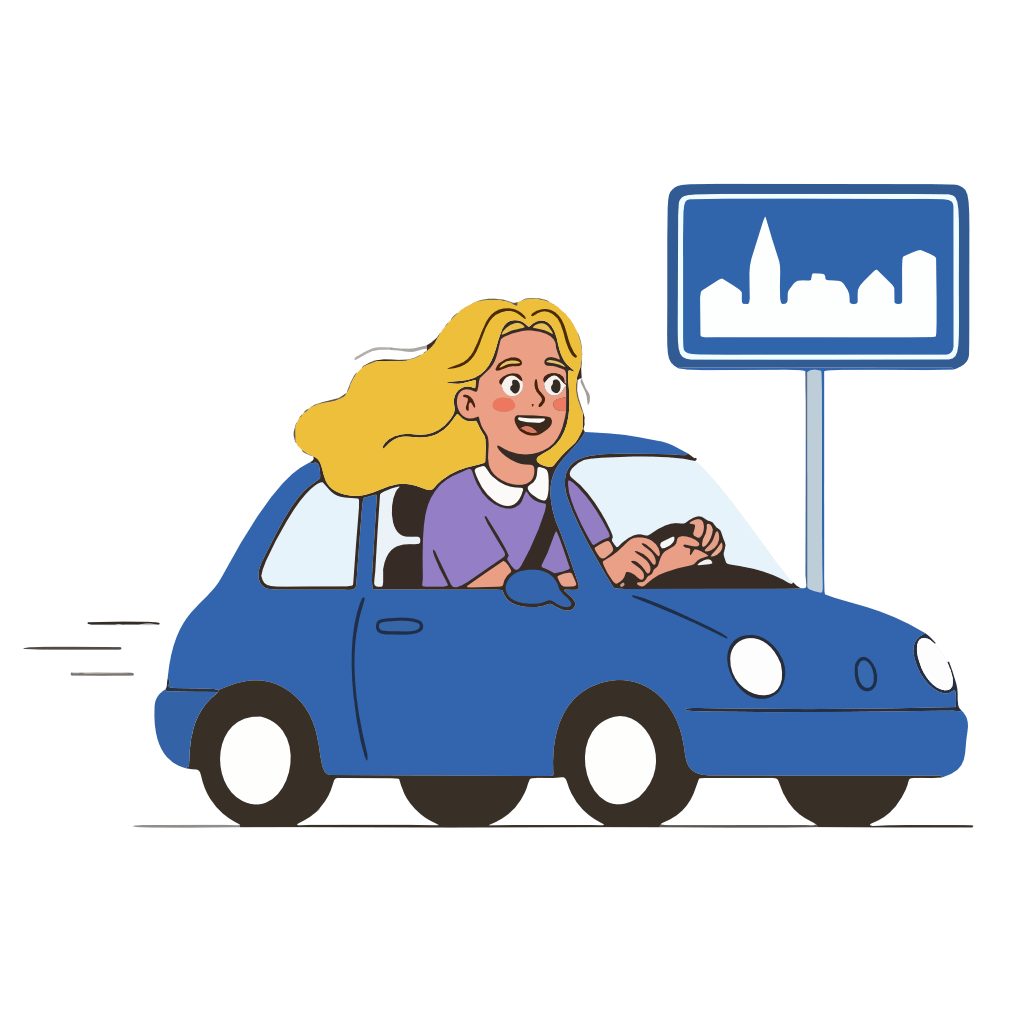
You recognise a motorway by the blue sign with an image of a double carriageway with a viaduct above it. If you see this sign, you know you are driving on a motorway.
Sign G1: double carriageway with viaduct — this is a motorway.
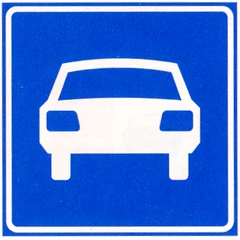
Sign G3 (Autoweg): looks similar, but it’s a different type of road with different speeds. Don’t confuse the two.
Which speeds apply to the motorway?
On a motorway there is a legal maximum speed of 130 km/h, unless indicated otherwise. In addition, in practice on all Dutch motorways 100 km/h applies between 06:00 and 19:00; after 19:00 you may drive 130 km/h again. There is also a lower limit: the minimum speed is 60 km/h.
Situation
What applies on the motorway?
No different sign or matrix sign
Maximum 130 km/h
Between 06:00 and 19:00
Maximum 100 km/h
Driving too slowly
Minimum 60 km/h
Motorway: minimum 60, maximum 130 unless indicated otherwise.An underpanel with times limits when that speed applies.
If there is a matrix sign above your lane, then that speed takes priority over everything above. See Motorway Matrix signs.
60 km/h is a lower limit, not an acceleration speed. How you merge is explained under Motorways: entering and exiting.
Reflector posts along the road
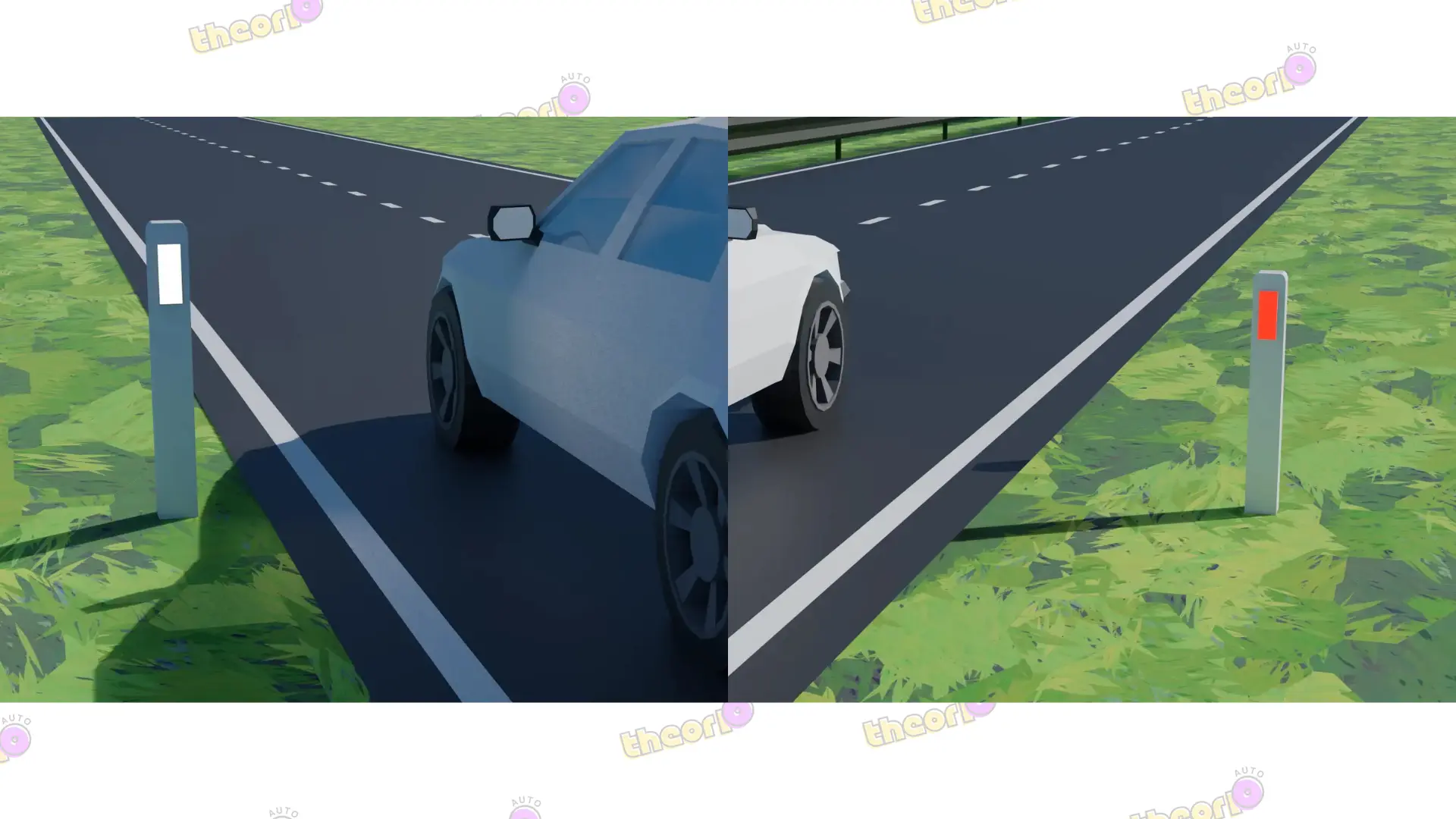
Along roads without street lighting there are posts with reflectors. They help you at night so you don’t end up in the verge or drive on the wrong side of the road.
White reflectors are on the left of the road.
Red reflectors are on the right of the road.
Compare it with the lights of the cars around you: on the left you see the white headlights of oncoming traffic, on the right the red rear lights of the car in front of you. Exactly the same arrangement.
Memory aid: red starts with an R, just like right.
White left, red right — the same colours as the headlights and rear lights around you.
Motorcyclists in a traffic jam
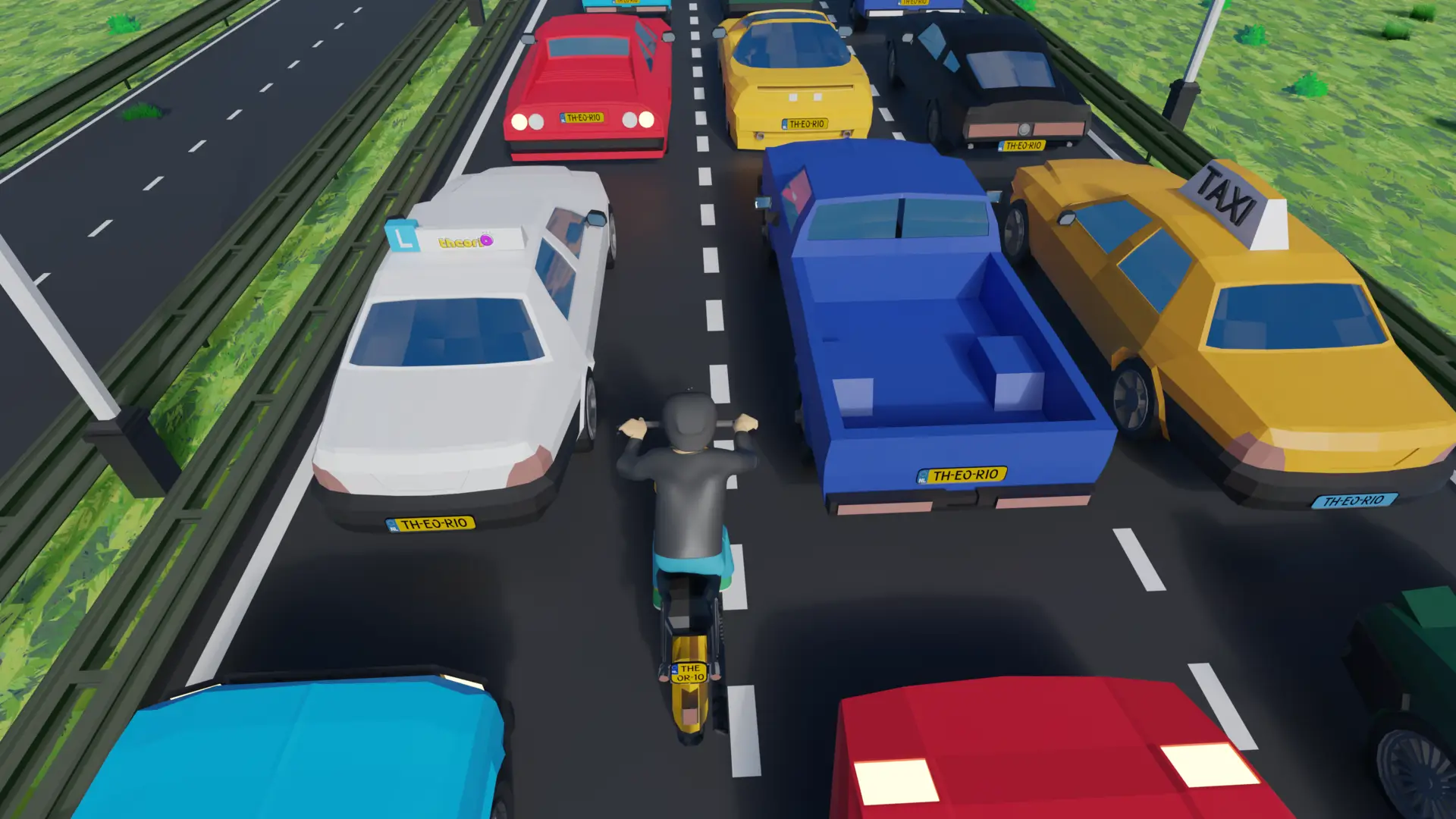
Motorcycles are small and therefore easy to overlook — especially in slow-moving or stationary traffic. And that’s exactly where they are: motorcyclists are allowed to ride between the traffic lanes in a traffic jam and they do. The speed difference between a motorcycle that comes through and the stationary traffic is large. If you then change lanes without looking, it goes wrong.
Where exactly do they ride?
On a road with more than two lanes, motorcyclists must ride between the two left-most lanes through the traffic jam. If they were to ride on the right, they would pass the lorries, and that is more dangerous. That’s why it is forbidden for motorcyclists to overtake via the right-hand lanes — otherwise you could be overtaken on both sides.
What you do
If you are stationary in the left-hand lane, move out to the left.
If you are in the right-hand lane, move out to the right.
This leaves a corridor free in the middle. And check your mirrors regularly: a motorcyclist can always come up behind you.
Everyone to the outside of their lane: then the motorcyclists have space in the middle.
Give large vehicles space
Lorries, buses and coaches take up more space and can’t just swerve out. If you meet one on a narrow road, that lorry won’t drive into the verge — so you have to. You never want a head-on collision with a lorry; giving a little space is always the better risk.
In a tight bend
Large vehicles need a lot of space to turn. If a bus or lorry turns into a tight bend in your direction, it’s normal that it comes partly onto your lane. Waiting is then the right answer — and sometimes even driving a little in reverse if that’s possible.
Back onto the road
If you see a lorry reversing onto the road, stop and give it space. This isn’t out of politeness: lorries often don’t have a wing mirror and have a large blind spot, so the driver can’t see well what happens next to and behind them. The squealing sound when reversing isn’t there for nothing. In situations like this it’s hard to predict what will happen, and everyone is at risk.
The lorry can’t make the bend any other way: you wait.
Oncoming traffic — and why it doesn’t exist on the motorway
On narrow roads in older neighbourhoods or in the countryside, two cars sometimes can’t fit next to each other. Then you look for a wider spot: an empty parking space or a designated passing place. The rule is simple: the driver who is at the passing place stops and waits until the oncoming vehicle has passed.
Sign L20 (Passing place): you can let an oncoming vehicle pass here.
The difference between motorway and autoweg
On the motorway, all traffic drives on your carriageway in the same direction, and the other direction is separated by a physical barrier. You can see that traffic, but it doesn’t count as oncoming traffic — it’s actually two separate roads next to each other.
On an autoweg it’s different: there you do have oncoming vehicles, and crossing traffic. So on autowegen you have to watch for traffic from all directions.
You've covered Motorways: reflectors and overtaking. Does it stick?
FAQ
Frequently asked questions
Short answers to common questions about Driving on the motorway.
Who has priority when merging onto a motorway?
Merging is a special manoeuvre. You give way to every driver already travelling in the lane you want to move into.
Do you have to use an open rush-hour lane?
Yes. An open rush-hour lane is the rightmost lane at that moment, and you must use the rightmost lane that leads to your destination.
Which takes priority: a matrix sign or a fixed sign?
The matrix sign takes priority. Matrix signs show the current speed limit and override the fixed signs along the road.
At what speed should you merge onto a motorway?
Not at the minimum speed. Use the slip road to build speed so that you merge at roughly the same speed as the traffic already on the carriageway. 60 km/h is only the minimum speed, not a safe merging speed.
What is the minimum speed on a Dutch motorway?
The minimum speed on a motorway is 60 km/h. The legal maximum is 130 km/h, though in practice it is often 100 km/h between 06:00 and 19:00.
Keep practicing with up-to-date material
This module gives you the basics for safe driving on the motorway: speed, matrix signs, merging, and lane use. There are more rules about rush hour lanes, traffic jams, breakdowns, and temporary signs; therefore, practice in our app with the most up-to-date CBR information.
Ready to practise?
Test your knowledge of Driving on the motorway with 80 practice questions in the app.
Your first quiz is free, no account needed. ·After that from €34.99 for 90 days of access.