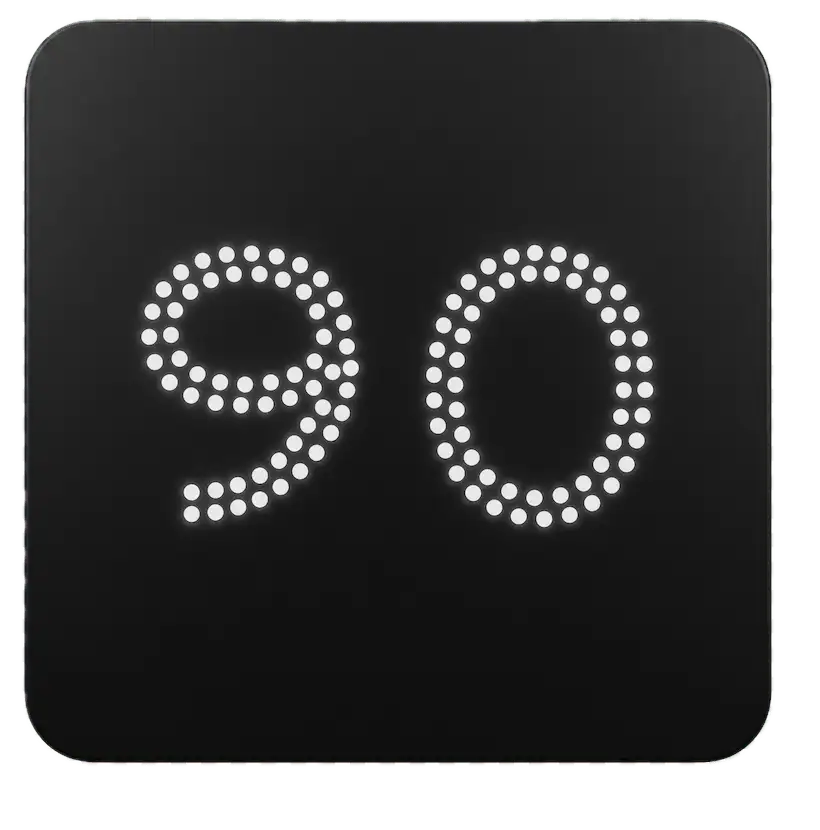
The maximum speed depends on the type of road and on your location: inside or outside the built-up area. If there is a sign or a matrix sign, then that always comes before on that standard limit.
Speeds at a glance
Speed limits by type of road
The maximum speed depends on the type of road and the location:
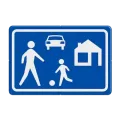
erf: maximum 15 km/h because of pedestrians and children playing.
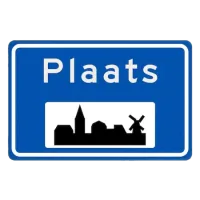
Built-up area: standard 50 km/h, unless a 30-zone applies.
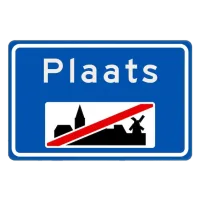
Outside the built-up area: Maximum speed of 80 km/h. Sometimes you may drive 60 km/h on narrow roads, but this is always indicated in advance with a 60 km/h sign. RVV 1990 article 21
Autoweg: Maximum 100 km/h, but that depends on the road markings. If you see on the CBR exam a question with only this sign, then it applies: the maximum speed is 100 km/h and the minimum speed is 50 km/h.
Motorway: Maximum 130 km/h. In practice, between 06:00 and 19:00 it is often 100 km/h, but on the CBR exam this restriction is always shown with a sign; without a sign you must assume 100 km/h on a motorway. Minimum 60 km/h.
Traffic signs and matrix signs
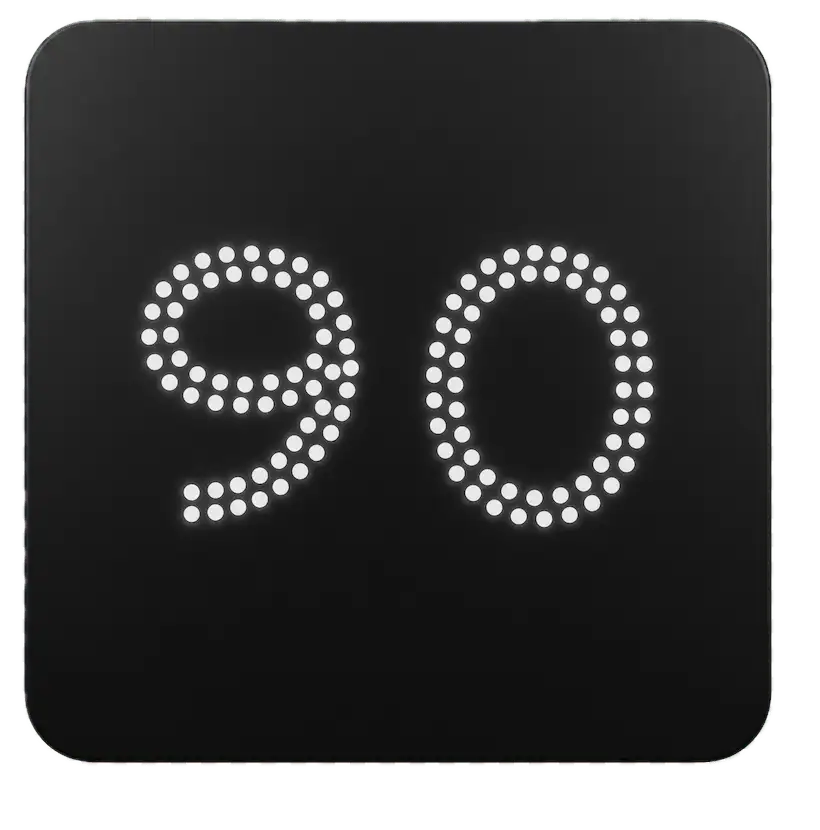
Maximum speeds are indicated with fixed signs, temporary signs, or matrix signs that can adjust speeds. Matrix signs are leading when they are active, for example when there are traffic jams.
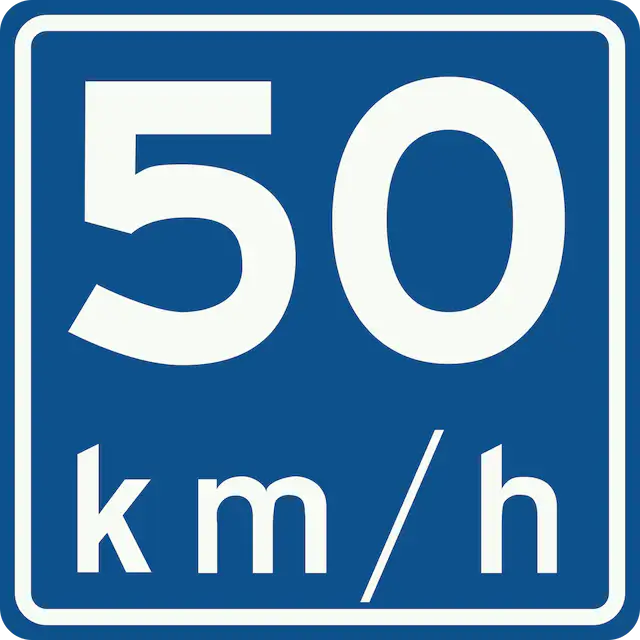
Recommended speeds are indicated with blue signs and are not mandatory, but it is sensible to follow them. Learn more about traffic signs here
Safe following distance
A safe following distance is essential so you can react in time. Always keep enough distance, depending on your speed and the traffic situation.
On motorways there is a minimum speed, but that does not mean you can merge safely at that speed. Adjust your speed and distance to the situation.
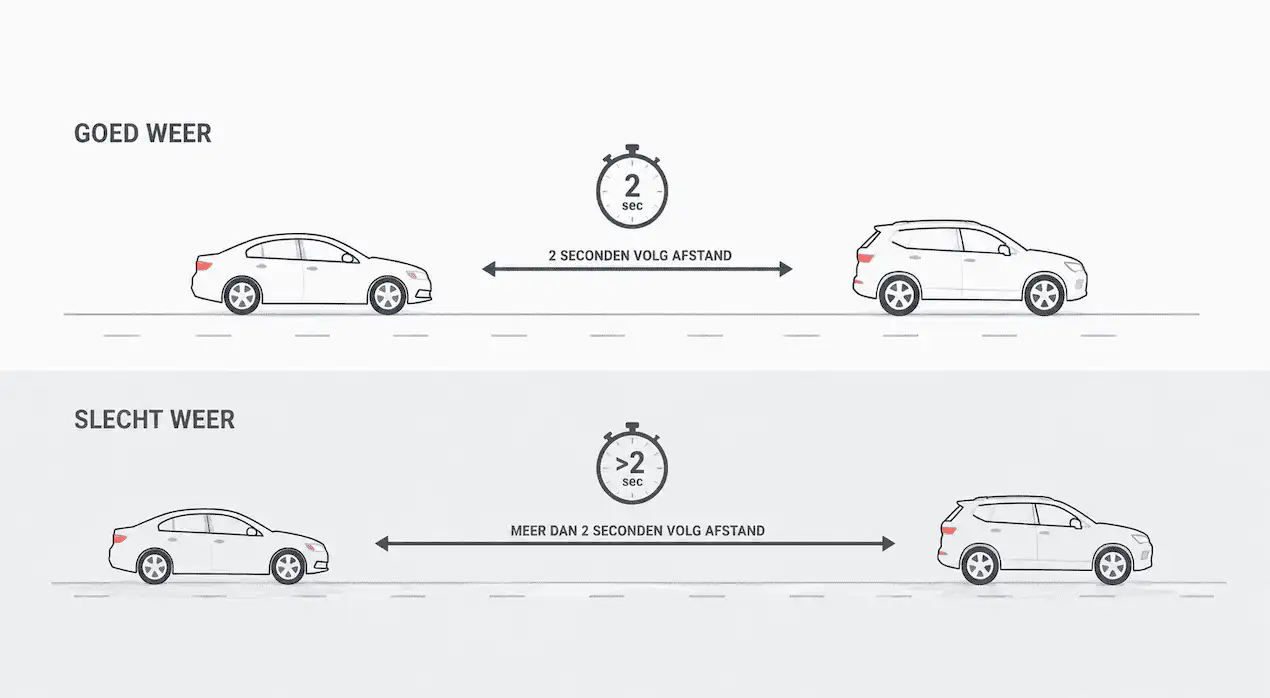
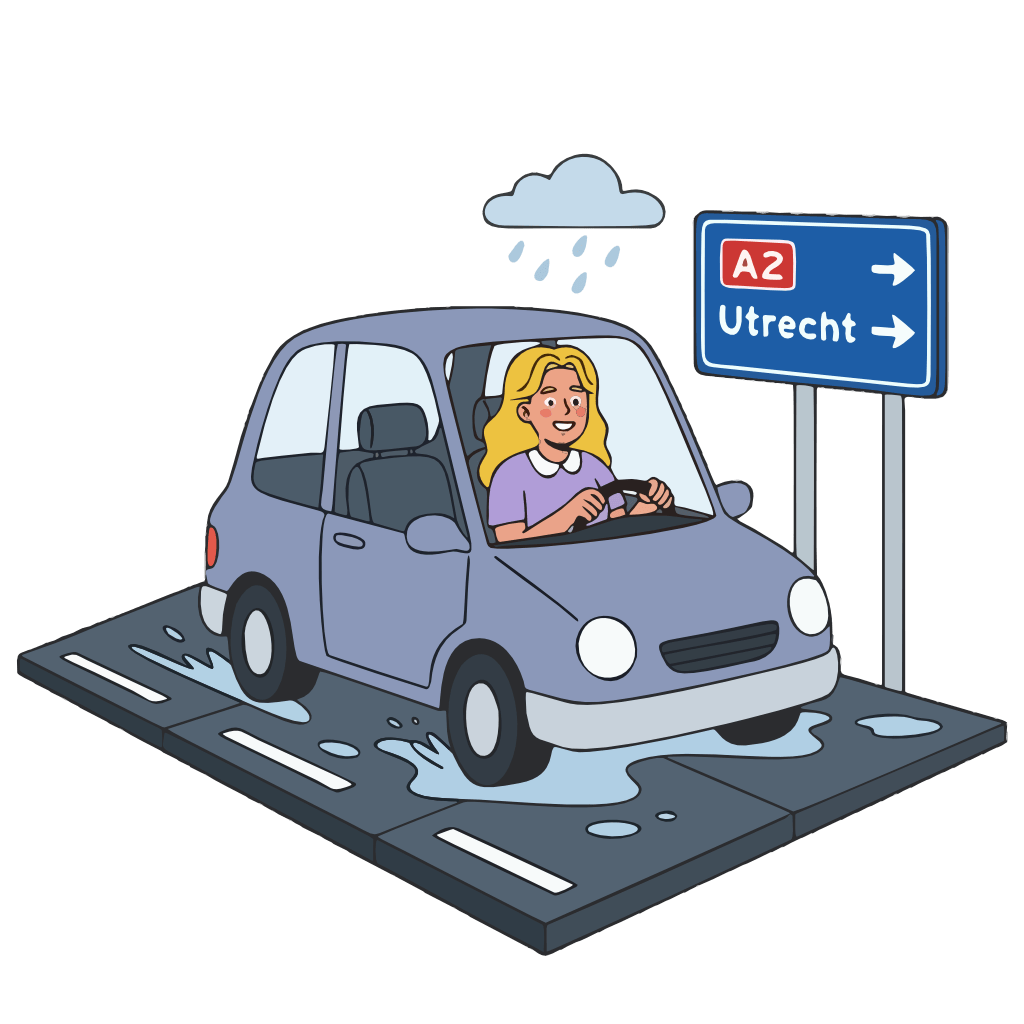
In general, a following distance of at least 2 seconds applies. In bad weather conditions (such as rain, fog, or slippery roads) you must increase the following distance, because you then need more time to react and to stop. You can find the full information about following distance here.
The speed limit you must follow varies depending on where you are and the type of road you are driving on. Whether you are inside or outside the built-up area, on the motorway, on an erf, or on an autoweg, different maximum speeds apply everywhere. The type of road and the maximum speed are often indicated by traffic signs. These can be permanent signs, but also temporary signs or matrix signs that can adjust speeds. In addition, there are signs that give a recommended speed. In this part of the lesson you learn, based on the type of road and the signs, how fast you may drive.
Inside the built-up area, the standard maximum speed is 50 km/h. Outside the built-up area, it is usually 80 km/h, unless signs indicate otherwise. RVV 1990 article 20
For the exam, you mainly need to recognize quickly: the place-name sign, the 30-zone, the erf, and the sign for the end of the maximum speed.
Speed
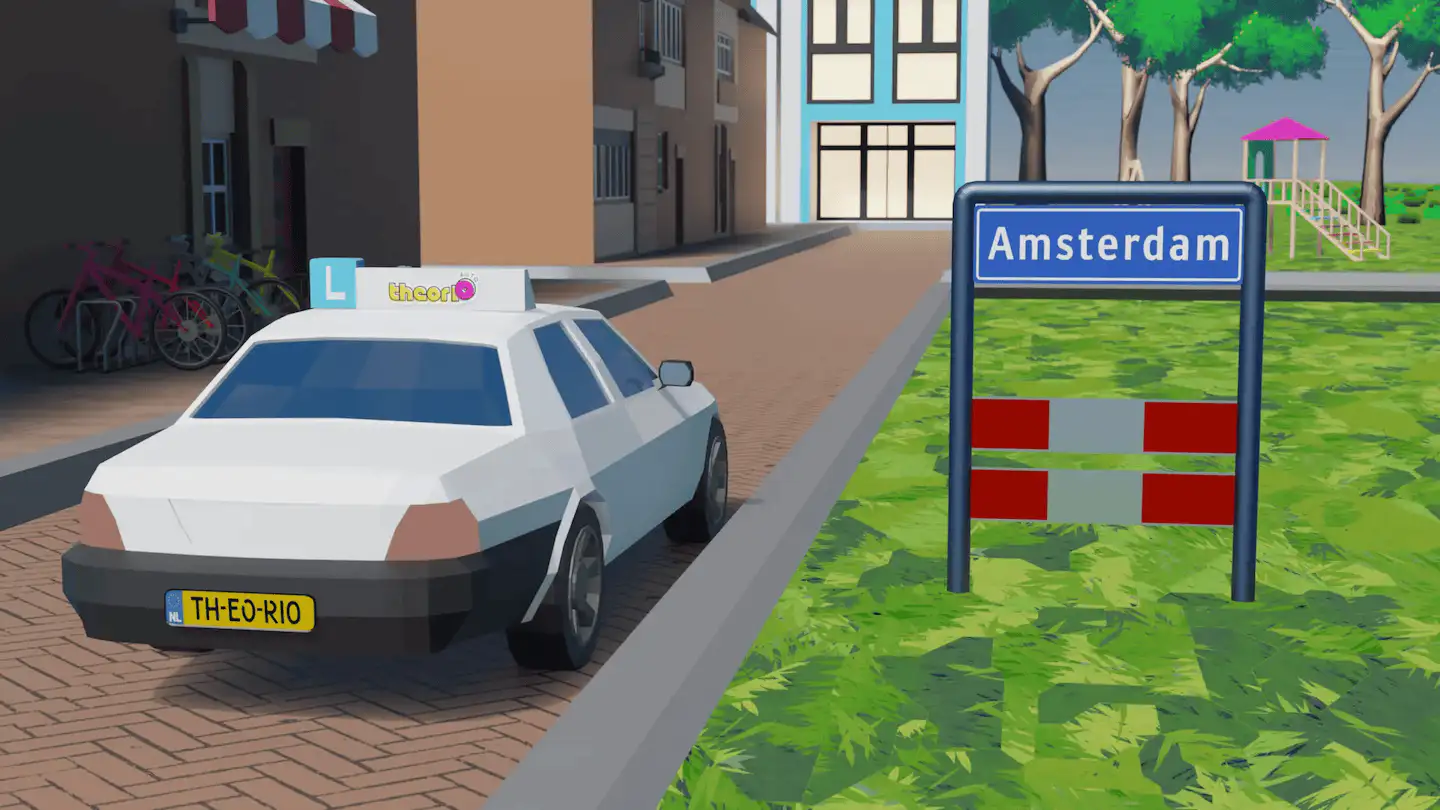
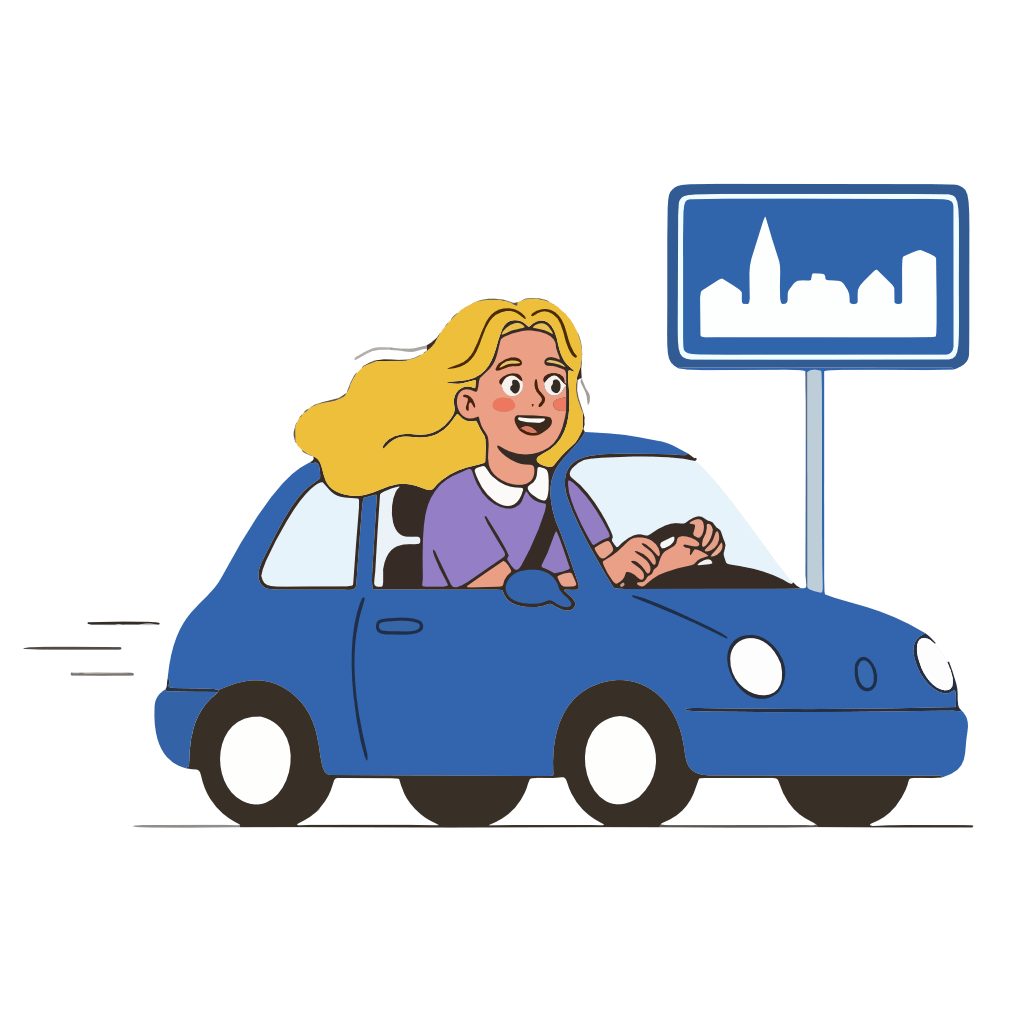
If you see a place-name sign, you are normally in the built-up area and 50 km/h applies. If you see the place-name sign with a red stripe, then you are outside the built-up area and usually 80 km/h applies, unless a sign or zone indicates otherwise.
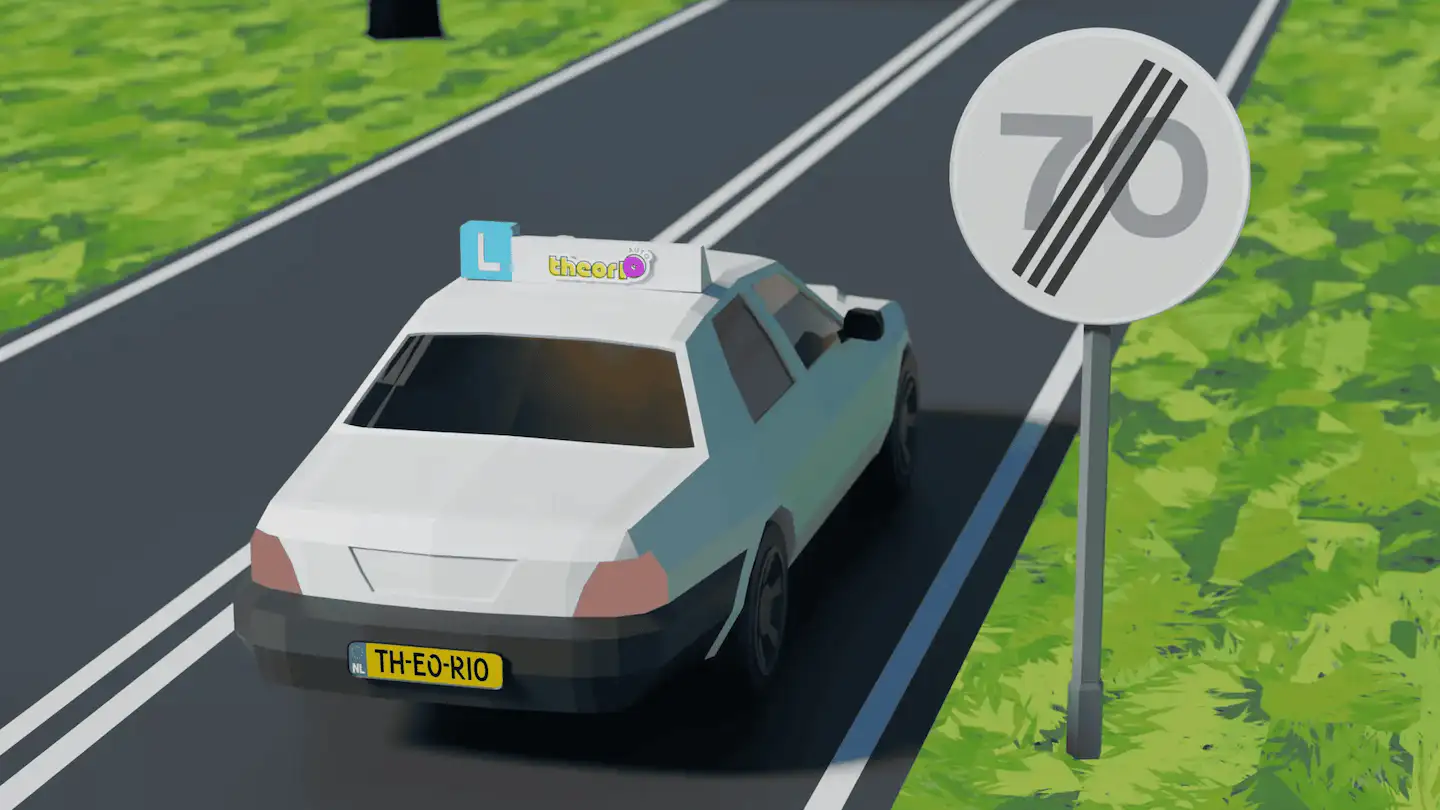
A place-name sign means: inside the built-up area; 50 km/h.On an erf, the maximum is 15 km/h.After the end of the maximum speed (50 km/h, 60 km/h, 70 km/h) outside the built-up area, you go back to 80 km/h.
CBR decision rules
1. First look: inside or outside the built-up area?
First of all, you determine this with the place-name sign. Not by instinct, not by houses, but by the sign.
Sometimes the question literally says: "You are driving outside the built-up area. What is your maximum speed here?" By formulating the question this way, it becomes immediately clear which speed area (outside the built-up area) you must recognize and which rule you must apply to it.
That is why you should always read the question carefully first and look at the image closely before answering. This is one of the most common mistakes on the CBR exam. Many candidates look first at the answers and only afterwards at the question, which makes them interpret the situation incorrectly. Don’t think: This won’t happen to me; even the very smartest make this mistake 😉.
2. Inside the built-up area
Standard 50 km/h.
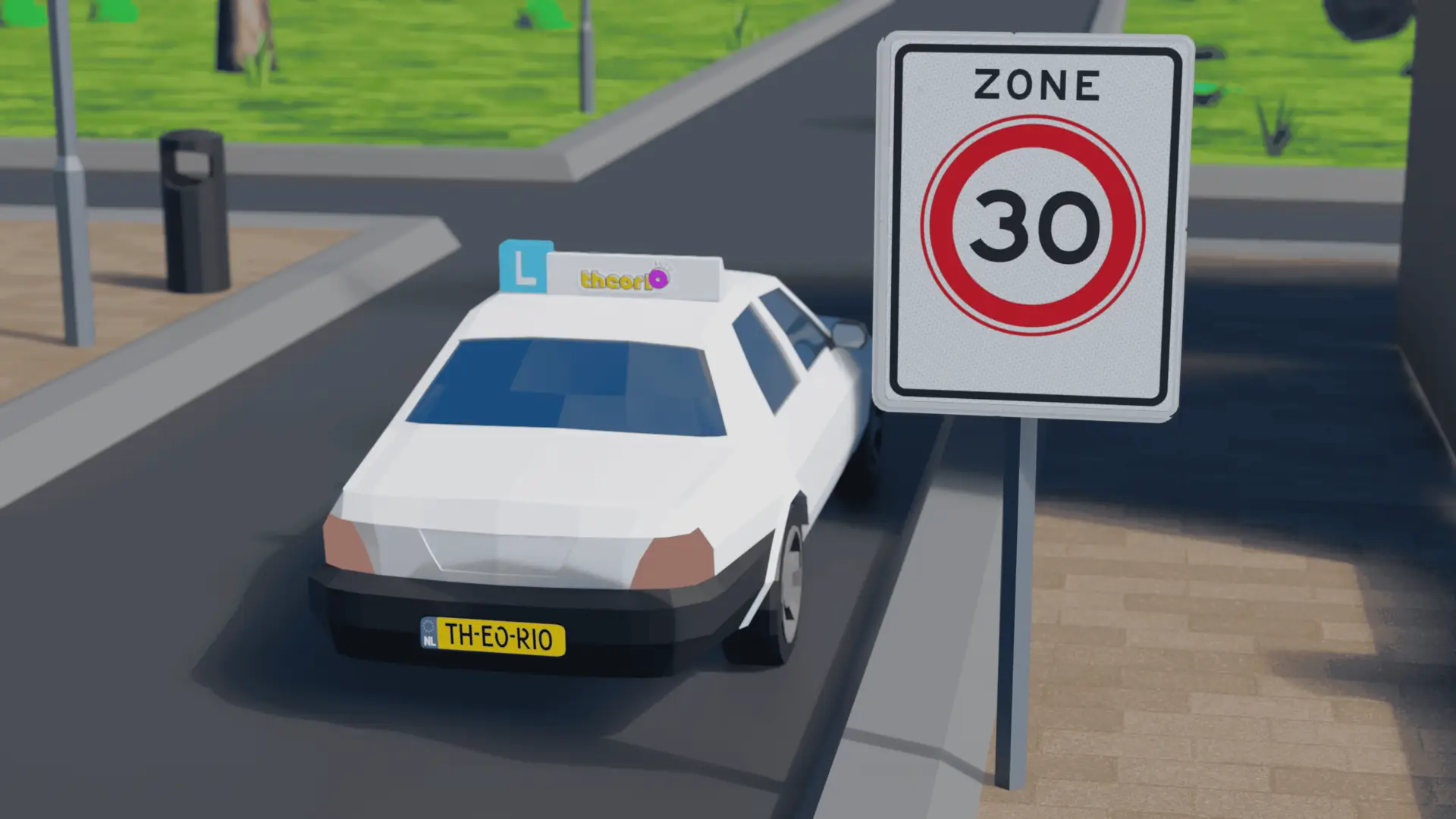
If you enter a 30-zone, then 30 km/h applies for the entire zone.
If you leave that 30-zone again inside the built-up area, then it becomes 50 km/h again.
If you drive into an erf, then 15 km/h applies.
3. Outside the built-up area
Standard 80 km/h.
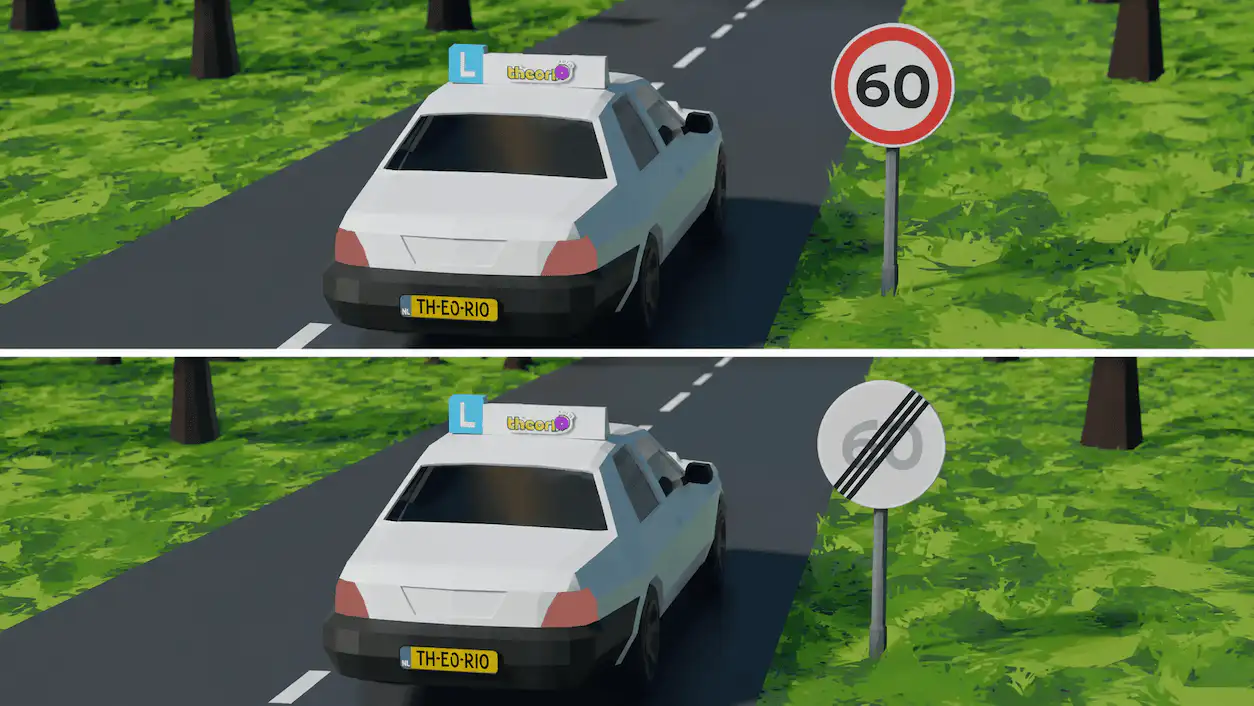
If you see a 60 km/h sign, you must follow it.
You may drive faster again only after passing the end of the maximum speed sign.
After that sign, outside the built-up area the standard speed applies again: 80 km/h.
4. Signs come first
If there is a speed sign, you follow that sign. This also applies if the road looks different from what you expected.
Where does the built-up area start and end?
The built-up area starts as soon as you pass a sign with the name of the place. You leave the built-up area again as soon as you see the same sign again with a red stripe through it.
Often, next to the place-name sign there is also a traffic sign with 50 km/h on it. That seems unnecessary, because the place-name sign already says that. So don’t let that confuse you in the exam: inside the built-up area, 50 km/h applies by default, with or without an extra sign.
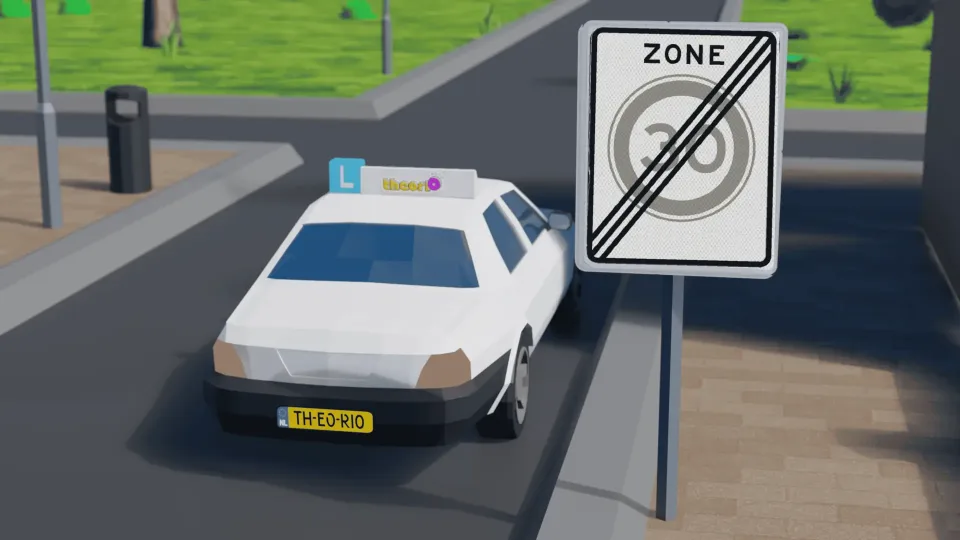
Inside the built-up area, you may come across a 30-zone. This maximum speed applies for the entire zone and only ends at the sign that indicates that the 30-zone ends. If you leave the 30-zone while you are still inside the built-up area, then you may drive at most 50 km/h again.
The sign with which a 30-zone begins. The zone only ends at the sign 'end of 30-zone'.
On an erf: 15 km/h and pedestrians everywhere
On an erf, a maximum speed of 15 km/h applies. But there is more to it than just that speed.
Cars may drive only on the carriageway.
Pedestrians and children playing may walk both on the pavement and on the carriageway. So on an erf they may use the entire width of the road.
Because children often play there, you drive at a maximum of 15 km/h. At that speed you can still anticipate well.
Also on an erf, you keep as much as possible to the right; there may simply be oncoming traffic.
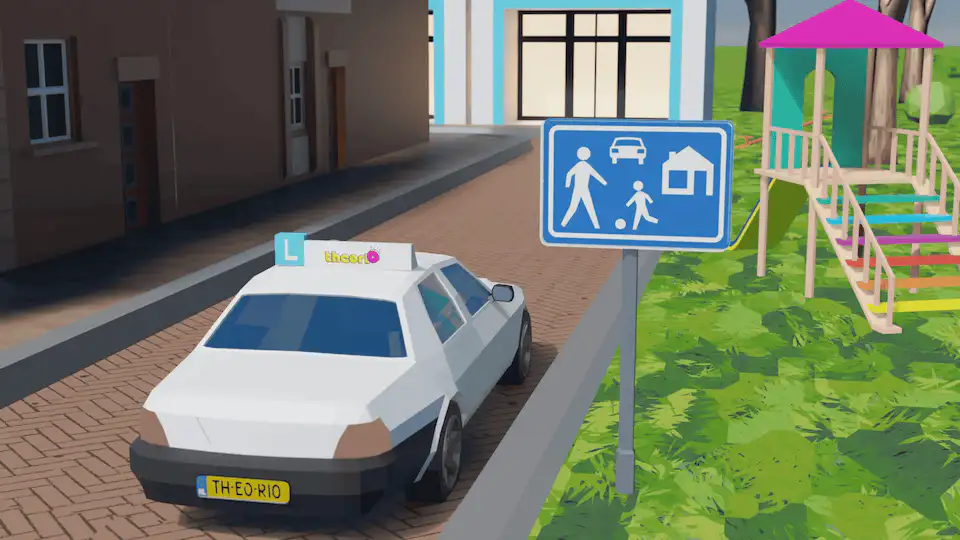
On an erf, pedestrians and children may use the entire width of the road. Maximum 15 km/h.
Why sometimes 60 km/h outside the built-up area?
Outside the built-up area, normally 80 km/h applies. Yet you regularly come across a sign with 60 km/h. This happens especially on narrower roads, where you encounter many oncoming vehicles, cyclists, and agricultural vehicles. There, 60 km/h is simply safer.
You may drive faster again only after you pass the end of the maximum speed sign. This sign has a white background with the earlier maximum speed (for example 50, 60 or 70 km/h) in grey numbers, with three black stripes through it. After that, outside the built-up area, 80 km/h applies again. These speeds — 50, 60, and 70 with stripes through them — you only encounter outside the built-up area.
First 60 km/h, after the end of the maximum speed sign again 80 km/h.
Recognize speed from the road itself
It happens that you miss a sign, for example because you are briefly paying attention to an oncoming vehicle. And there are roads where there are no signs at all. Then you can often infer the speed from the layout of the road, such as the markings on the road surface.
Pay attention: signs are always leading. If there is a sign, you follow the sign — not the markings.
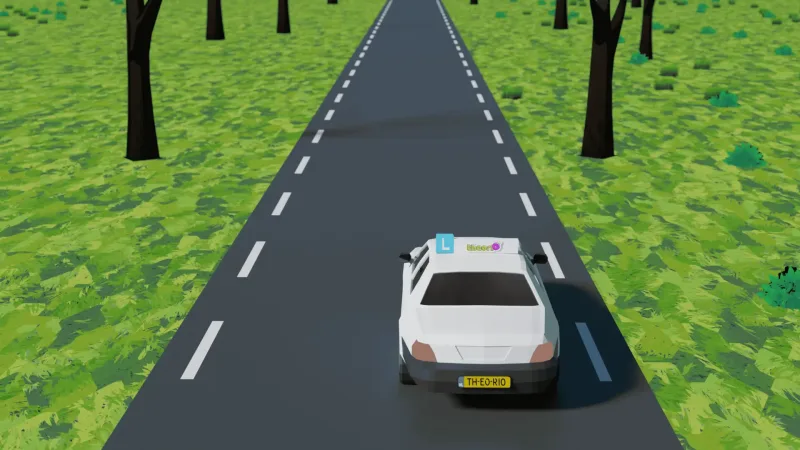
Double white lines in the middle of the road → normally 80 km/h, unless a sign says otherwise.
Only lines on the side, no sign → usually also 80 km/h.
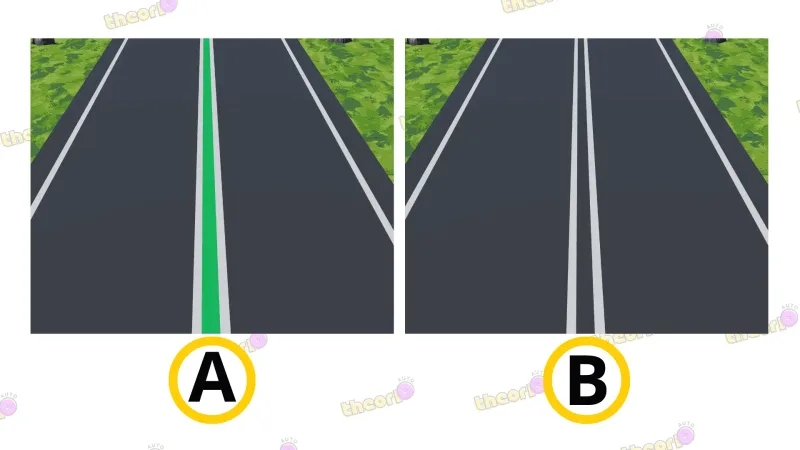
Double white lines with a green strip in between → this is an autoweg: 100 km/h. Memory aid: a 100-euro bill is also green. Green = 100 km/h.
Green between the double center lines: 100 km/h. No green: 80 km/h.
Differences you must be able to choose
Situation
Recognition
Maximum speed
When does this end?
Inside built-up area
Place-name sign without red stripe
50 km/h
At another zone, erf, or end of built-up area
30-zone
Zone sign 30
30 km/h
At the sign end of 30-zone
erf
erf sign
15 km/h
At the end of erf
Outside built-up area
Place-name sign with red stripe
80 km/h
At another speed sign or new situation
Outside built-up area with 60 sign
Around the 60 sign
60 km/h
At the sign end of maximum speed
Example situations like in the exam
Situation 1
You drive past a place-name sign into a village. There is no other speed sign further on.
Correct choice: maximum 50 km/h.
Why: inside the built-up area, 50 km/h applies by default.
Situation 2
You drive into a 30-zone while inside the built-up area. A little later you leave that zone, but you are still in the built-up area.
Correct choice: after the end of the zone again maximum 50 km/h.
Why: the 30 applies for the entire zone and only ends at the sign end of zone.
Situation 3
You drive outside the built-up area on a narrow road. First you see a 60 sign and later a sign end of maximum speed.
Correct choice: first 60 km/h, then again 80 km/h.
Why: outside the built-up area, after the end of maximum speed you return to the standard speed of 80 km/h.
Situation 4
You drive outside the built-up area on a road with double white center lines. There is no speed sign at all.
Correct choice: maximum 80 km/h.
Why: without a sign you infer the speed from the layout of the road. Double white center lines without a green strip belong to 80 km/h.
CBR trap
❌ Mistake: thinking that after a 30-zone you always keep driving 30.
✅ Correct: inside the built-up area, after the end of the zone you return to 50 km/h.
❌ Mistake: thinking that with a speed restriction you always must drive exactly that speed.
✅ Correct: with a speed restriction, such as 30 km/h, the indicated speed is a maximum; so you may also drive slower, for example 20 km/h.
❌ Mistake: thinking that a place with houses automatically is the built-up area.
✅ Correct: you look at the place-name sign.
❌ Mistake: choosing the same speed on an erf as in a 30-zone.
✅ Correct: on an erf it is 15 km/h.
❌ Mistake: on a road without a sign, ignoring the lines and just choosing any speed.
✅ Correct: if there is no sign, you read the speed from the road markings. If there is a sign, then the sign always comes first.
On the CBR exam, this part is largely covered by the chapter 'use of the road'.
You've covered Speeds inside and outside the built-up area. Does it stick?
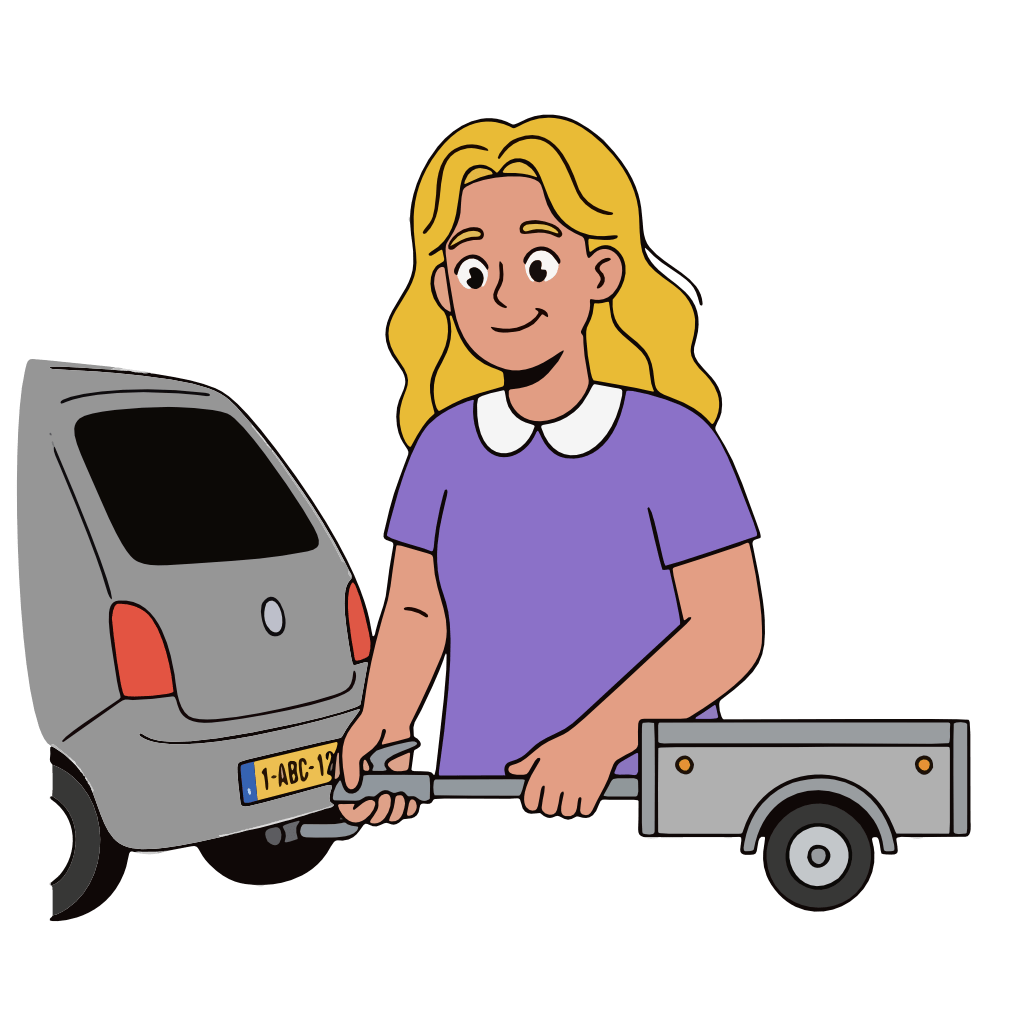
With driving licence B you may tow a trailer of 750 kg or more than 750 kg, as long as car and trailer together do not exceed 3500 kg.
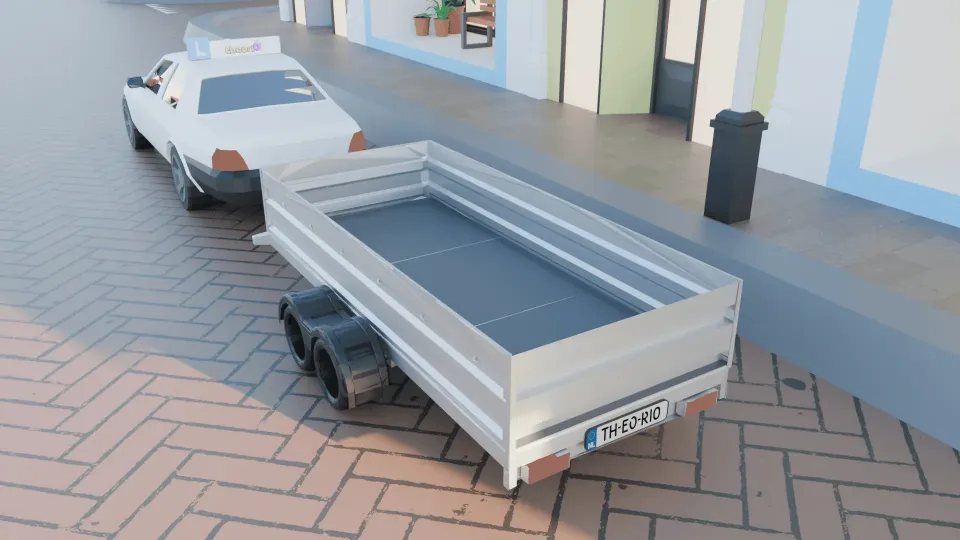
A trailer of maximum 750 kg has the same vehicle registration certificate as the car on a white number plate with black letters and numbers.
A trailer of more than 750 kg is considered as a separate vehicle and has a its own number plate: yellow with black letters.
You do not use both number plates. So do not drive with a white and a yellow plate at the same time.
On the vehicle registration card of the car it states how much weight you may tow with the car.
See the difference between a light trailer and a heavier trailer.
The number plate must be official
The plate on the trailer must have a approval mark. So you may not quickly write a number plate on a piece of white paper with a black marker: you must buy an official number plate.
Which plate you need depends on the weight. You cannot carry both plates "just in case" in advance, because you do know whether your trailer is heavier or lighter than 750 kg. So having both a white and a yellow plate at the same time is always wrong.
Load on the trailer: where may it stick out?
With a trailer, the load may stick out, but the important difference with the car is the direction:
At the front, the load may not stick out. Only at the back.
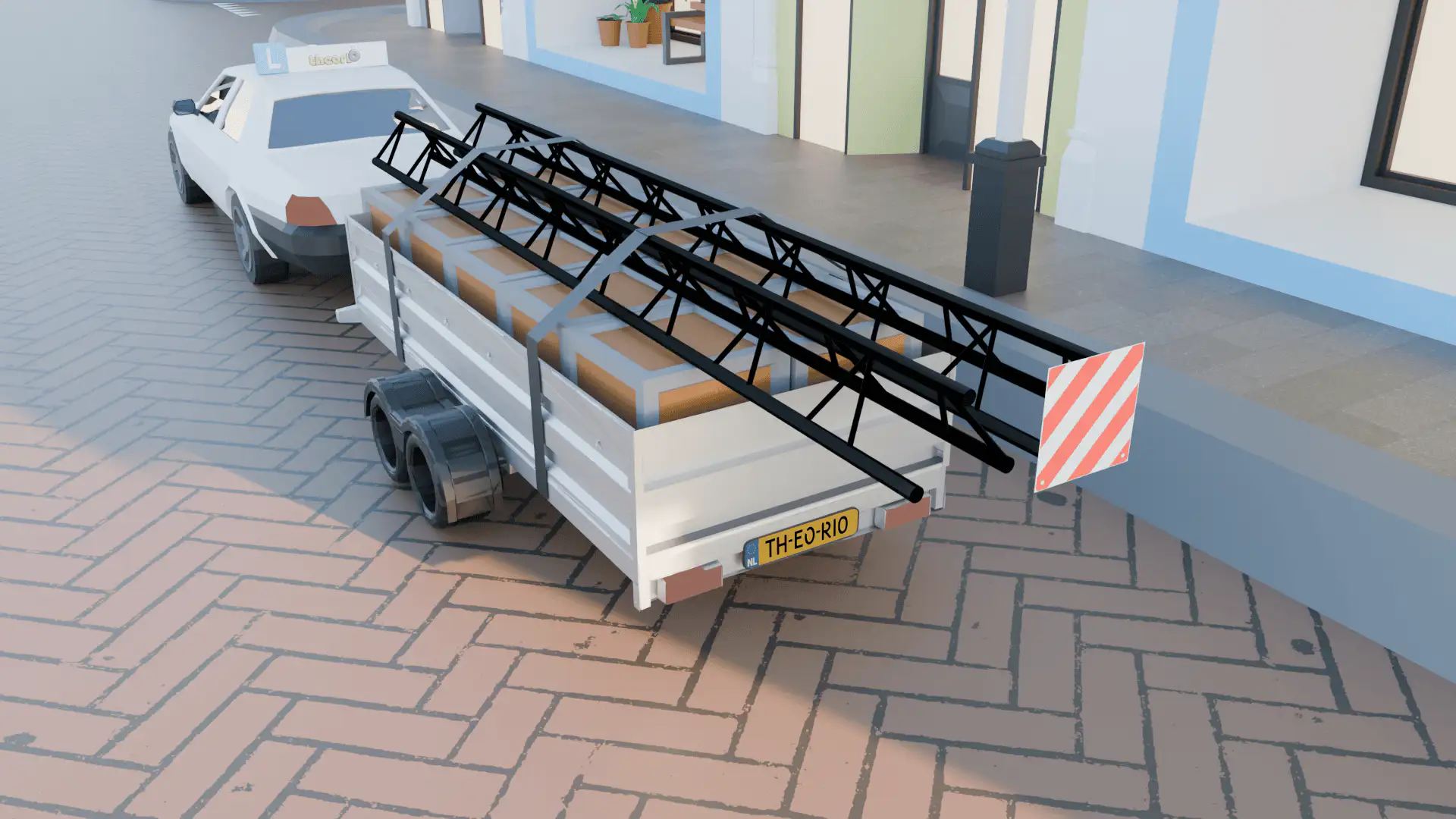
At the back, the load may even stick out more than 1 meter, but then a red-and-white striped marker sign is mandatory. That is the only correct way.
If the load sticks out less than 1 meter, then you may use that sign, but it is not mandatory.
If the load sticks out more than 1 meter behind the trailer, a red-and-white striped marker sign is mandatory.
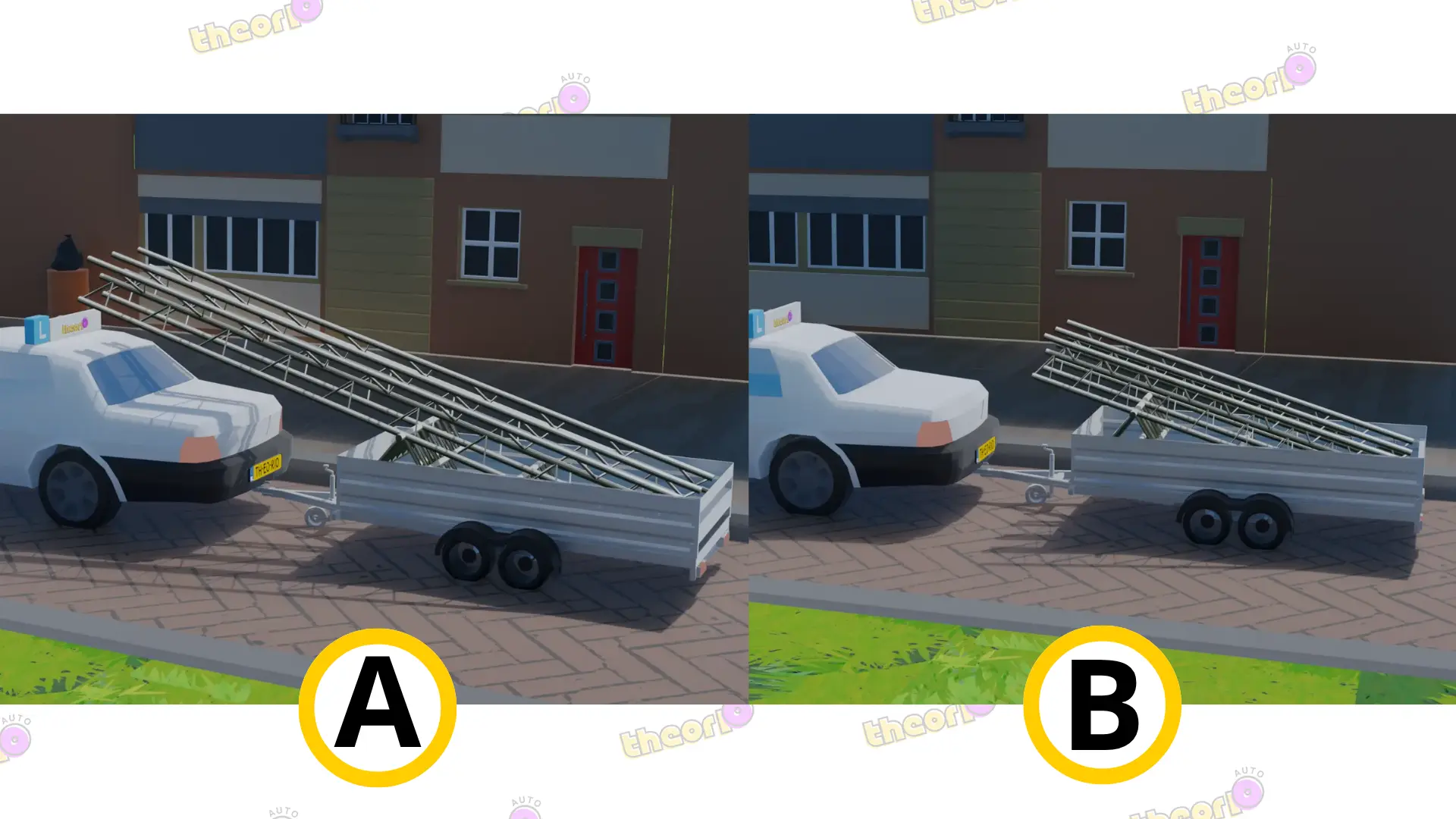
Pay attention to what "the front" exactly is. The front of the trailer is a bit in front of the loading area, at the drawbar. So the load may stick out a bit forward from the loading area, but never beyond the front of the trailer itself.
Right: the load stays within the front of the trailer. Left: wrong—the load sticks out beyond the front.
Load inside the trailer: neat and weight distribution
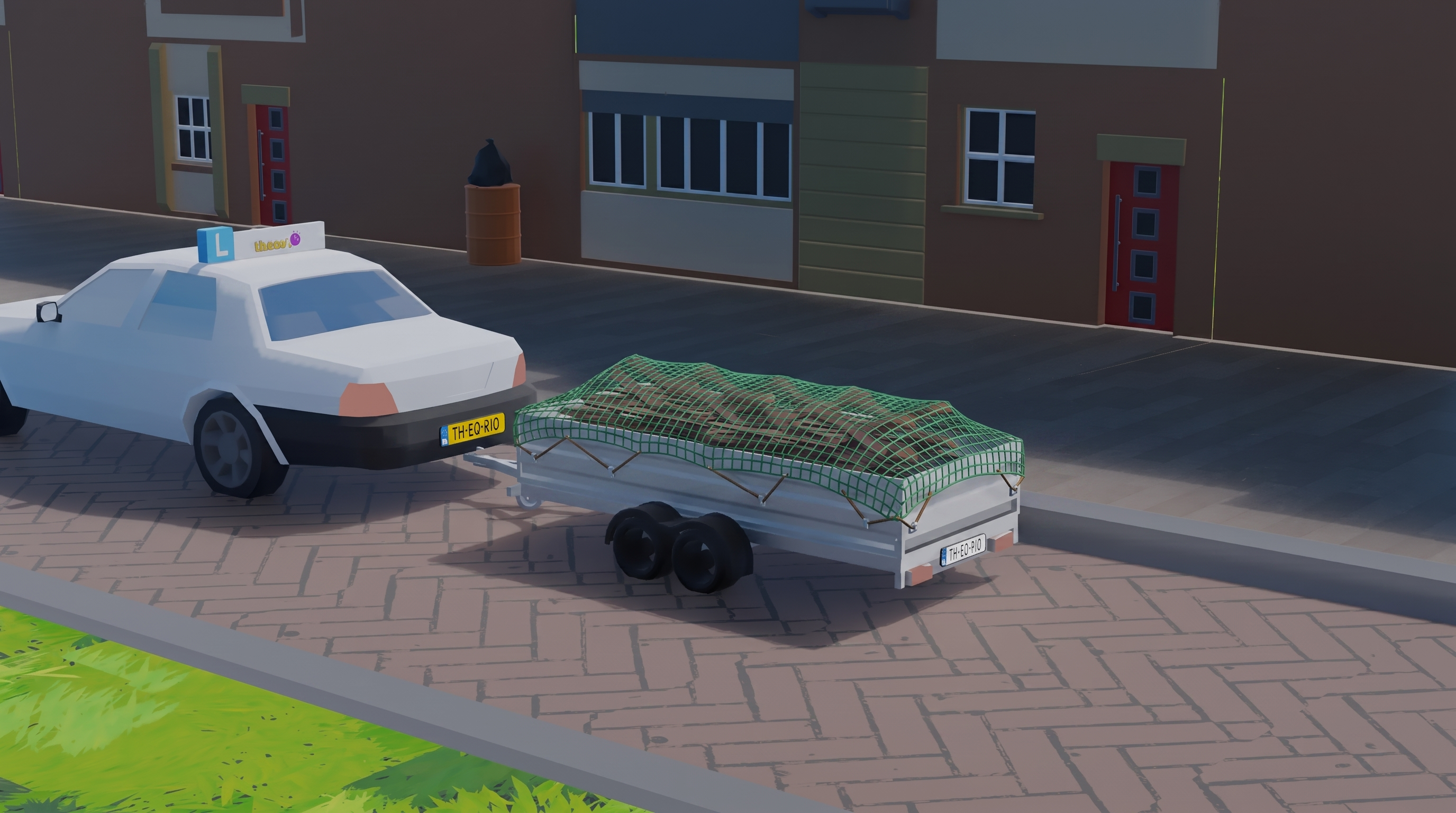
Secure loose cargo with a net over the trailer. That way nothing can fall out and everything stays in place.
Place heavy cargo in the middle of the trailer. If you put it at the back, the back becomes too heavy and you increase the risk of swaying.
Heavy cargo in the middle, and a net over loose cargo: this prevents swaying and loss of cargo.
Table: choose quickly in the exam
Situation
May / should be like this
Not correct
Trailer maximum 750 kg
White number plate with the car’s number
Use the separate yellow number plate
Trailer more than 750 kg
Its own yellow number plate
Use the car’s white plate
Car + trailer together
Maximum 3500 kg with driving licence B
Exceed 3500 kg
Load sticks out behind less than 1 meter
Marker sign may, but is not mandatory
Think that marking is always mandatory
Load sticks out behind more than 1 meter
Red-and-white striped marker sign mandatory
Drive without a sign or use something else
Load at the front of the trailer
May not stick out beyond the front
Let it stick out in front of the trailer
Heavy cargo in the trailer
Place it in the middle
Put it at the back; the trailer will sway
CBR trap
Students often look only at the loading area or only at the type of number plate that happens to be available. In the exam, you must reason very precisely:
A bicycle carrier is not a trailer. Therefore, there is no separate speed restriction for a trailer, but the general maximum speed for the vehicle still applies. RVV 1990 article 22
There are tricky questions where a sign or matrix sign indicates a speed restriction of 100 km/h, but if you are driving with a trailer, a lower maximum speed of 90 km/h applies to you. So don’t only look at what is on the sign, but also check which speed applies to your combination (car with trailer).RVV 1990 article 22a
Some people see a trailer and immediately think: the answer is 90 km/h. But the question says that you are driving outside the built-up area. Therefore, your maximum speed here is max 80 km/h. So read the question carefully first and only then look at all the answers carefully.
Thinking that cargo at the front of the trailer may stick out just like it may with the car. With a trailer, cargo may only stick out at the back.
You've covered Speeds with a trailer. Does it stick?
On the motorway you must mainly pay attention to the motorway sign, the applicable maximum speed, and active matrix signs.
For the CBR, the key point is: on the motorway, a maximum of 130 km/h and a minimum of 60 km/h apply, unless signs or matrix signs indicate a different speed.
Recognising that you are driving on a motorway
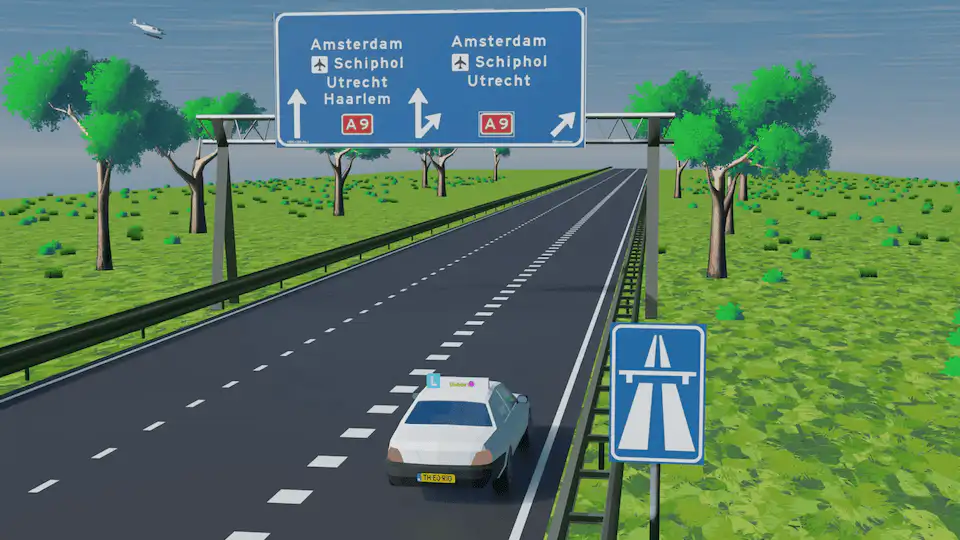
You can recognise a motorway by the blue rectangular sign with an image of a dual carriageway and a viaduct above it. The end of the motorway is indicated with the same sign, but with a red slash through it.
The sign looks a bit like a race track — a handy memory aid for the highest maximum speed there is in the Netherlands.
If you see this sign, you are driving on a motorway.
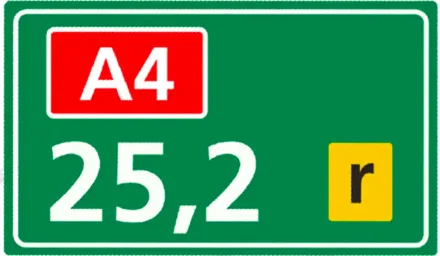
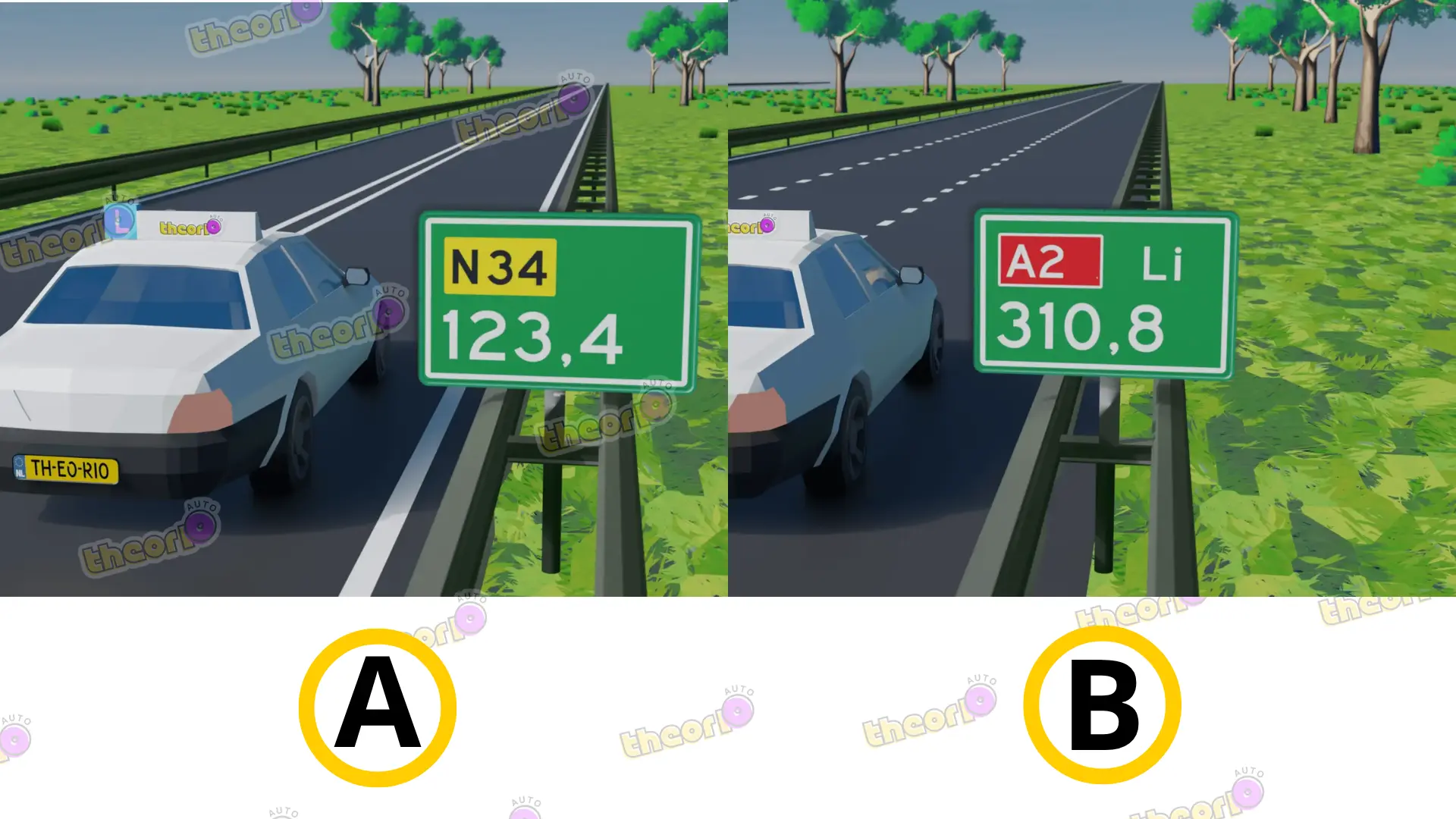
Motorways have A-numbers, such as A4 or A2. Those numbers are shown on hectometre signs along the road. The hectometre signs are placed every 100 metres, so you can determine your exact location on the motorway very precisely.
A = Motorway (for example A4, A2).
N = Non-motorway (for example N11, N207). These are often provincial roads, where a different maximum speed may apply.
Hectometre signs are not only useful for recognising the type of road. They also show your exact location. This is very useful in case of a breakdown or an emergency: you can then tell people exactly where you are.
CBR decision rules on the motorway
Maximum speed: 130 km/h, unless indicated otherwise.
Minimum speed: 60 km/h.
Active matrix sign: the speed on the matrix sign is leading.
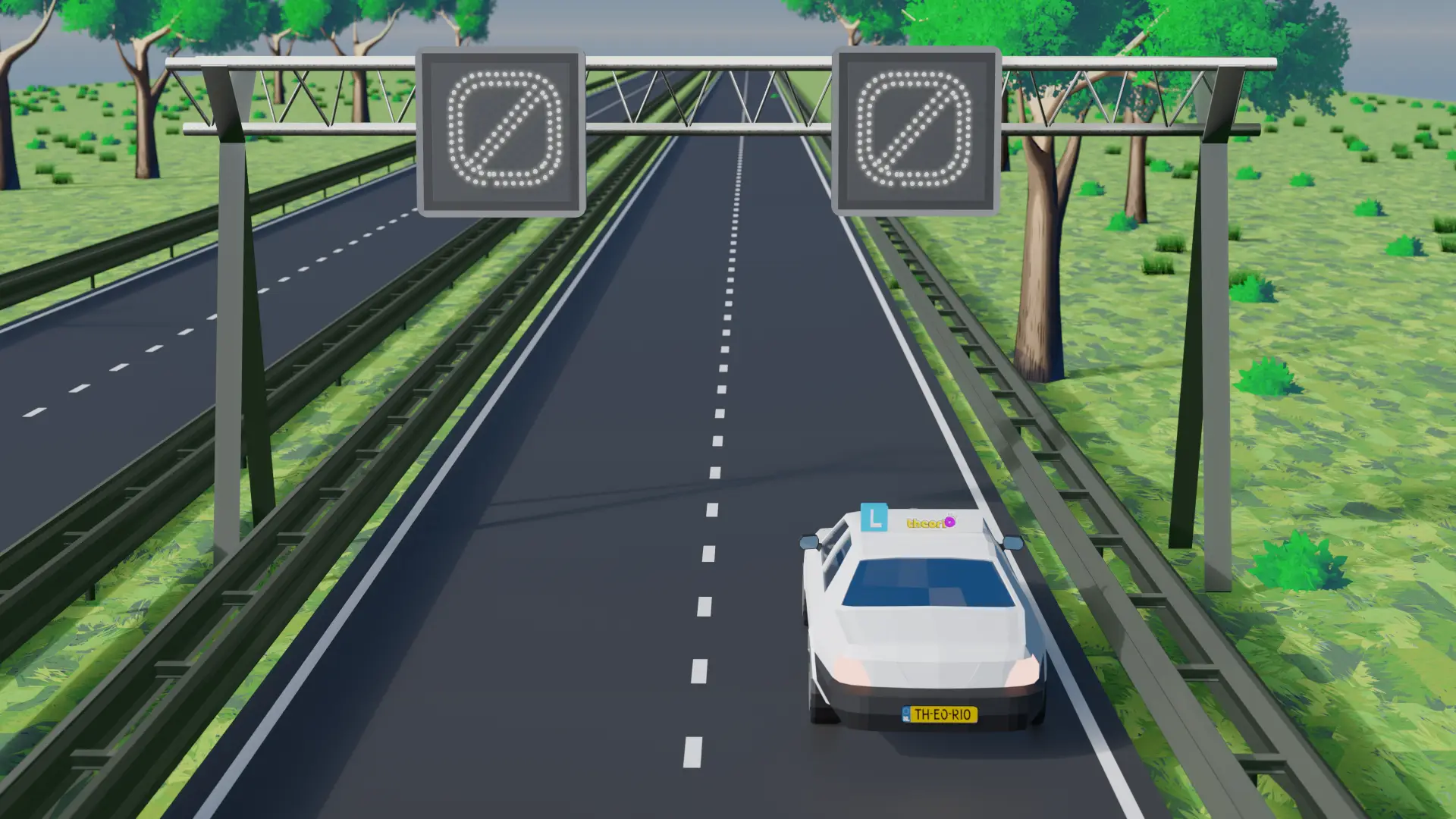
White square with a diagonal slash on a matrix sign: end of all previously indicated matrix signs.
Sub-sign with times: then the indicated speed only applies at those times.
This indicates that, at the end of the previously indicated matrix signs, you go back to the original maximum speed. For example: you are driving on the motorway at night and your maximum speed is 130 km/h, but because of a matrix sign it is temporarily reduced to 90 km/h. As soon as you see the end of that matrix indication, you may drive 130 km/h again.
The road autoweg and the motorway are called special roads. Not only because of their high maximum speed, but especially because there is also a minimum speed.
On the autoweg, the minimum speed is half the maximum speed: at 100 km/h that is therefore 50 km/h. On the motorway, the minimum speed is 60 km/h.
130 km/h in theory, 100 km/h between 06:00 and 19:00 in practice
The source makes an important distinction between theory and practice:
Legal maximum speed on the motorway: 130 km/h.
In practice in the Netherlands: on all motorways, 100 km/h applies between 06:00 and 19:00.
After 19:00: then you may drive 130 km/h again.
That 100 km/h in the daytime was introduced to reduce CO2 emissions of harmful substances. So this is not a different law: the legal maximum speed is still 130 km/h, but in practice there is almost always a sign with a lower speed.
Note: if signs or matrix signs indicate something else, you follow that.
Normally you drive 130 km/h on the motorway, but in practice, on almost every motorway in the Netherlands there is a sign with a lower maximum speed. That means you must drive 100 km/h between 6:00 and 19:00, because those signs indicate the speed that applies. In the CBR test answer, the rule is that the maximum speed on the motorway is 130 km/h, but only if there is no (temporary) lower maximum speed in force with a sign.
Merging onto the motorway
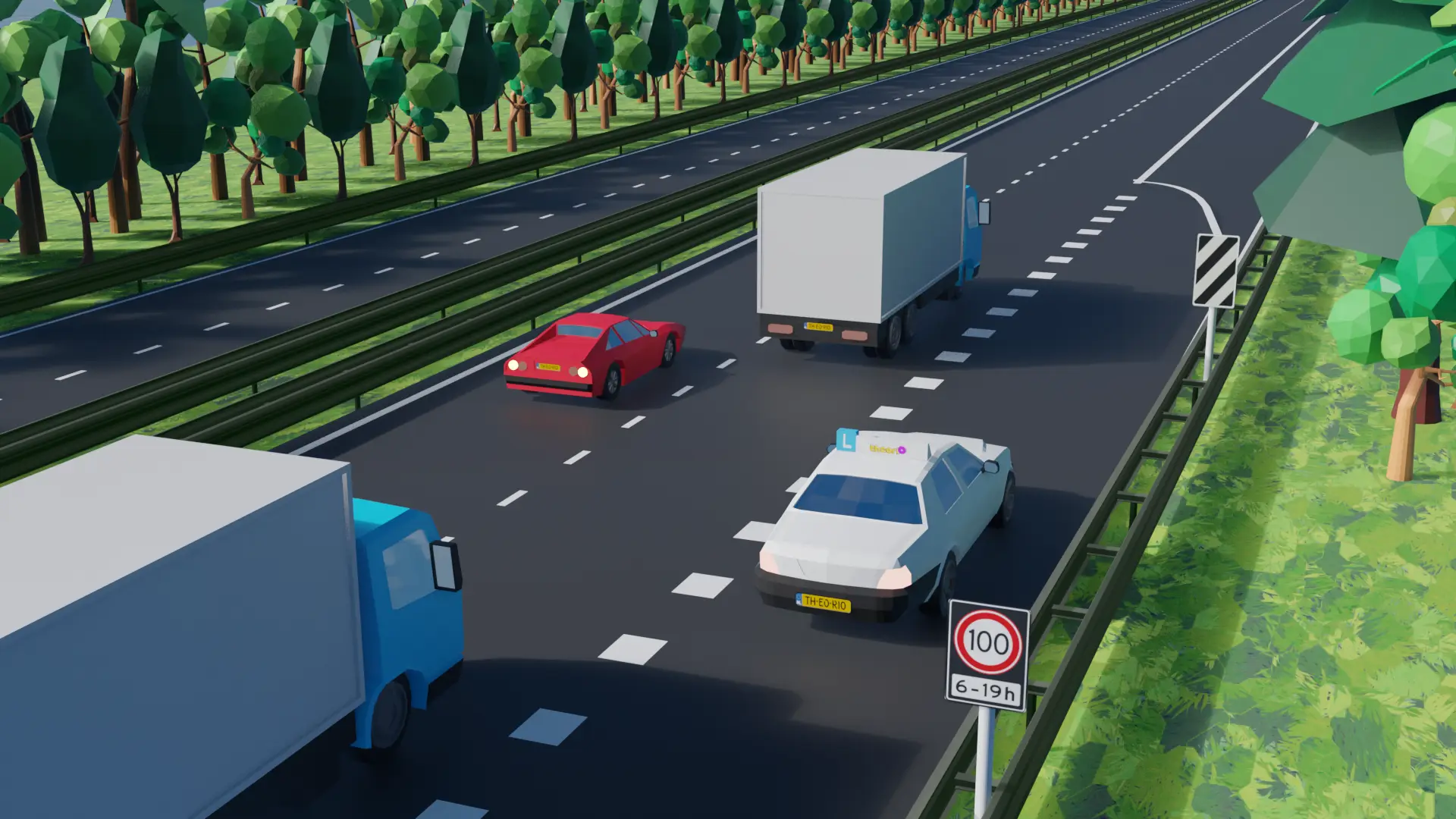
You now know that on the motorway there is a minimum speed of 60 km/h. But that does not mean it is safe to merge at that speed. On the main carriageway, traffic may drive at a maximum of 130 km/h and on average people drive about 100 km/h. If you merge at 60 km/h, you run the risk that someone behind you crashes into you.
First adjust your speed on the acceleration lane, so that at the moment you merge you are driving at about the same speed as the traffic on the main carriageway. Then traffic will keep flowing smoothly.
You adjust your speed on the acceleration lane, not only on the main carriageway.
What to pay attention to when merging
Lorries usually drive in the right-hand lane and may drive at a maximum of 80 km/h. If you want to merge between two lorries, you must adjust your speed accordingly. If you don’t, you will have to brake hard suddenly shortly after merging.
Buses and coaches may drive at a maximum of 100 km/h.
So always adjust your speed to the traffic on the motorway before you merge.
And when leaving the motorway
You reduce speed on the deceleration lane, not on the main carriageway. This way you do not hinder the other traffic and the flow remains normal.
All maximum speeds, once more in a row
Erf: 15 km/h.
Within the built-up area: standard 50 km/h, unless you enter a 30-zone (30 km/h) or enter an erf (15 km/h).
Outside the built-up area: standard 80 km/h, unless indicated otherwise. If you see markings through 50, 60 or 70, then it is back to 80 km/h.
Sometimes a sub-sign indicates at which times the sign applies.
Table: what applies on the motorway?
Situation
✅ Follow
❌ Don’t choose
You are driving on a motorway without an deviating sign
Maximum 130 km/h, minimum 60 km/h
100 km/h as a fixed main rule for every moment of the day
You see an active matrix sign with a lower speed
The speed on the matrix sign
Still keep driving 130 km/h
You see a white square with a diagonal slash on the matrix sign
End of the previously indicated matrix speed
Think that the last displayed speed keeps applying
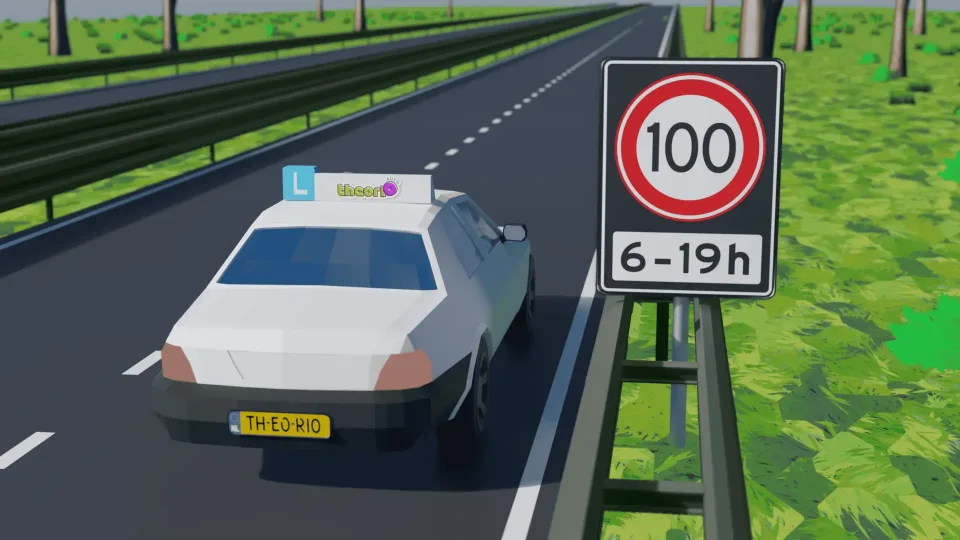
You see a sub-sign with times, such as 6-19h
The speed applies only at those times
Think that the speed always applies
You are driving between 06:00 and 19:00 on the motorway
100 km/h in practice, unless indicated otherwise
Always 130 km/h
You merge from the acceleration lane
Adjust your speed to the traffic on the main carriageway
Merge with the minimum speed of 60 km/h
CBR trap
Many candidates automatically choose 130 km/h on the exam as soon as they see “motorway”. That is too simple.
An active matrix sign takes priority.
Some candidates think that, in the CBR question, “What is the maximum speed on a motorway?” the answer is always 100 km/h. That is not correct. Only if there is a sub-sign next to it that indicates the time period (for example 6:00 and 19:00), does the maximum speed of 100 km/h apply within those indicated times.
Do not confuse the minimum speed of 60 km/h with a safe merging speed; when merging you must adjust your speed to the traffic on the main carriageway.
Thinking that you reduce your speed as soon as you want to leave the motorway. You brake on the deceleration lane, not on the main carriageway.
You've covered Speeds on motorways. Does it stick?
For the CBR, you must recognise an autoweg immediately by the blue sign with a white car. Then you determine the speed: normally a maximum of 100 km/h and a minimum of 50 km/h, unless signs or matrix signs indicate something else.
In exam questions, the difference with the motorway is important: autoweg = white car on a blue sign, no motorway symbol.
Autoweg or motorway? This is how you see the difference
You probably know roughly what a motorway looks like, but in an exam question that is not always very clear. There are two reliable ways to determine it: the sign and the hectometre signs.
A autoweg is indicated with a blue sign with a white car on it. If you see the sign with the car, then you are on the autoweg. A motorway has a blue sign with a dual carriageway and a viaduct.
If there is no sign visible, look at the hectometre signs along the road:
A + number = Motorway (A4, A2).
N + number = Non-motorway (N11, N207).
A = Motorway, N = Non-motorway. Handy if there is no sign visible.
3 types of markings
A. Double white centre lines with green colour in between: 100 kilometres per hour
B. Double white centre lines without green colour: 80 kilometres per hour
C. No centre line: 80 kilometres per hour
Memory aid for the green strip: a 100 euro banknote is also green. Green = 100 km/h.
Always check whether signs adjust the speed
Just like on other roads, the speed on an autoweg can be adjusted.
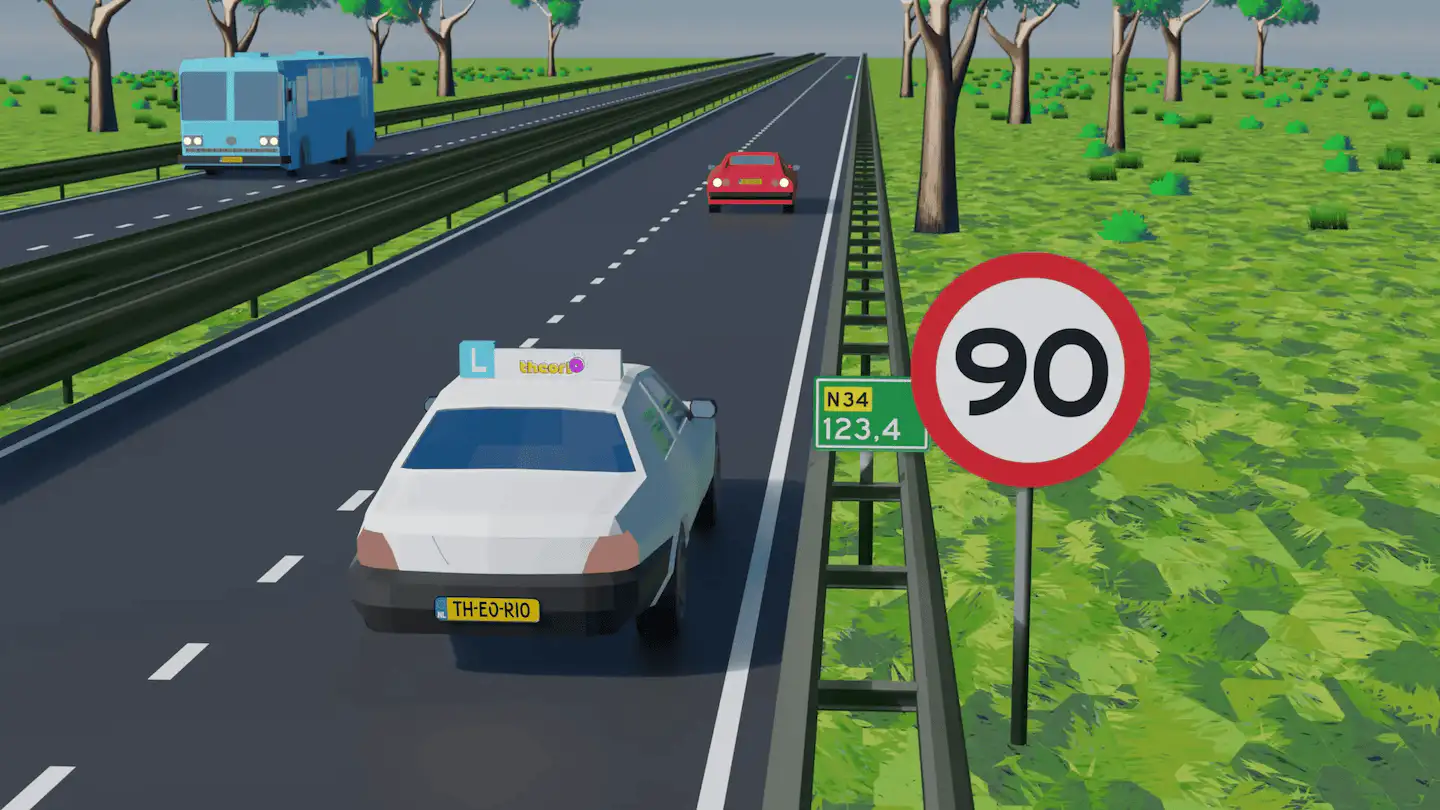
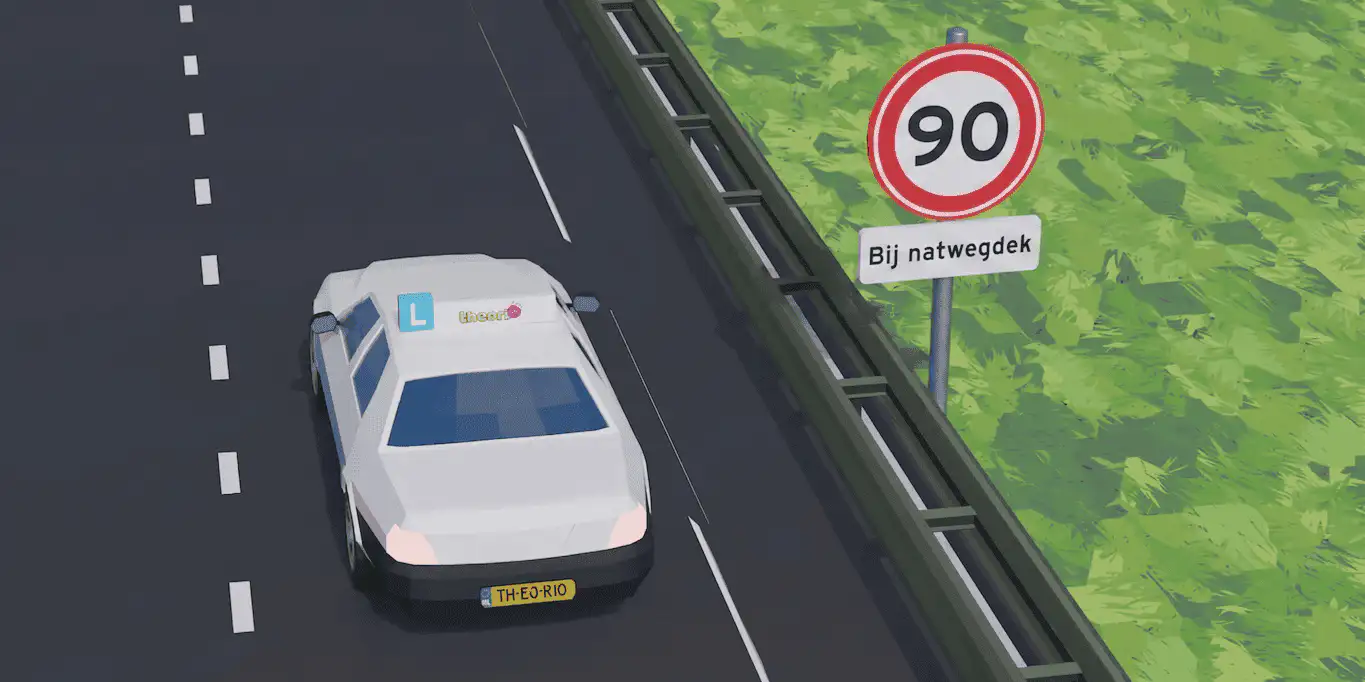
If you see a round white sign with a red border and a speed, then that maximum speed applies. Here the maximum speed is 90 km/h.
If you see an active matrix sign, then it is leading.
Why an autoweg has risks you don’t expect
A-roads — motorways — are relatively safe despite the high speed: everyone drives in the same direction, there are no intersections and no oncoming traffic.
Most accidents happen on roads where you may drive 50 to 80 km/h. On those roads, vehicles with very different speeds drive alongside each other, and you do have to deal with intersections and oncoming traffic.
Drivers see motorcyclists arriving more slowly. That is why collisions between cars and motorcycles often occur on this kind of road. So when you approach an intersection or carry out an overtaking manoeuvre, consciously look again extra carefully.
Differences the CBR likes to test
Situation
Autoweg
Motorway
Recognition sign
Blue sign with a white car
Blue sign with road/viaduct
Hectometre sign
N + number
A + number
Normal maximum speed
100 km/h
130 km/h, unless indicated otherwise
Minimum speed
50 km/h
60 km/h
Matrix sign active
Follow
Follow
CBR trap
Many candidates accidentally choose 130 km/h on an autoweg, because they confuse the sign with a motorway or think that “fast road” automatically means motorway. On the exam you must first recognise the correct sign and only then choose the speed. RVV 1990 article 42
A second mistake is thinking that 100 km/h only means maximum. On the autoweg there is also a minimum speed of 50 km/h.
A third mistake is ignoring an active matrix sign. If the matrix sign shows a lower speed, that speed applies at that moment.
Last common mistake: The minimum speed on an autoweg is 50 km/h. Vehicles that cannot reach that speed, such as a tractor, brommobielen and mopeds, are therefore not allowed to drive on an autoweg. More information about these vehicles you can find here.
You've covered Speeds on autowegen. Does it stick?
In the exam, speed signs are recognised mainly by shape, colour and function. A round sign with a red border is a prohibition, a round sign with blue is an obligation, and a square usually means that something is allowed.
So with speed questions you must first determine: is this a maximum that you must follow, an advice, or a warning?
Matrix signs
On the motorway, besides the normal fixed traffic signs, you also come across electronic signalling signs: matrix signs. If they are active, they indicate the new maximum speed. An active matrix sign is therefore always leading, even if the fixed sign indicates something else.
Matrix signs are activated, for example, when there is a traffic jam further ahead. By lowering the maximum speed over time, you can anticipate that traffic jam more easily.
End of a matrix indication
The end of such a temporary maximum speed is indicated on the matrix sign with a white square with a diagonal slash. That means: end of all previously indicated matrix signs. In this case, therefore, the end of the maximum speed that a previous matrix sign indicated.
White square with a diagonal slash: end of all previously indicated matrix signs.
What a matrix sign can show more
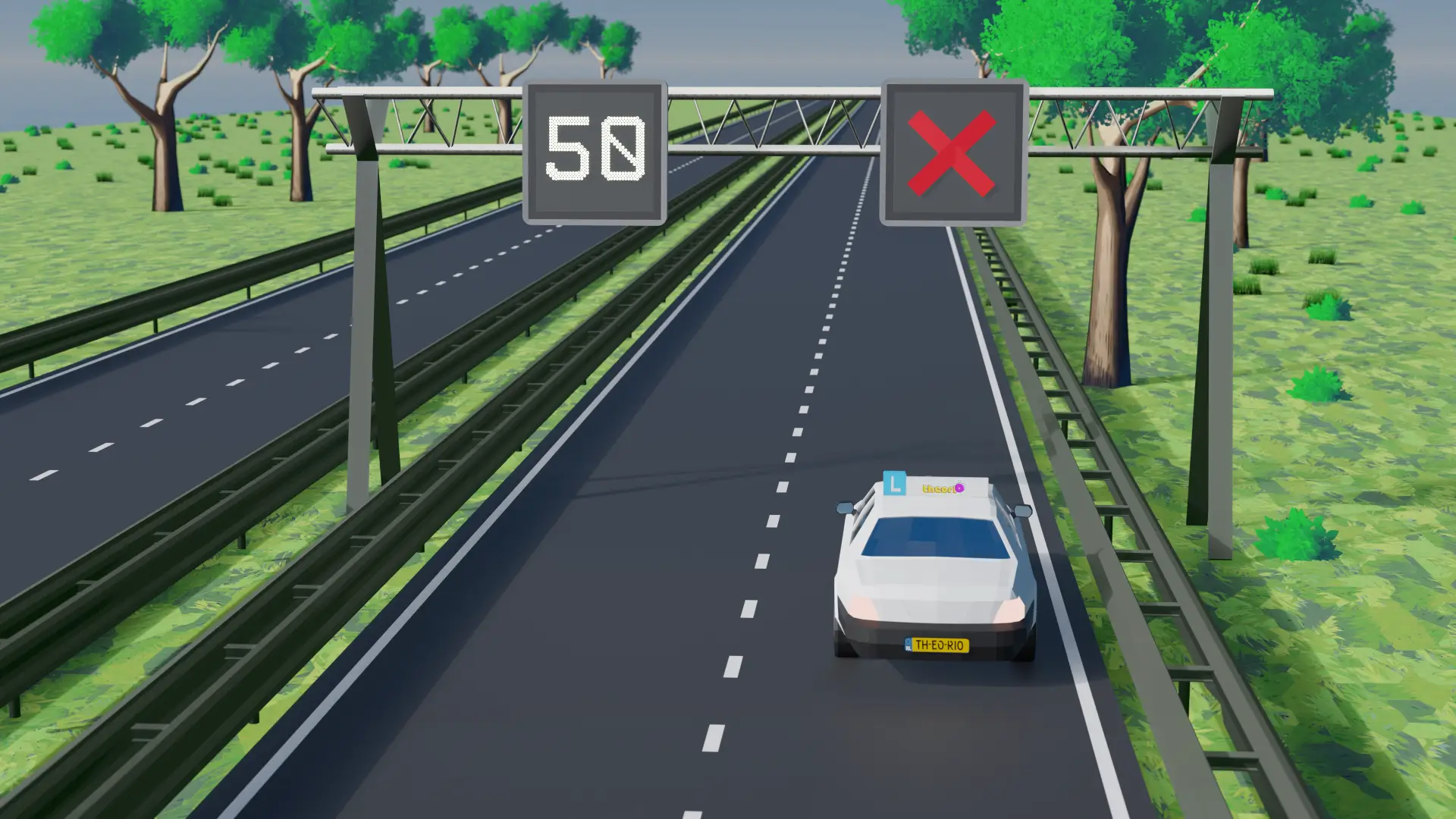
Besides a speed, a matrix sign can also display a diagonal arrow (does this lane end?) or a red cross (lane closed). You can read more about this at Traffic signs & Signals.
A matrix sign can also show a diagonal arrow or a red cross.
An advice sign gives advice to road users. For example, at a bend there may be a sign saying it is sensible to follow the indicated lane markings. This advice is not mandatory: you may deviate from it with a good reason, but you must still drive safely and with sufficient attention.
Advice speed: square = friendly
Besides the round white signs with a red border and the matrix signs — which indicate a mandatory maximum speed — there are square blue signs with white numbers. These indicate an adviessnelheid, especially at sharp bends.
Square = friendly. The speed on such a sign is advice. Sensible to follow, but not mandatory.
If you drive faster than advised in a bend anyway, you increase the risk of going off the bend and hitting an oncoming vehicle or a tree.
How to read speed signs in the exam
Traffic signs are in principle valid. If there is a sub-sign next to it, an exception or extra explanation may be stated there. If you see multiple signs one below the other, read them from top to bottom as one story.
Signs that only apply in certain situations
Sometimes you come across signs that only apply in specific situations. On busy motorways, for example, you see signs with a sub-sign 6-19h: then that adjusted maximum speed applies only between 6:00 in the morning and 19:00 in the evening. A sign can also apply only under certain conditions, such as on a wet road surface.
Fixed rule: if a sign applies only under certain conditions or at certain times, then that always appears on a white sub-sign underneath it. If there is no sub-sign, then the sign applies at all times.
Roads set up for 30 km/h
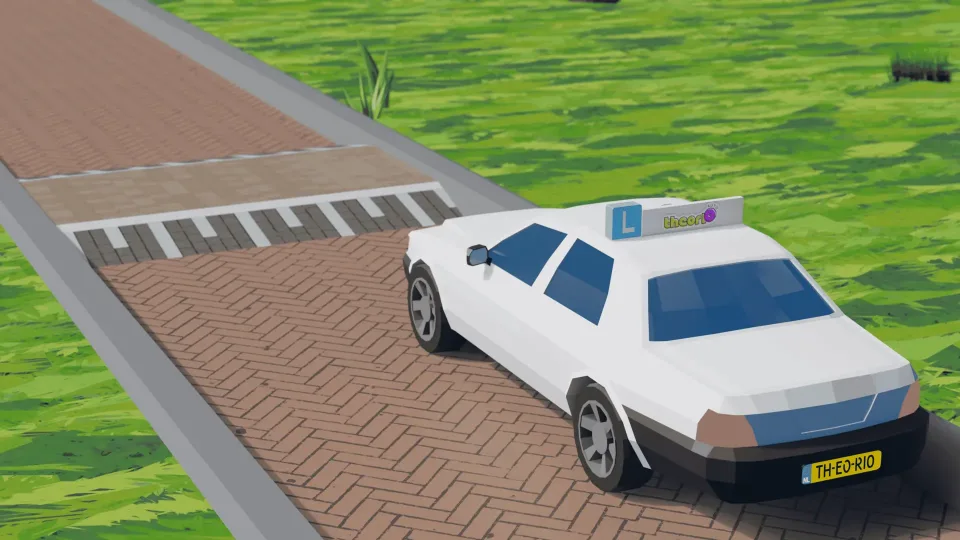
Roads with speed bumps and cobblestones are set up for a speed of 30 km/h. This kind of road markings and road construction forces drivers to adjust their speed to the built-up area.
Roadworks with maximum 90 km/h
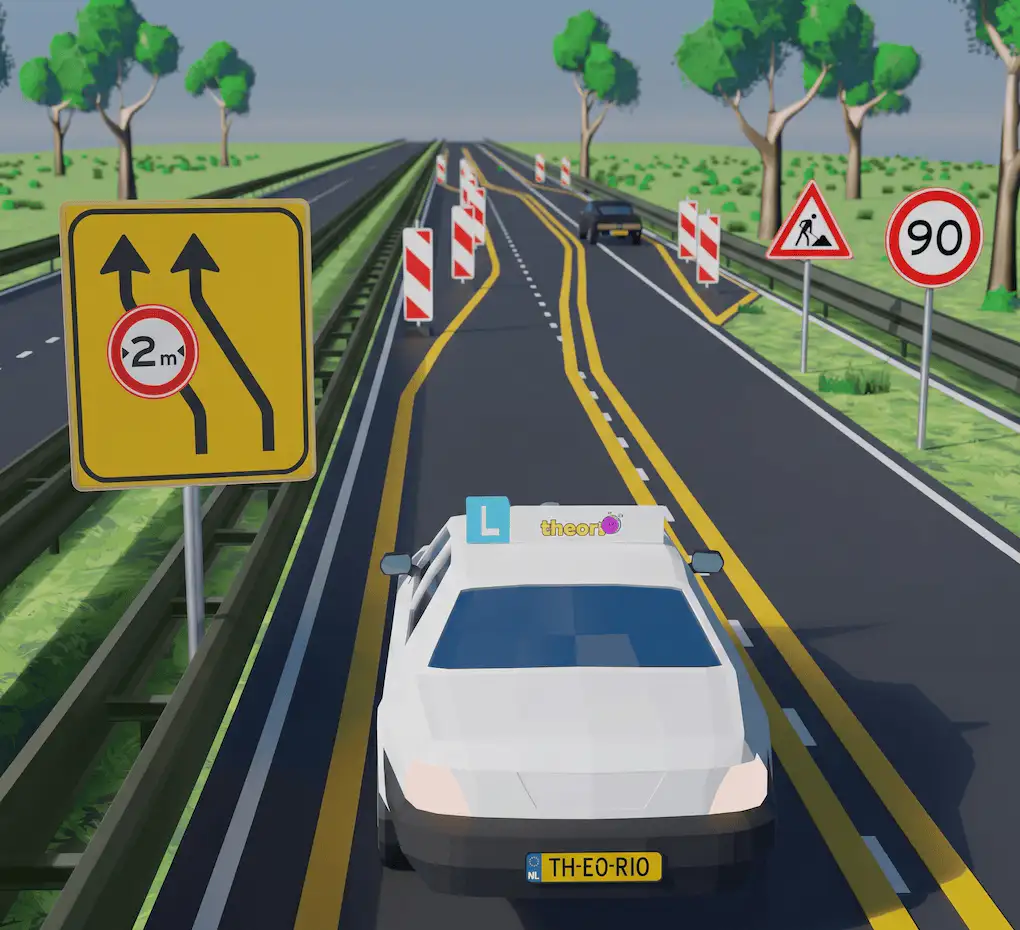
With signs for roadworks, you must reduce your speed to a maximum of 90 km/h. This also applies even if no work is being carried out at that moment: the signs indicate a speed restriction that is in force. So the signs are always valid as long as they are in force.
Warning signs do NOT give a speed restriction
These signs do not themselves indicate a maximum speed. They only indicate that you are driving on a certain type of road (for example the motorway). That is why CBR questions often refer to the situation: “You are driving on the motorway and ask whether you may drive 90 km/h there.” For everyone, the answer is then: yes.
Poor road surface: think of bumps and potholes.
Speed bump: one clear rise in the road.
Slippery road surface: extra chance of skidding.
Poor visibility: for example due to rain, snow or fog.
Traffic jam building up: traffic in front of you can come to a standstill.
There is one exception: children can unexpectedly cross. That is why you must reduce your speed, so that you have enough time and space to react.
Table: which sign does what?
Sign
Shape and colour
Meaning
Mandatory?
Maximum speed
Round, white with a red border
This is the highest permitted speed
Yes
End of maximum speed
Round, white with grey numbers and diagonal stripes
The earlier restriction no longer applies
Yes
Advice speed
Square, blue with white numbers
Recommended speed, often in a bend
No — square = friendly
Matrix sign with speed
Electronic, above the lane
New maximum speed, takes priority over the fixed sign
Yes, as long as it is active
Matrix sign: white square with a slash
Electronic
End of all earlier matrix indications
—
Warning sign
Triangle, white with a red border
Warns of a danger
No speed restriction
CBR trap
❌ Wrong: treat a square blue speed sign as a mandatory maximum speed.
✅ Correct: square blue = advice. Round with a red border = mandatory.
❌ Wrong: ignore an active matrix sign because the fixed sign indicates a higher speed.
✅ Correct: an active matrix sign always takes priority.
❌ Wrong: think that a warning sign itself imposes a maximum speed.
✅ Correct: a warning sign only warns; the applicable maximum speed does not change because of it.
❌ Wrong: assume a time or weather restriction that is not there.
✅ Correct: such a restriction is always shown on a white sub-sign. No sub-sign means: the sign applies at all times.
You've covered Speed signs. Does it stick?
FAQ
Frequently asked questions
Short answers to common questions about Speeds.
What is the maximum speed with a trailer?
The maximum speed with a trailer is 90 km/h, unless indicated otherwise.
What is the maximum speed on a motorway?
On the motorway, the maximum speed is 130 km/h, with a minimum speed of 60 km/h, unless signs or matrix signs indicate otherwise.
What is the maximum speed outside built-up areas?
Outside built-up areas, the maximum speed is usually 80 km/h, unless signs indicate otherwise.
What is the maximum speed within built-up areas?
The standard maximum speed within built-up areas is 50 km/h, unless a 30 zone applies.
What is the maximum speed limit in a residential area (dutch: woonerf / erf)?
The legal maximum speed limit in a residential area (in dutch: 'woonerf' or just 'erf') is 15 kilometers per hour. This used to be commonly referred to as a "walking pace". This low speed is necessary because pedestrians must be able to safely use the entire width of the street.
Keep practicing with up-to-date material
With these speed rules, you have the basics for speeds, following distance, and matrix signs. There are still more exceptions per sign, time, type of road, and weather situation, so practice in our app with the most up-to-date CBR information and recognize faster which speed applies in each exam situation.
Ready to practise?
Test your knowledge of Speeds with 55 practice questions in the app.
Your first quiz is free, no account needed. ·After that from €19.99 for 90 days of access.

 erf: maximum 15 km/h because of pedestrians and children playing.
 Built-up area: standard 50 km/h, unless a 30-zone applies.
 Outside the built-up area: Maximum speed of 80 km/h. Sometimes you may drive 60 km/h on narrow roads, but this is always indicated in advance with a 60 km/h sign. RVV 1990 article 21
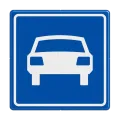 Autoweg: Maximum 100 km/h, but that depends on the road markings. If you see on the CBR exam a question with only this sign, then it applies: the maximum speed is 100 km/h and the minimum speed is 50 km/h.
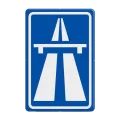 Motorway: Maximum 130 km/h. In practice, between 06:00 and 19:00 it is often 100 km/h, but on the CBR exam this restriction is always shown with a sign; without a sign you must assume 100 km/h on a motorway. Minimum 60 km/h.