New exam questions on driver assistance systems from 1 October 2026
The CBR is expanding the exam material on driver assistance systems. No extra questions are being added, but the questions are about something different. Here is exactly what changes.
On 17 August 2026 the CBR announced that the exam material on driver assistance systems (ADAS) is being expanded. The change takes effect on 1 October 2026.
No questions are being added
This is the most important thing to know, and it is often reported wrongly online: the number of exam questions does not change. The CBR says so explicitly. What changes is what the questions are about.
Until now they mostly covered how a system works: what does adaptive cruise control do, what does lane keeping assist do. From 1 October they are about your behaviour while that system is switched on. Not "what does the system do", but "what is expected of you".
What the new questions are based on
The CBR names three places in the Rijprocedure B:
- the principles in the Introduction;
- the guidelines in chapter 1, under the heading Rijhulpsystemen;
- the guidelines in chapter 2, under the heading Rijhulpsystemen.
Those guidelines have in fact been there since 2023. What is new is not the content, but that the CBR designates it as exam material for the car theory exam.
The common thread: you stay responsible
Every guideline comes down to one principle: the driver is responsible for performing the driving task, not the car and not the assistance system. If you are torn between two answers in the exam, that is almost always the deciding thought.
Concretely, the CBR expects you to check before the drive which systems the car has, to check that sensors and cameras are clean, to maintain an active driving posture so you can take over immediately, to keep observing for yourself rather than leaning on the system, and to switch a system off when the situation calls for it.
The seven principles almost nobody covers
This is the part most courses miss. In the Rijprocedure B the CBR writes literally that the eight guidelines in chapters 1 and 2 were developed on the basis of seven principles in the Introduction, and the announcement names that Introduction separately as exam material. In short:
- You are always responsible for the driving task, not the car and not the system.
- Good driving skill shows in safe, comfortable, social and adapted driving, with or without assistance systems.
- You reasonably know what the systems are for, how they work and how to use them well.
- You know that names and controls differ per brand, and that weather, road and traffic affect how they work.
- You know what a system can do and that it has limits.
- You deliberately let them inform or support you, except emergency systems, which intervene by themselves.
- You recognise the risk of negative behavioural adaptation.
That last point is the biggest trap, and the CBR supplies the example itself: keeping a shorter following distance because the car will brake anyway in an emergency. Technology must not make you lazier. Following closer, checking mirrors less or skipping the shoulder check because "the car sees it" is exactly what gets marked wrong.
Where the systems stop working
The questions are rarely about how a system works and almost always about where it stops. The main ones:
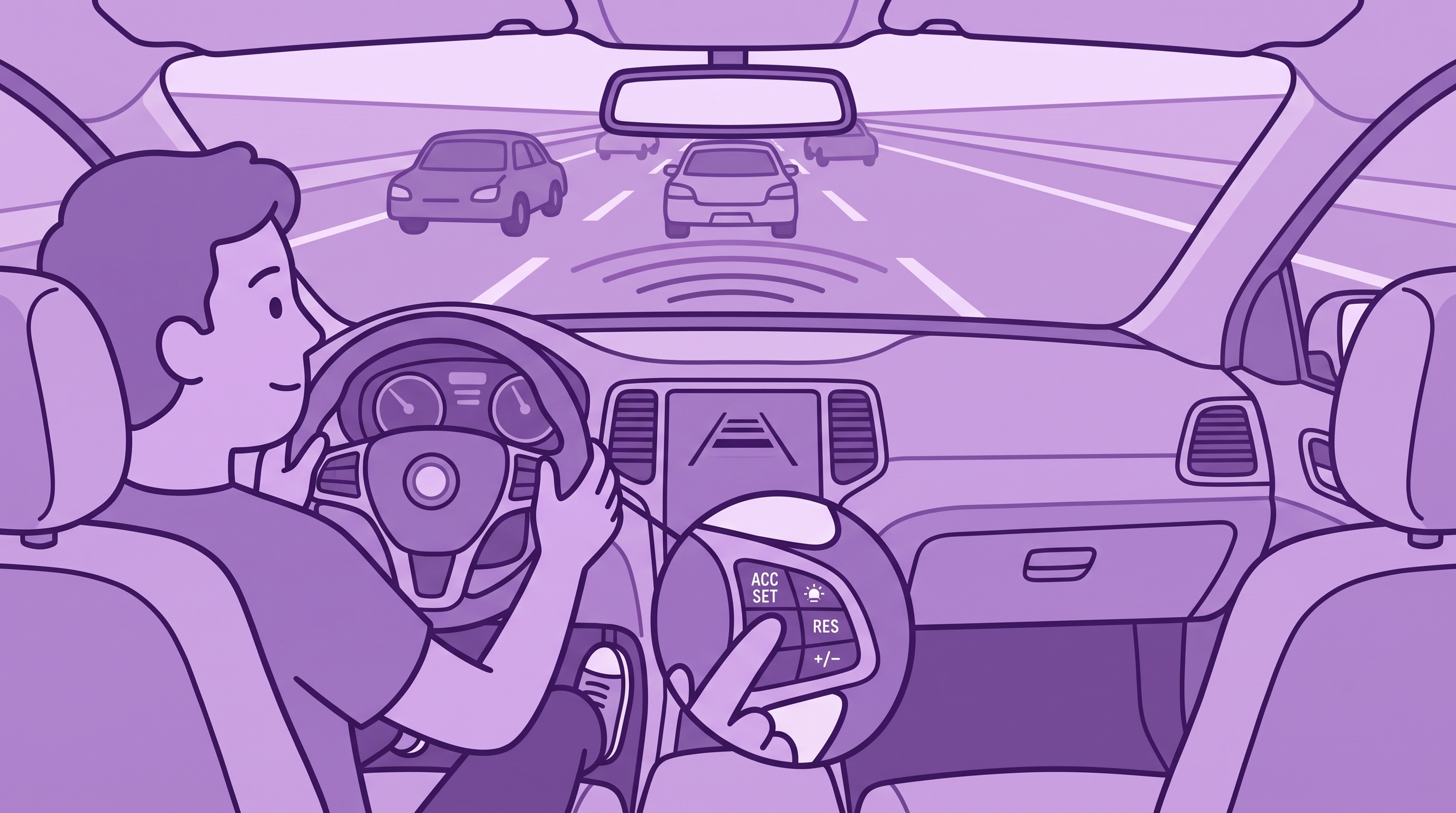
- Adaptive cruise control often does not see stationary traffic, the radar is tuned to moving objects. Approaching a jam, you brake.
- Lane keeping assist does not work without visible markings. Note the difference: lane departure warning (LDW) only beeps, lane keeping assist (LKA) actually steers.
- Blind spot detection regularly misses motorcyclists and cyclists. No warning is not proof it is clear; the shoulder check stays mandatory.
- ISA relies on map data that lags behind roadworks. Where they differ, the sign decides. You can override ISA, and it switches back on every trip.
- ABS does not always shorten your braking distance. On snow or gravel it can lengthen it. The point is that you can keep steering. And ESP cannot beat physics.
- Automatic emergency braking is a last resort: if it has to intervene, you were already too late anticipating.
It is also worth knowing eCall (calls 112 itself in a serious crash, mandatory and cannot be switched off), hill hold assist (holds the brake for a second or two but does not pull away for you) and rear cross traffic alert when reversing out of a space.
On your practical exam too
You may use assistance systems in the practical exam. Allowed since 2016, provided you show you stay in charge. Since January 2024 the examiner also asks about them during the vehicle checks, just as about your tyres. Two exceptions: automatic parking is not allowed during the bijzondere verrichtingen, and neither are "hands-off" systems that take over the steering. The CBR's vademecum is explicit: "Het automatisch inparkeersysteem … mag niet gebruikt worden bij het uitvoeren van de bijzondere verrichtingen."
What this means for you
If you sit your exam before 1 October 2026, the old material applies. If you sit it after that, you may get these questions. And because the announcement only came in mid-August, many theory courses have not been updated yet. Check whether yours covers the guidelines in chapters 1 and 2 of the Rijprocedure B.
We have set out all the guidelines, each with an example question in the new style. And you can practise ten free questions to see whether you can handle the new phrasing.
Note: nobody outside the CBR knows the real exam questions. Our example questions were written by us based on the published guidelines in the Rijprocedure B.