Question
1: In which situation must you give way to the pedestrian?
Correct answer: in situation A and B
The correct answer is C: in situation A and B. Here, the CBR-type question tests whether you can see the difference between giving way to crossing drivers and giving way to pedestrians when you are turning. In both situations, the car is heading in a direction where the pedestrian is located. You must give way to that pedestrian. A trick to remember this is as follows: if you see the belly or back of the pedestrian, then ease off the accelerator and let them go. If you see the side? Then accelerate and drive on.
The yield lines and the give way sign do not change this. According to traffic rules, yield lines apply to crossing drivers, not to pedestrians. This means: you look for traffic on the crossing road before that marking, but if you then turn, you still need to pay attention to pedestrians on the road you are entering. That is exactly where the pitfall in this question lies.
Question
2: This symbol lights up while driving. What does this symbol relate to?
Correct answer: with the braking system
The correct answer is A) with the braking system. This red dashboard light with an exclamation mark between brake symbols is related to the braking system. In such a question, the CBR tests whether you can immediately recognize a important warning light: red means it concerns something serious that affects the safety of the vehicle.
Why specifically the braking system? Because this symbol is specifically used for a problem with the brakes, brake fluid, or an activated handbrake. It does not concern 'general vehicle control', but really a component that directly affects safe stopping. In vehicle knowledge, that is exactly the principle: you need to know which system is being warned about and why that is important.
B) with the engine oil is incorrect, because engine oil has a different warning symbol. You do not recognize that from this brake symbol. C) with the windscreen washer fluid is also incorrect, because there is also a different, separate symbol for that. Moreover, that fits less with a red warning light, because this brake symbol specifically indicates a safety-relevant problem.
Question
3: At which sign may you overtake a truck?
Correct answer: at sign A
The correct answer is at sign A. This sign means a prohibition for trucks to overtake motor vehicles.
The CBR tests here whether you can see the difference between a prohibition that applies only to trucks and a general overtaking prohibition. At sign A, you see a red truck next to a black passenger car. This sign applies only to trucks and not to you! You may overtake here with the learner car, but trucks may not.
Sign B, on the other hand, shows a red passenger car next to a black passenger car. This indicates a general overtaking prohibition for motor vehicles, which means you may not overtake here. Therefore, A is correct and B is not.
Question
4: How can you ensure that your car consumes less fuel?
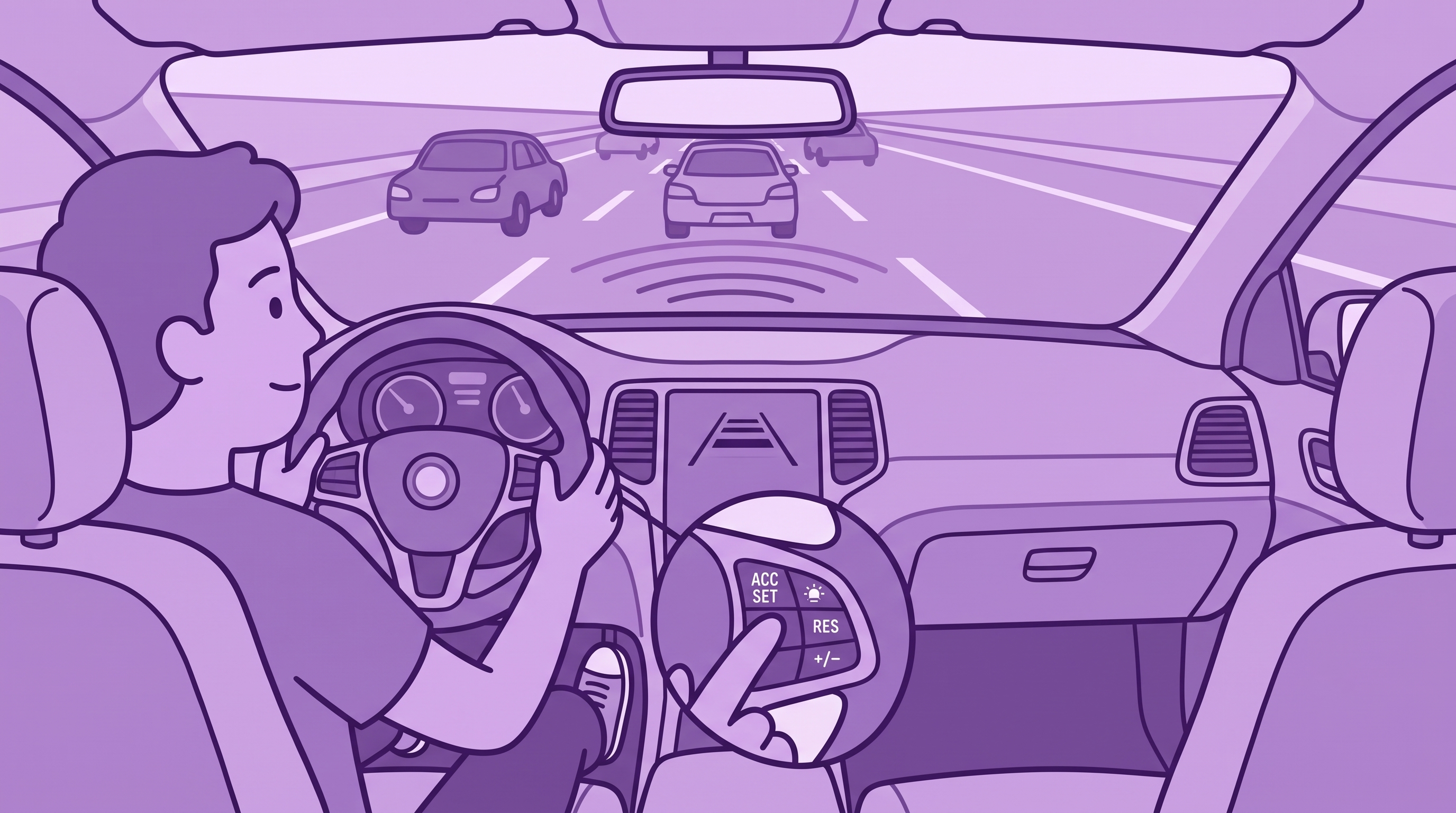
Correct answer: by keeping the tires at the correct pressure; by using cruise control
The correct answer is: by keeping the tires at the correct pressure and by using cruise control. In such questions, the CBR tests whether you understand what economical driving behavior is. Correct tire pressure helps because the car rolls more efficiently.
Also, cruise control is a suitable answer here, as it usually allows for smoother driving. Driving calmly and consistently prevents unnecessary acceleration and braking, which is beneficial for fuel consumption. The question is therefore about choices that help the car drive as efficiently as possible.
Option C, staying in a low gear as much as possible, is actually unfavorable. A low gear usually causes the engine to rev more than necessary, which consumes more fuel rather than saving it. Therefore, that option is incorrect or at least less suitable for economical driving.
Question
5: What is the correct order of giving way?
Correct answer: Order on the image: 1 → 2 → 3
The learner car has yield lines here. This means that it must give way to all crossing drivers. In this case, the learner car goes last.
The scooter (on the left in the image) and the motorcycle (on the right in the image) are on the same road. Two rules apply here: 'going straight ahead has priority over turning' and 'short turn has priority over long turn'. NOTE: this only applies if both drivers are on the same road.
In this case, the rule 'going straight ahead has priority over turning' applies. The scooter on the left therefore goes before the motorcycle on the right. The correct order is therefore: scooter, motorcycle, learner car.
Question
6: At which sign must you give way to drivers on the intersecting road?
Correct answer: Stop sign; Yield lines
The correct answer is: at the stop sign and the yield lines sign (the inverted white-red triangle). These two signs both indicate that you must give way to drivers on the intersecting road. The stop sign even states this literally in its meaning: you must stop and yield to drivers on the intersecting road. With the yield lines sign, you must also give way to those drivers.
The CBR pays attention to the difference between a sign that only warns and a sign that actually imposes a priority rule. A warning sign for an intersection only indicates that an intersection is approaching. It does not mean that drivers on the intersecting road automatically have priority. The general priority rules at intersections still apply, such as yielding to drivers on the right, unless another rule or sign indicates otherwise.
The sign priority road is also incorrect because it indicates the opposite: you are driving on a road with priority. That sign does not mean that you must give way to drivers on the intersecting road. Therefore, only the stop sign and yield lines are correct in this question.
Question
7: Must you yield to the cyclist?
Correct answer: No
The correct answer is No. Here you see a regular intersection: there are no priority signs and no yield lines. Then, according to Dutch traffic rules, the basic rule at an intersection applies: you yield to drivers who come from the right. The cyclist is coming from the left, so you do not have to yield to him.
This is exactly what the CBR tests in such a question: do you first recognize whether it is really an intersection, and then check if there is anything that changes the normal priority rule. That is not the case here. Yield lines would mean that you must yield to traffic on the intersecting road, but they are not present. There are also no signs visible indicating a different priority situation.
Therefore, A) Yes is incorrect: a cyclist does not automatically have priority just because he is a cyclist. B) No is correct, because at this intersection the rule “right has priority” applies and the cyclist is not coming from the right.
Question
8: At which of the 4 signs may you go straight ahead?
Correct answer: 4: No U-turn
The correct answer is sign 4 no U-turn. That is the sign that only allows going straight ahead, because it is a prohibition to make a U-turn and NOT a prohibition on going straight ahead. In such questions, the CBR tests whether you know the difference between a mandatory sign and a prohibition sign: a blue round sign with a white arrow indicates which direction you must follow.
The other signs do not fit this. Sign 3 is a mandate to turn right (so you must go right), so you cannot go straight ahead. Sign 1 is a One-way street, closed in this direction for vehicles: that means you cannot enter this street from this side, so you also cannot go straight ahead.
Question
9: Which side of the road does this reflector indicate?
Correct answer: the left side
The correct answer is A) the left side. A white reflector indicates that you are looking at the left side of the road. In such questions, the theory exam tests whether you can recognize reflectors to follow the road properly in the dark or in poor visibility.
The other option, B) the right side, is incorrect here because a red reflector is used for that. The handy mnemonic is: white = left, red = right. In the image, you see a reflector post with a white reflector, so that corresponds to the left side of the road.
This is not about a priority rule or sign, but about recognizing road guidance. If you know this difference, you can more quickly assess where you are on the road and better anticipate, especially in the dark.
Question
10: Which sign indicates the end of the advisory speed limit?
Correct answer: only sign A
The correct answer is A) only sign A. This sign indicates the end of the advisory speed limit. In such questions, the CBR tests whether you recognize the difference between an advisory sign and an end matrix sign. Sign A corresponds to the RVV sign A5: a blue sign for advisory speed, with a red diagonal stripe through it to indicate that the advice ends.
Sign B is incorrect because that sign indicates the end of all prohibitions and advice indicated by electronic signaling signs. After this, the normal traffic rules apply again on the motorway.
Question
11: You are driving in a slow-moving traffic jam. What do overtaking motorcyclists expect from you?
Correct answer: that you drive to the right on your lane
The correct answer is: that you drive to the right on your lane. In a traffic jam, motorcyclists often weave between the two leftmost lanes. Motorcyclists expect you to create space for them by driving as far to the right on your lane as possible.
Question
12: In which situation may you let someone get out?
Correct answer: only in situation A
The correct answer is A: only in situation A. Here, the exam tests whether you know the difference between parking/stopping at a blue line and stopping along a yellow continuous line. Letting someone get out does not fall under parking according to Dutch traffic rules, as it concerns the immediate boarding or alighting of passengers.
In situation A, you are parked next to a blue line. This blue line pertains to rules about parking, and you must use a parking disc here. This does NOT prohibit you from briefly letting someone get out. As long as it is indeed about immediate alighting, that is allowed. In situation B, you are parked next to a yellow continuous line. You are not allowed to stop there. And if you let someone get out, you must indeed stop for a moment. At a blue line, you must use a parking disc (you may stop briefly), while at a yellow line, you have a prohibition on stopping. That difference is exactly what the CBR is focusing on here.
Question
13: On which road is your permitted maximum speed 90 kilometres per hour?
Correct answer: only on road B
The correct answer is only on road B. With a trailer, your maximum speed on a dual carriageway or motorway is 90 km/h. Situation B shows a dual carriageway. The normal maximum speed there is 100 km/h, but with a trailer, you are limited to 90 km/h. In situation A, we see a sign 'end 70'. After this, the standard maximum speed outside built-up areas applies: 80 km/h. Therefore, you are not allowed to drive 90 km/h there.
Question
14: In which situation does the bicycle carrier have the correct number plate?
Correct answer: only in situation B
The correct answer is: only in situation B. A bicycle carrier must have a white number plate mounted, not a yellow one. A yellow number plate is the official document of the vehicle itself. Because the bicycle carrier obstructs the view of this original plate, you are legally required to display an approved white follow plate (with the same registration number as the car) on the carrier.
Question
15: Should you be aware of aquaplaning?
Correct answer: Yes
The correct answer is: A) Yes. In this situation, you need to be extra alert to aquaplaning. This is due to two factors in the image: Wet road surface: There is clearly water on the road. Warning sign 'track formation': This yellow sign warns of tracks or ruts in the asphalt (often caused by heavy goods traffic). In these ruts, a significant layer of water can easily remain. But what is aquaplaning? In aquaplaning, the car tire can no longer process the water on the road surface. A thin layer of water forms between the tire and the road surface. As a result, the car effectively starts to 'water ski', causing you to temporarily lose all grip and control over the steering wheel.
Question
16: How are you allowed to overtake on this roundabout?
Correct answer: both right and left
The correct answer is C: both right and left. Normally, according to traffic rules, overtaking occurs on the left. That is the main rule. However, on a roundabout, vehicles often drive side by side in different lanes, and in practice, it can also happen that you pass another vehicle on the right. In such an exam question, the CBR tests whether you know the main rule, but also understand that the road layout on a roundabout can allow traffic to pass on both sides.
Therefore, A: only right is incorrect. Overtaking on the right is not the general basic rule; the correct one is overtaking on the left. Choosing only right is too limited. B: only left is also incorrect because on this roundabout you do not have to assume just one side. If the situation on the roundabout allows it, you can pass traffic both left and right.
It is important that you do not “aggressively overtake” on a roundabout, but keep your lane, look carefully, and drive predictably. So, it is not just about the word overtaking, but mainly about passing safely within the lanes of the roundabout.
Question
17: What is the correct order of yielding?
Correct answer: Order on the image: 1 → 2 → 3
The cyclist may go first here. This is a tricky intersection because the motorcyclist still formally has to yield to crossing drivers.
Let’s explain that. The motorcyclist is positioned between two roads, so in the middle of the road. However, the yield lines still apply to the motorcyclist. Therefore, he must yield to the cyclist (crossing traffic).
The driving school car also has yield lines and must therefore yield to the cyclist as well.
Now we know that the cyclist goes first. The motorcyclist and the driving school car are coming from the same direction. Here the rule applies: 'the short turn yields to the long turn'. The driving school car has the short turn and goes first. The correct order is therefore: cyclist, driving school car, motorcyclist.
A handy mnemonic for these kinds of situations, where a driver is in the middle of the road, is: 'middle of the road, is big fat trouble'. The motorcyclist must yield to everyone in this position. So you immediately know: the cyclist goes first and the motorcycle goes last.
Question
18: The police gives you a driving ban. Which vehicle are you still allowed to drive?
Correct answer: no vehicle at all
The correct answer is A) no vehicle at all. A driving ban applies not only to cars or motorcycles but to any vehicle in general. According to the legislation, it is prohibited to drive a vehicle during that driving ban, even a bicycle. The law states literally: “It is prohibited for the person to whom a driving ban as referred to in the first paragraph has been imposed to drive a vehicle.”
Therefore, B) only a bicycle is incorrect. A bicycle is also a vehicle, so you are not allowed to drive it during a driving ban. C) a bicycle and a speed-pedelec is wrong for the same reason, and even more clearly wrong because a speed-pedelec also falls under vehicles. The CBR tests whether you read the word vehicle broadly and do not think that a driving ban only concerns motorized vehicles.
The core rule is therefore: if you receive a driving ban from the police, you may not drive any vehicle during that period. That is exactly why answer A is correct.
Question
19: The load on your car extends 25 centimeters on both sides. Are you allowed to drive like this?
Correct answer: No
The correct answer is: B) No. The CBR has a clear main rule for protruding loads on the sides of a passenger car. Indivisible loads (items that cannot be made smaller, such as a long pole or a cupboard) may extend a maximum of 20 centimeters on the sides. Note: divisible loads (such as bags or loose boxes) are not allowed to extend at all on the sides. Additionally, the car, including the load, must never be wider than 2.55 meters on paved roads and 2.20 meters on unpaved roads.
Question
20: What is the allowed maximum speed in a residential area?
Correct answer: 15 kilometers per hour
The correct answer is 15 kilometers per hour. In a residential area, according to Dutch traffic rules, there is a specific, lower maximum speed: drivers may not exceed 15 km per hour there. The CBR tests whether you recognize that a residential area is a special traffic space, with extra emphasis on driving slowly and carefully.
Why not 20 km/h or 30 km/h? Because those speeds simply do not apply here. A residential area has its own rule, which takes precedence over the more general speed rules for other roads. So you do not need to think about ordinary speeds within built-up areas; a residential area specifically corresponds to 15 km/h.
The principle behind this is safety. In a residential area, pedestrians and playing children can be directly present in the traffic space. Therefore, you must drive there very slowly and in a controlled manner, so you can quickly respond to unexpected situations.
Question
21: Who must you give way to?
Correct answer: the cyclist; the lorry; the pedestrian
At intersections with a pedestrian, we always recommend: first look only at the drivers and forget about the pedestrian for a moment. Which of the drivers may go first in this case? The driving school car and the cyclist have yield lines and must therefore give way to all crossing drivers, including the lorry. The lorry goes first among the drivers.
Next, we look at the lorry and the pedestrian. The lorry may go before the pedestrian. To see this quickly, we have two tricks. Trick 1: if you see the side of a pedestrian, then you 'accelerate'. If you see the belly or back, then you 'decelerate'. The lorry driver sees the side of the pedestrian and may therefore continue driving. Trick 2: the pedestrian is walking from left to right in front of the lorry. If the driver follows this movement with his head, he shakes his head 'no'. He does not have to give way. Therefore, the lorry goes first.
After that, we have the driving school car, cyclist, and pedestrian left. The driving school car and the cyclist are on the same road and coming from the same direction. Here, the rule is: 'short turn gives way to long turn', so the cyclist goes before the driving school car. Finally, the driving school car and the pedestrian. If the driver of the driving school car follows the walking direction of the pedestrian (from front to back) with his head, he nods 'yes'. So yes: he must give way to the pedestrian! (Or via the other trick: you see the back of the pedestrian, so 'decelerate').
The question is: to whom must the driving school car give way? The answer is: to the lorry, the cyclist, and the pedestrian. The exact order at this intersection is therefore: 1. Lorry, 2. Pedestrian, 3. Cyclist, 4. Driving school car.
Question
22: You want to overtake the delivery van on the right. Is that allowed?
Correct answer: No
The correct answer is B) No. According to Dutch traffic rules, the main rule is that overtaking happens on the left. A delivery van is just a driver, so you normally should not overtake on the right. In such a question, the CBR tests whether you recognize that basic rule and do not think too quickly: “there is space on the right, so it’s allowed.”
Overtaking on the right is only allowed in a few special situations. For example, if someone is indicating left and clearly intends to turn left, or just before or at a roundabout, and also in traffic jams, overtaking on the right is permitted. Those exceptions must be clearly evident from the situation.
Question
23: How many meters from an intersection may you park?
Correct answer: Correct value: 5 meters
The correct answer is at least 5 meters. According to Dutch traffic rules, you must not park at an intersection at a distance of less than five meters from it. That distance is there for a reason: if you park too close to an intersection, you obstruct the view of other road users and make turning and crossing less safe.
This is exactly the kind of rule that the CBR pays attention to: do you not only know the number, but do you also understand why that rule exists? An intersection is a place where traffic flows come together, so visibility must be maintained. Therefore, parking within that 5 meters is not allowed.
Question
24: You want to set off. Must you give way to the pedestrian who wants to cross?
Correct answer: Yes
The correct answer is A) Yes. You want to set off, and that is considered a special manoeuvre according to Dutch traffic rules. In a special manoeuvre, you must give way to all other traffic. In this situation, that pedestrian is included, especially since they clearly seem to be about to cross.
This is exactly what the CBR looks for: not only who has “normal” priority, but also whether you recognize that setting off always gives extra responsibility. The main rule here is not a regular priority situation at an intersection, but the principle of the special manoeuvre. According to the legislation: “Drivers performing a special manoeuvre, such as setting off, ... must give way to other traffic.”
Therefore, always read the question carefully.
Question
25: Who goes first? (video question)
Correct answer: the cyclist
We see an animation of an intersection. First, let’s look at the tram. The general rule is: a tram has priority, except at yield lines and pedestrian crossings. In this case, the tram has yield lines and must therefore give way to all crossing drivers.
The motorcyclist also has yield lines and must therefore give way to crossing drivers. The question now is who may go first: the driving school car or the cyclist?
Look closely at the driving school car: you see a left indicator. The cyclist and the driving school car are on the same road and coming from the same direction. Here, the rule applies: 'going straight on the same road has priority over turning'. The cyclist is going straight and may therefore go first at this intersection.
The correct order is therefore: 1. Cyclist, 2. Driving school car, 3. Motorcyclist, 4. Tram.