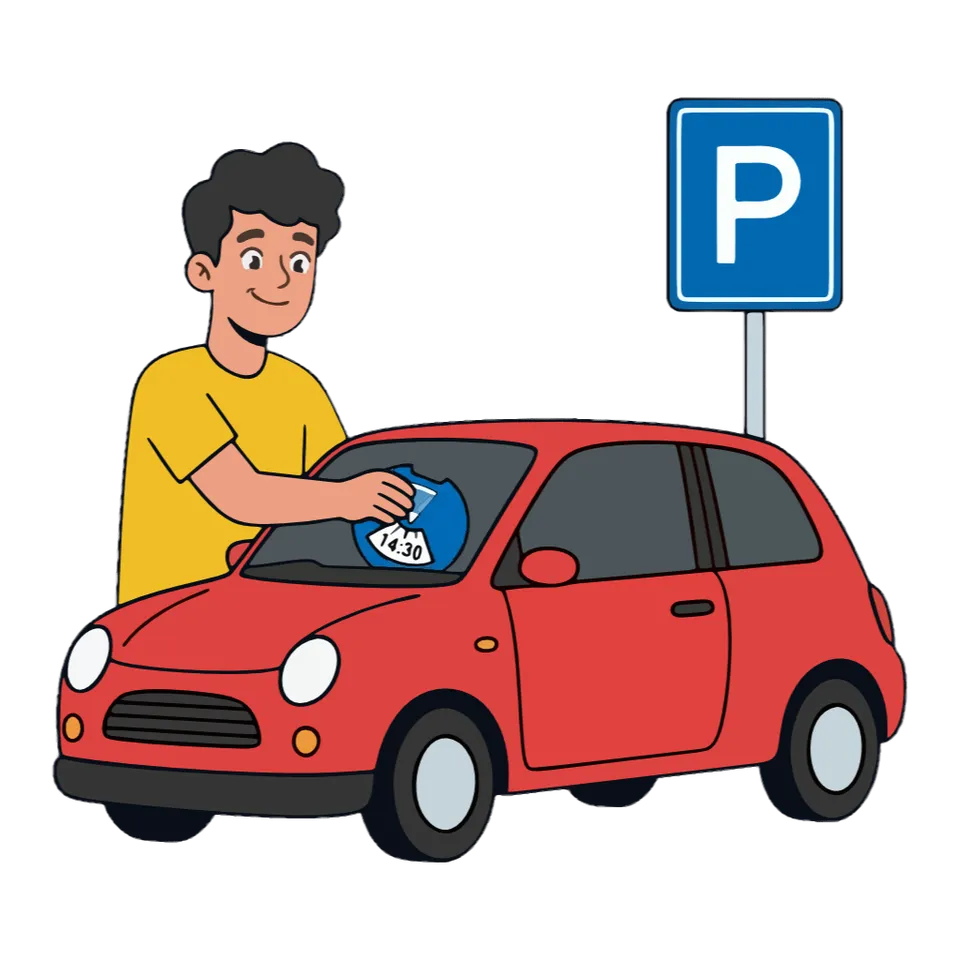
Illustration of a red car next to a blue parking sign with a P on it

Parking & Stopping

75 Questions
Medium
0 Parts

Learn the rules for parking, stopping and special manoeuvres such as turning around and reverse. Practise this CBR topic for free with real theory exam questions.

Practise car theory

Free mock exam · no account needed

Study material

What will you learn?

Parking and stopping are not the same: letting someone get in or out, or loading and unloading, is stopping; everything else is parking. Here you read where it is allowed and which signs apply.

Parking & Stopping at a glance

Here you learn where you may park and stop, which signs apply and how to use a parking disc. Each part has its own explanation page.

  • Parking rules: you may park wherever it is not forbidden. Outside a built-up area (bebouwde kom) you do not park on the carriageway of a priority road. Never park within 5 metres of a junction.
  • Getting in and out: letting someone get in or out straight away is stopping. If you wait, make a call or set your navigation, you are parking, even while sitting in the car.
  • Loading and unloading: this counts as stopping, so it is allowed under a no-parking ban. It is not allowed at sign E2, along a solid yellow line or at a bus stop.
  • Parking signs: sign E1 with one red slash only bans parking. Sign E2 with a red cross also bans stopping. A blue sign with a P tells you who the space is for.
  • Stopping: never allowed on a cycle lane, on a junction, on a zebra crossing and within 5 metres of it, in a tunnel or on the motorway (autosnelweg).
  • Setting a parking disc: set it to your arrival time, rounded up to the next full or half hour. If you arrive at 13:12, you set it to 13:30.

Yellow kerb lines are explained in yellow lines on the road. Which light to leave on when parking in the dark is in parking lights.

FAQ

Frequently asked questions

Short answers to common questions about Parking & Stopping.

What counts as a special manoeuvre in Dutch traffic theory?

Examples include pulling away, reversing, entering or leaving an access, turning around, moving from an acceleration lane to the main carriageway, moving onto an exit lane and changing lanes. The driver lets all other traffic go first. When boarding, alighting or opening doors, passengers must also avoid obstruction and danger; ordinary traffic-required stopping is not automatically a special manoeuvre.

Is merging onto a motorway a special manoeuvre?

Yes. Merging onto a motorway is a special manoeuvre: you must give way to traffic already on the main carriageway, use the acceleration lane and match speed before merging. The CBR tests this with video scenarios.

Keep practicing with up-to-date material

With this basic knowledge, you know the difference between parking, stopping and special manoeuvres. There are more exceptions involving signs, zones, junctions, bus stops and exits; practise in our app with up-to-date CBR information so that you make the right choice in every situation.

Ready to practise?

Test your knowledge of Parking & Stopping with 75 practice questions in the app.

Practise car theory

Free mock exam · no account needed

Your first quiz is free, no account needed. After that from €34.99 for 90 days of access.