Reaction time, braking distance and stopping distance
Reaction time, braking distance and stopping distance on the motorway, and why rest time counts for long journeys.
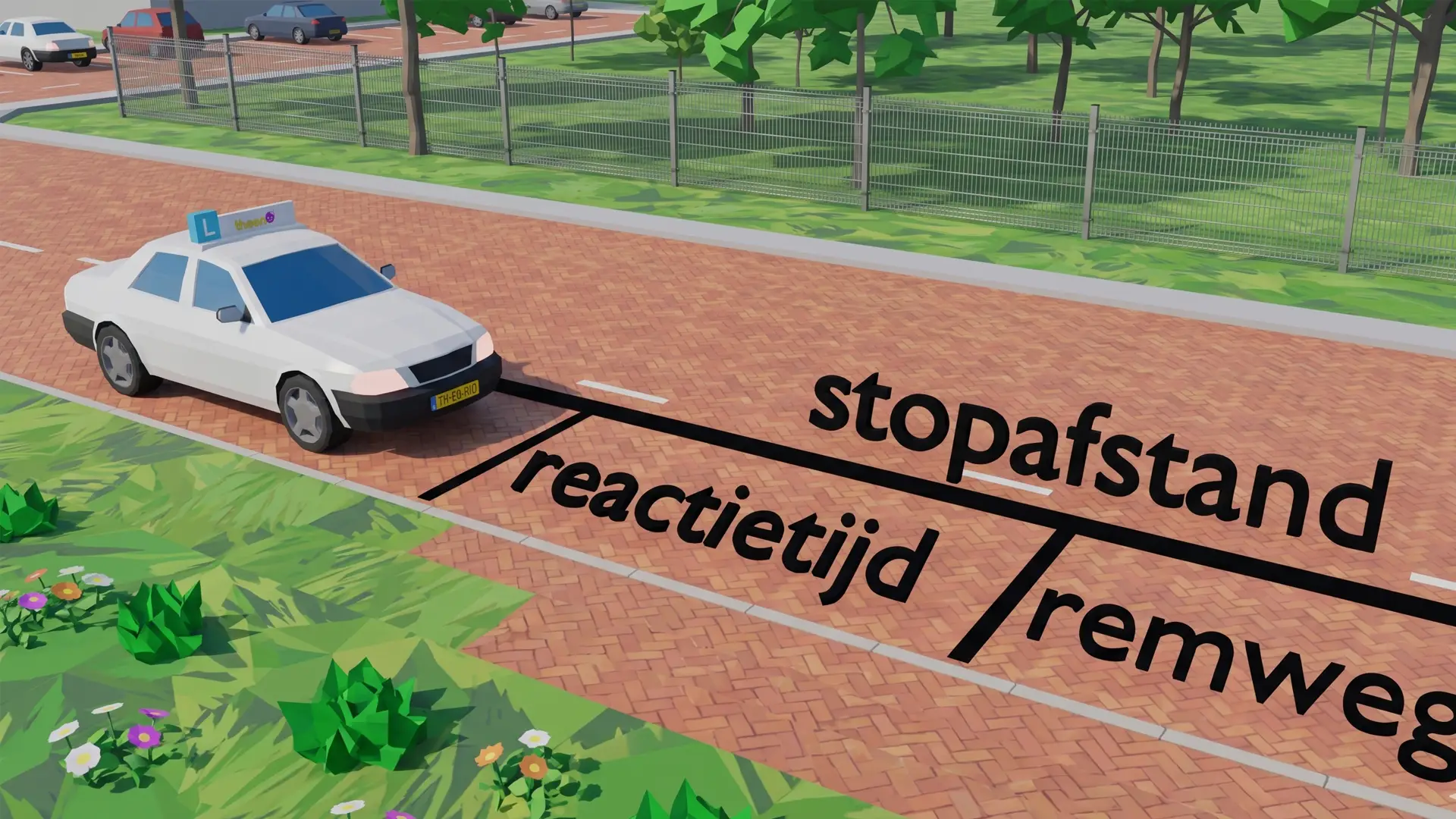
On the motorway it’s not only about how fast you’re allowed to drive, but about how much space you need to stop. That space is your stopping distance: your reaction time plus your braking distance.
For the CBR you have to keep the three reaction terms separate, know what extends the braking distance, and be able to give the following distance in seconds and in metres.
Key rule for the exam: stopping distance = reaction time + braking distance. Anything that increases your reaction time or reduces your grip makes that stopping distance longer.
Reaction speed, reaction ability and reaction time
Three words that almost sound the same and all appear in the exam. You have to know the difference.
| Term | What it is | When you’re tired, or with alcohol, drugs or medicines |
|---|---|---|
| Reaction speed | How quickly you react to what happens around you | Decreases — you react more slowly |
| Reaction ability | How well you react: can you correctly judge the situation? | Decreases — you judge it worse |
| Reaction time | The total time you need to react | Increases — it takes longer |
Watch out for the reversed movement in the last column, because that’s where the trap question is:
- Reaction speed decreases = reaction time increases.
- Reaction speed increases = reaction time decreases.
A normal reaction time is about 1 second. That sounds short, but at 130 km/h you cover almost half a football pitch in that one second — before you’re even on the brake.
Condition of the driver
The main rule is short: if you are not able to drive safely, you may not drive. This applies to a broken leg in a car with a manual gearbox just as much as it does to alcohol.
Everything that affects your reaction time and reaction ability: alcohol, drugs, medicines with a yellow sticker, fatigue and phone use.
Alcohol, drugs and medicines
Even if you notice nothing yourself, these substances can affect your driving ability — and if you still drive, you are punishable. Medicines with a yellow sticker include sleeping and calming medicines and strong painkillers; always check the package leaflet.
Don’t believe in tricks: there is no way to become sober faster. Coffee, a shower or fresh air changes nothing about the time it takes to sober up. Even eye drops can temporarily make it harder to see properly.
One more thing the CBR tests: young, new drivers are involved in accidents more often than experienced drivers. This is not always because of alcohol or drugs, but mainly because they underestimate the risks in traffic.
Fatigue and rest
Fatigue makes you slower. The rule of thumb you have to know by heart works both ways:
2 hours of driving = 15 minutes of rest. 15 minutes of rest = 2 hours of driving.
Phone use
Calling with your phone in your hand is forbidden — everyone knows that. But it goes further: even just touching your phone while driving can lead to a fine. You don’t even have to make a call.
If you really have to call, then use hands-free, with a car kit or headset. But watch out for the exam question: even hands-free calling distracts you and slows down your reaction speed, just like calling with your phone in your hand. The best answer remains: drive on to a parking lot and call from there on the way back.
Stopping distance = reaction time + braking distance
The stopping distance is the distance you cover from the moment something happens until you are completely stationary. It consists of two parts:
- The distance you cover during your reaction time — about one second, in which you simply keep driving.
- The braking distance: the distance from the moment you are on the brake until you come to a stop.
Factors on the road
The braking distance is not always the same. Anything that reduces grip makes it longer:
- Wet road surface. Less grip, so longer braking distance.
- New road surface. It still has to be “worn in” and is smoother than older asphalt — compare it with an ice rink where the floor-cleaning machine has just been over it.
- A shower after a dry period. Cars leave oil residues behind. When it rains, they come loose and mix with dust and water; the road surface becomes greasy, and grease is slippery.
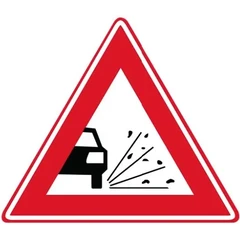
- Loose stones and mud. Less grip, and mud can even create a risk of skidding.
- Snow. The tyres slide over the road as soon as you brake hard.
Remember one hard connection: the risk of skidding always means a longer braking distance than normal.
Sign J25 (Loose stones): less grip, so expect a longer braking distance.
Influence of the vehicle
Two properties of your car determine the rest:
- Higher speed = longer braking distance. And not proportionally: if you drive twice as fast, your braking distance becomes four times as long.
- More weight = longer braking distance. A caravan, extra passengers or heavy suitcases push the car forward when braking, like a train with many wagons.
Extra weight also costs more fuel: your car has to work harder to move forward.
And the driver themselves
Even with a perfect road and a perfect car, you can still extend the stopping distance. The braking distance is fixed, but the reaction time is not: fatigue, alcohol, medicines and drugs make it longer, and that also makes your stopping distance longer. If you’re well prepared, you react faster and therefore come to a stop earlier.
Following distance
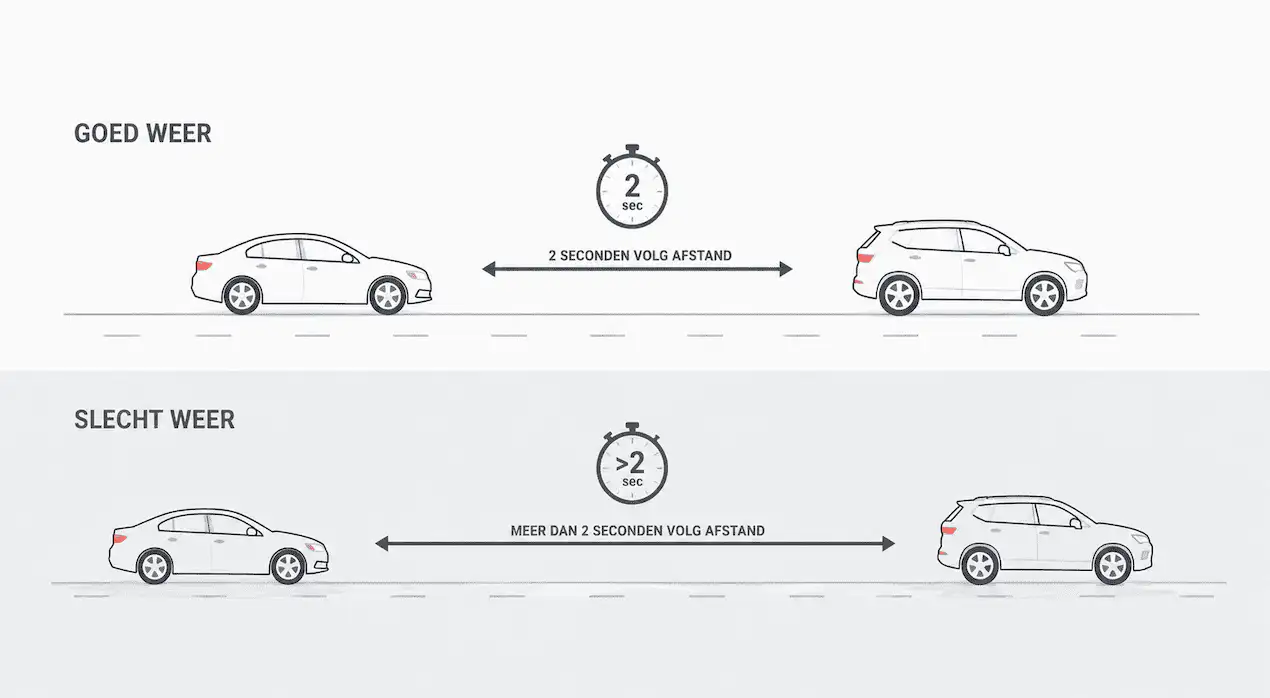
The following distance is the space between your car and the one in front of you. The basic rule is based on time, not distance:
Under normal circumstances at least 2 seconds — regardless of how fast you drive.
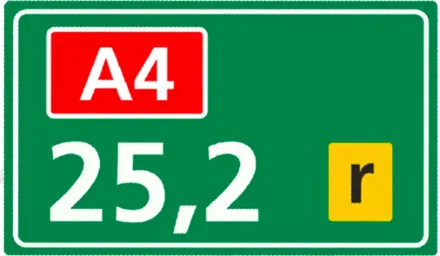
You measure it like this: choose a fixed point along the road, for example a hectometre marker post. Start counting when the car in front passes that point, and stop when you pass it yourself.
In bad weather — rain, fog or strong wind — you drive more slowly and leave more space. When there is strong side wind, pay extra attention to large lorries and buses: they catch a lot of wind and can start to sway.
If you’re too close to the vehicle in front, that’s called tailgating. It’s dangerous because you don’t have time to react, and it results in a hefty fine. The collision that follows is a rear-end collision: the front (nose) of one car against the rear (back) of the other. Increasing your following distance prevents this in most cases.
Following distance in metres
If the exam asks for seconds, the answer is 2 and your speed doesn’t matter. If it asks for metres, your speed does matter. The calculation:
speed ÷ 2, add 10% to that.
Example at 100 km/h: 100 ÷ 2 = 50, and 10% of 50 is 5. Together that’s 55 metres.
If you can’t calculate it quickly, remember the rule of thumb: about half your speed in metres, plus a bit. For comparison: that’s a little more than half a football pitch, or a little more than half the distance between two hectometre marker posts.
If you can’t make space
Sometimes you can’t move sideways: all lanes are full, or there is a continuous line. Suppose your lane ends and you can’t move to the right because there’s a bus driving there.
Then there’s one thing left: adjust your speed. Take your foot off the accelerator so that space appears in front of or behind that bus, and you can still change lanes. In that case you don’t create space next to you, but lengthwise.
Sometimes driving more slowly isn’t enough and you really have to stop. If a city bus pulls away from a stop and leaves, then the bus has priority — but it accelerates slowly. Then you wait patiently until it’s up to speed and has merged safely, instead of trying to squeeze in right behind it.
CBR trap
The classic mistake with this topic is converting the following distance into a fixed number of metres and then using that everywhere. The 2 seconds are the rule; the number of metres follows from that and therefore changes with your speed.
The second mistake is thinking that the braking distance scales with your speed. Twice as fast means four times as long, not twice as long.