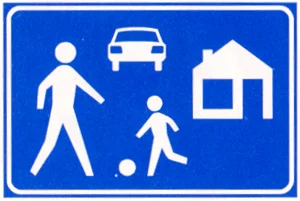
Residential zone
Official name: Residential/shared-space zone
Road type designation


Written by Chris Prosman Reviewed by Dirk van Zuijlen
Updated
- Sign code
- G5
- Category
- Road type designation
- Traffic signs
- Residential zone: walking pace only.
Sign G5 marks the start of an erf, usually called a woonerf or residential zone. You drive at walking pace: at most 15 km/h. Pedestrians may use the full width of the street, and you may only park in marked bays.
What to do in a residential zone
Drive at walking pace: at most 15 km/h.
Pedestrians may walk across the full width of the road and children may play there. You adapt to them, not the other way round.
Parking in a residential zone
You may only park in places marked with a P or a marked bay. You may not leave your car anywhere else. Stopping briefly to let someone in or out or to load and unload is allowed, because that is not parking.
This is the rule the exam asks about most often.
Priority when leaving a residential zone
Driving out of an erf counts as leaving a driveway. You must give way to all traffic on the road you join, including cyclists and pedestrians.
The same applies when you enter an erf from an ordinary road.
Where you will see it
In residential areas built without a separate pavement, where the street is on one level and there are play areas and planters in the carriageway.
Difference from G6, end of residential zone
G6 is the same sign with a red line through it and ends the zone. From there the ordinary rules apply again, with the normal speed limit.
G6, end of residential zoneLegal basis
Frequently asked questions
- How fast may you drive in a woonerf?
- At walking pace: at most 15 km/h.
- Where may you park in a residential zone?
- Only in bays marked with a P. Parking anywhere else is not allowed.
- Who has priority when you leave a residential zone?
- All traffic on the road you join, including cyclists and pedestrians, because you are leaving a driveway.
Explained in the course
Practise this sign for your theory exam
Residential zone belongs to the Road type designation category. In the CBR theory exam a traffic sign is almost never asked on its own: you are shown a situation and have to know what you may or must do in it. In the free sign trainer you practise the signs by category, with the explanation shown right after every answer.
Practise traffic signs for free Practise car theory: free mock exam