Part 2 of 4 in Trailers & Bicycle carriers
Trailer: how far may a load stick out and how do you couple safely?
How far may a load stick out on a trailer? The rules for the front, sides and back, the marker board, secondary coupling and breakaway cable.


Written by Chris Prosman Reviewed by Dirk van Zuijlen
Updated Reviewed on 6 min read
Free mock exam · no account needed
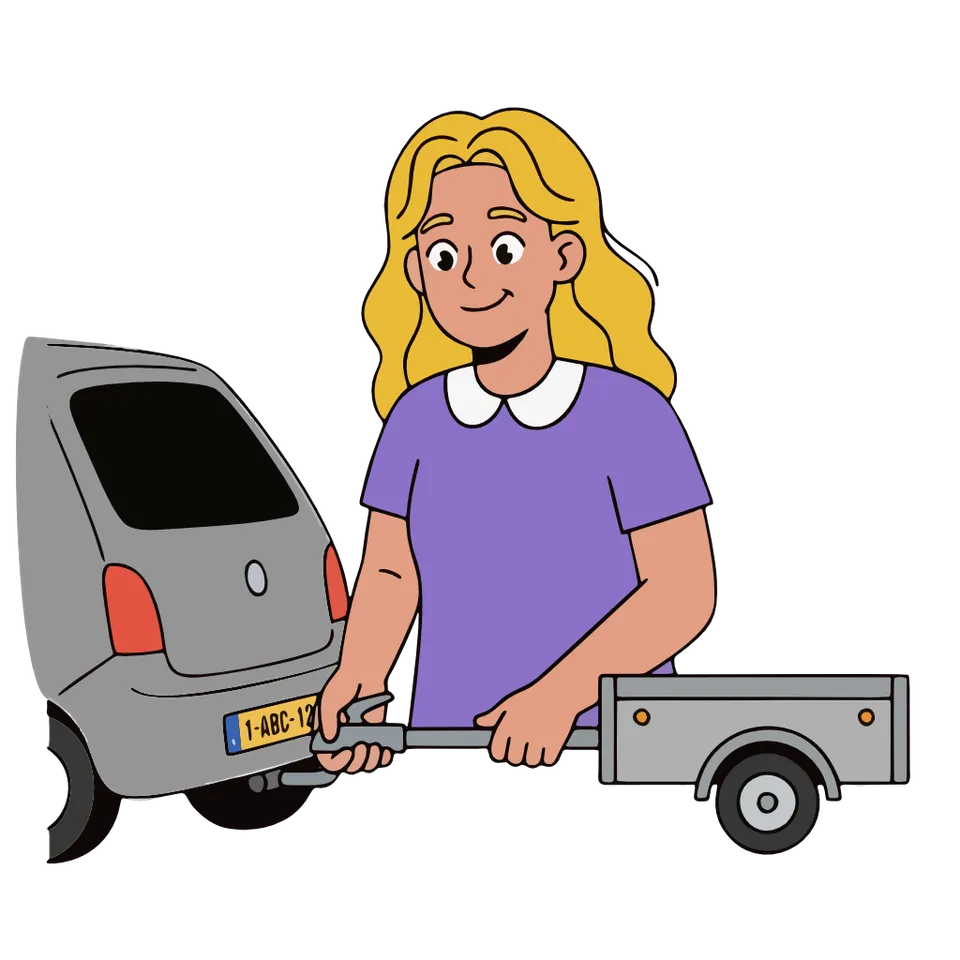
These are the rules for your trailer before you set off: hitch it properly, use the right safety device, check the lights and secure the load. You also learn how far a load may stick out at the front, the sides and the back.
Hitching a trailer: checking the coupling and towbar

The trailer’s ball coupling clicks over the ball of your towbar. Afterwards, always check three things:
- The coupling is closed and locked.
- The plug for the lights is firmly in the car’s socket.
- The secondary coupling or the breakaway cable is attached properly.
Do you have a detachable towbar? It must be locked properly too. Driving without a trailer and the towbar covers your number plate? Then take it off. Your number plate must always be readable.
Also stay within the towing capacity and the nose weight. The nose weight is how hard the trailer may press down on the ball. Where to find the towing capacity is explained under maximum trailer weight.
When is a secondary coupling required on a trailer?
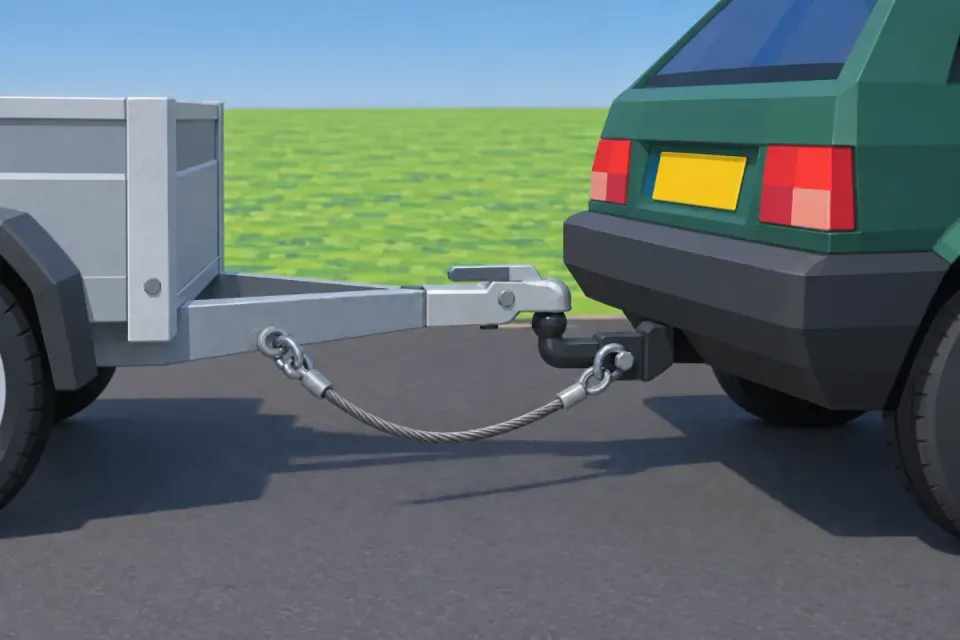
A secondary coupling (hulpkoppeling) is required on a trailer with a maximum authorised mass up to and including 1500 kg that has no breakaway brake. The maximum authorised mass is how much the trailer may weigh including its load.
An unbraked trailer has no brakes of its own, so no breakaway brake either. That is why it always needs a secondary coupling. Is there a cable or chain on your unbraked trailer? Then that is the secondary coupling, not a breakaway cable. If the coupling comes loose, the secondary coupling keeps the trailer attached to your car.
The secondary coupling must be firmly attached. It must not be bent, cracked or badly worn. Does your trailer have a breakaway brake? Then do not replace it with a loose chain.
How to attach a trailer breakaway cable correctly
Attach the breakaway cable to the eye on your car or to a special clip. Never just loop it around the towball. A braked trailer has a breakaway brake. If the trailer comes loose, the breakaway cable pulls that brake on.
| Picture | What happens? |
|---|---|
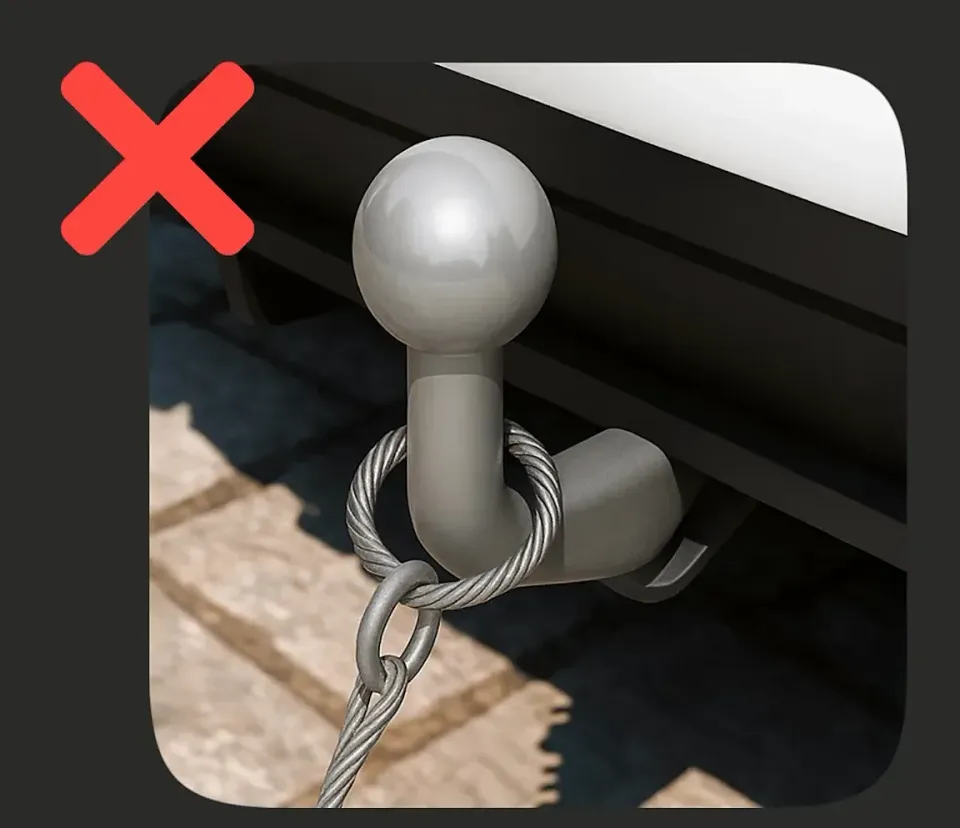 | Wrong: the cable can slip off together with the coupling. Then it may not pull the brake on. |
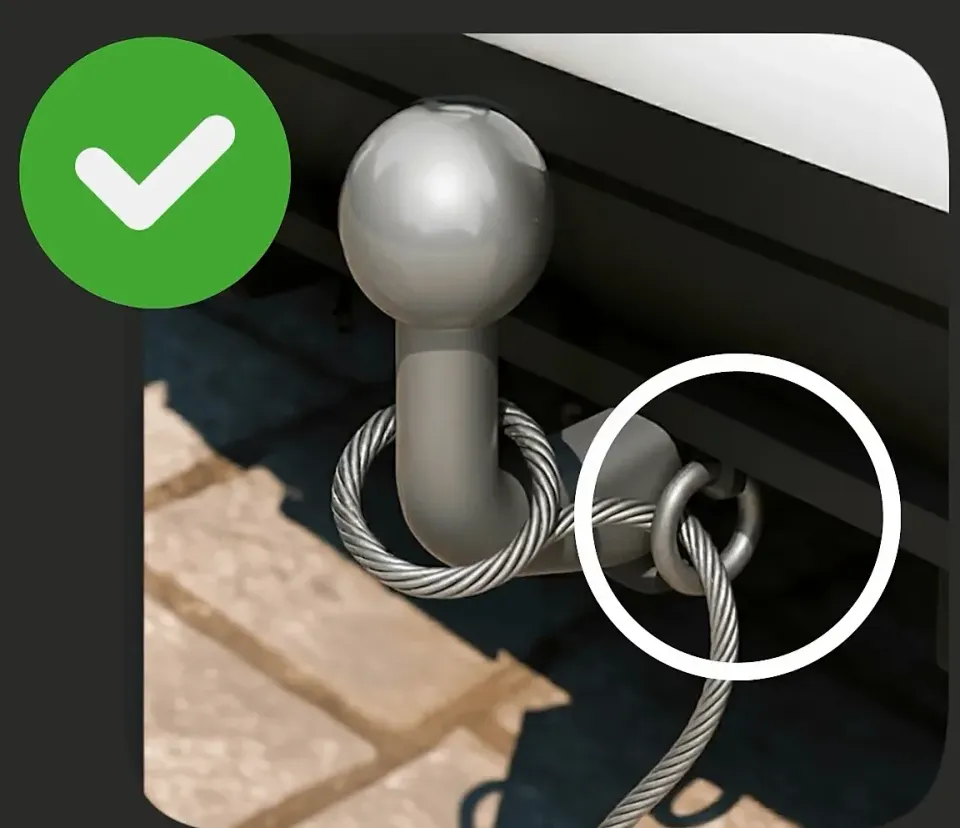 | Right: the cable is attached to the eye made for it. Follow the instructions for your towbar and trailer. |
A trailer with a breakaway brake must not also have a secondary coupling. So never use both at the same time. RDW: coupling and safety devices.
Which lights and reflectors does a trailer need?
A trailer has its own lights and reflectors. The red triangular reflectors show that it is a trailer.
| What? | Colour |
|---|---|
| Rear lights | Red |
| Brake lights | Red |
| Indicators | Amber |
| Number plate light | White |
| Triangular reflectors at the back | Red |
How to check the lights before you set off:
- Connect the plug.
- Switch on the lights and check that everything works.
- Ask someone to stand behind the trailer while you brake and indicate.
A larger trailer may need more lights. A load or a cover must not hide the lights, the reflectors or the number plate.
How far may a load stick out on a trailer?
Nothing at the front, more than 1 m at the back: a board. On a trailer a load may stick out further at the back than on your car. At the front nothing may stick out.
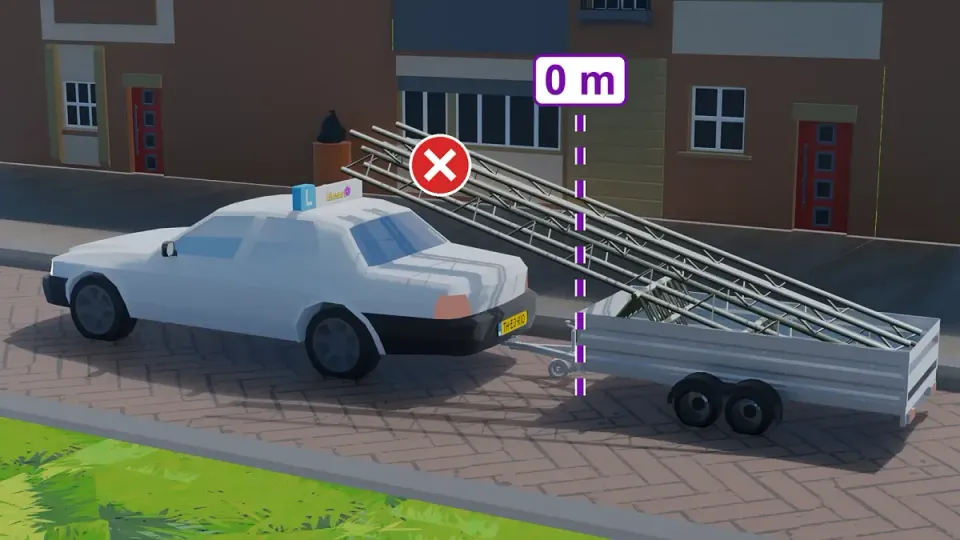
Front: nothing. The coupling is the front of the trailer. So a load above the drawbar is fine, as long as it does not go past the coupling.
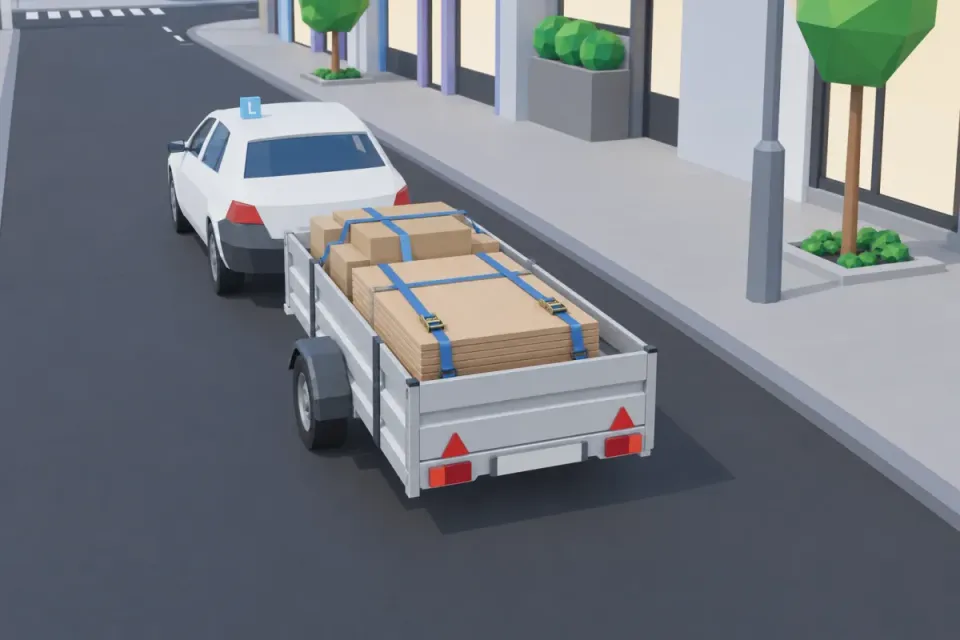
Sides: within the width. A divisible load stays within the permitted width. An indivisible load may be at most 3 m wide in total, and no wider than needed. Does a load stick out more than 10 cm at the side? Then markers are required.
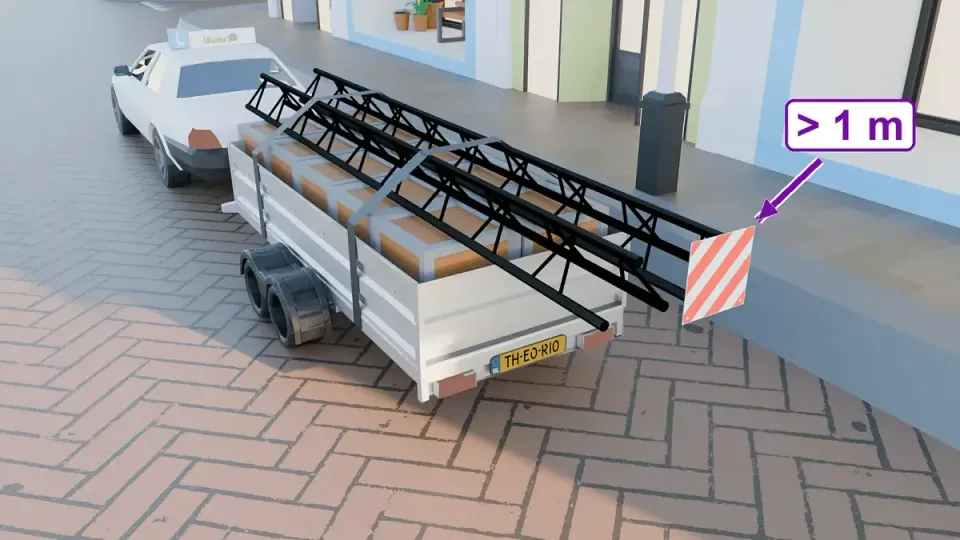
Back: at most 1 m without a board. A divisible load may stick out at most 1 m behind the trailer and at most 5 m behind the centre of the rear axle. Other limits apply to an indivisible load, see below.
A normal car has different rules. How far something may stick out of your boot or off your roof is explained under loads sticking out of a car.
How far may an indivisible load stick out behind a trailer?
An indivisible load cannot be made smaller without breaking it, such as one long beam or ladder. A divisible load can be split up, such as separate boxes or planks.
An indivisible load may stick out further behind a trailer. Behind the centre of the rear axle it may stick out at most:
- half the length of the trailer, and
- never more than 5 m.
Both limits apply at the same time. The smaller limit counts:
| Trailer length | Maximum behind the centre of the rear axle |
|---|---|
| 3 m | 1.5 m (not 5 m) |
| 6 m | 3 m |
| 12 m | 5 m (not 6 m) |
When do you need a marker board for a projecting load?
Does a load stick out more than 1 m behind the trailer? Then hang a reflective red-and-white marker board at the end. A red flag or cloth is not enough. In the dark you also need a red light. Up to 1 m no board is needed. A board never makes a load that sticks out too far allowed.
Securing a load on a trailer: is a net required?
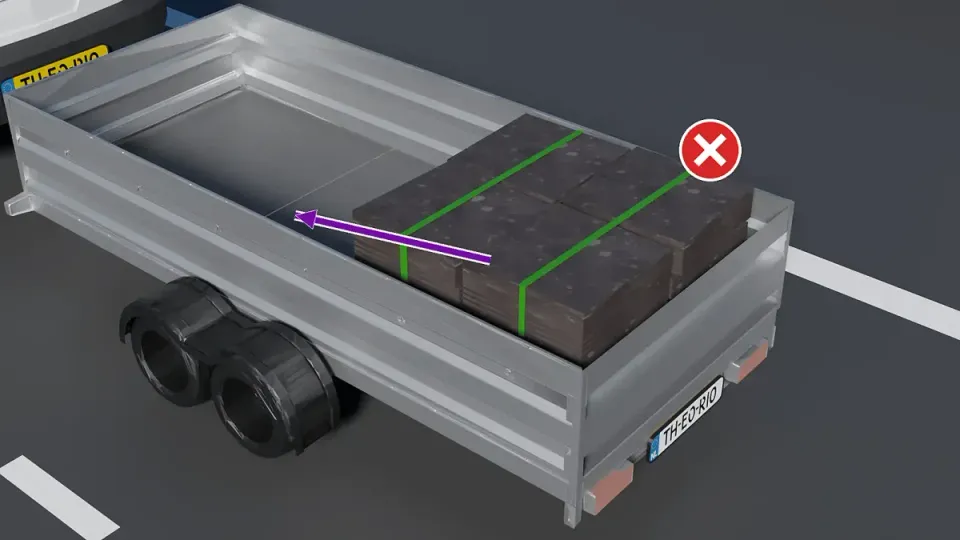
A net is not always required. But your load must be secured or covered so that nothing can shift, fall off or blow away. With loose material, such as branches or garden waste, a net or tarpaulin is therefore often needed.
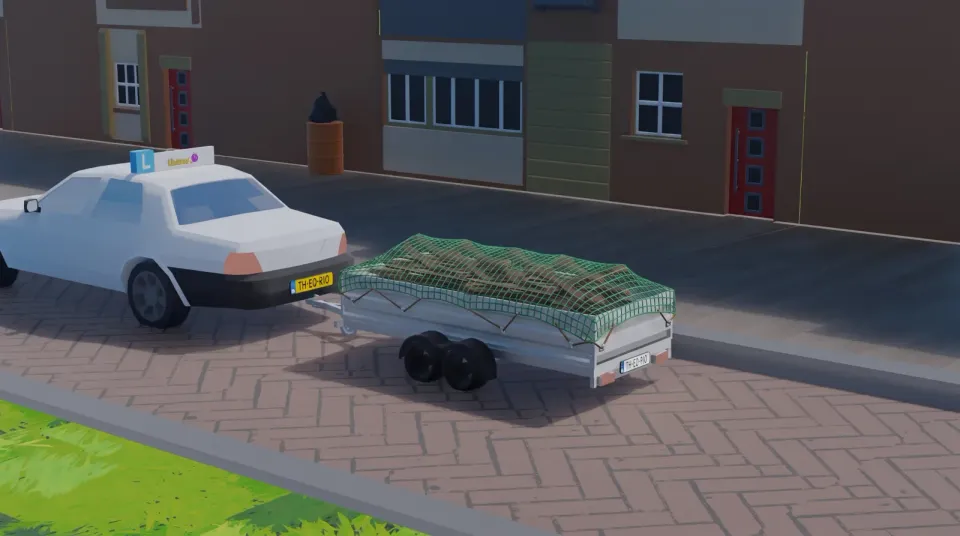
Choose a cover that suits your load. A net holds back coarse items. Fine sand needs a solid tarpaulin. Tie down a heavy loose beam with straps; a net alone is not enough then.
Spread the load well: heavy items above the axle and evenly left and right. Stay below the maximum authorised mass. Check the trailer’s tyres too, see tyre tread.
Practise like the exam
Example questions like in the CBR exam
Real questions from the Theorio app. You can expect similar questions in your CBR exam.
Question 1 of 5
Which breakaway cable is correctly attached?
Tap the answer you think is right.
Your load extends 0.60 meters, do you need to use a marking board?
Tap the answer you think is right.
Your load extends 1.20 meters, do you need to use a marking board?
Tap the answer you think is right.
Your load extends more than 1 meter, which marking is correct?
Tap the answer you think is right.
Is the load distributed well?
Tap the answer you think is right.
Answers and explanations for the example questions
Question 1: Which breakaway cable is correctly attached?
Correct answer: Situation B
You should never just wrap the breakaway cable around the tow bar. The cable must always be secured directly to the fixed chassis (the frame) of the car with a special attachment ring or eye. This prevents the cable from coming loose if the trailer detaches. 🔗✅.
Question 2: Your load extends 0.60 meters, do you need to use a marking board?
Correct answer: No
For loads extending less than 1 meter, no marking board is required. In the Netherlands, a marking board is only mandatory when indivisible loads extend more than 1 meter behind the trailer. ✂️🚫 This is because a small extending load is usually still clearly visible to other road users and therefore does not require an additional warning. If the load extends further, it can pose a danger and a marking board must be used to increase visibility and safety.
Question 3: Your load extends 1.20 meters, do you need to use a marking board?
Correct answer: Yes
Because your load extends more than 1 meter (namely 1.20 m), you must use a marking board. This way you remain easily recognizable 📏✅.
Question 4: Your load extends more than 1 meter, which marking is correct?
Correct answer: A marking sign
For a load extending more than 1 meter, only an official marking sign is allowed. 🔎.
Question 5: Is the load distributed well?
Correct answer: No
Place heavier objects above the axle and distribute the load evenly ⚖️🚛.
FAQ
Frequently asked questions
Short answers to questions that often come up on this subject.
Where do you attach the breakaway cable of a trailer?
With a hook to an eye on your car, or to a special clamp. Never just loop the breakaway cable round the tow bar: it can slip off.
May you hang a red flag on a load sticking out of a trailer?
A red flag or cloth does not replace prescribed marking. If an indivisible load complies with every dimensional limit and projects more than 1 m behind, use the correct red-white marker board and prescribed red lighting in darkness/poor visibility. A marker does not allow divisible cargo beyond its projection limit. Check dimensions first, then marking.
Ready to practise?
Test your knowledge of Trailers & Bicycle carriers with 45 practice questions in the app.
Free mock exam · no account needed
Your first quiz is free, no account needed. After that from €34.99 for 90 days of access.